 Birch Bay Roofing
 Why Bellingham Decks Fail Faster Than Homeowners Expect
A deck in Bellingham lives a harder life than the same deck would in a drier climate. Between the marine air moving in off the water, long stretches of driving rain through fall and winter, and a moss season that can run eight months or more, the wood, fasteners, and footings underneath a deck are under near-constant moisture pressure. Most failures we find aren't dramatic — they're slow. A ledger board that's been quietly absorbing water behind the siding. Joist hangers that rusted from the inside out. A surface that looks fine from a few feet away but has gone soft and spongy where water collects and never fully dries.
Salt-laden air accelerates corrosion on any fastener, bracket, or hanger that isn't rated for it. Combine that with our rain patterns and the shade many Bellingham lots get from mature trees, and you get ideal conditions for moss and algae to take hold on horizontal surfaces — which then trap moisture against the decking itself. A deck built to a generic national standard, without accounting for this specific combination of salt, rain, and shade, tends to show its age years before it should.
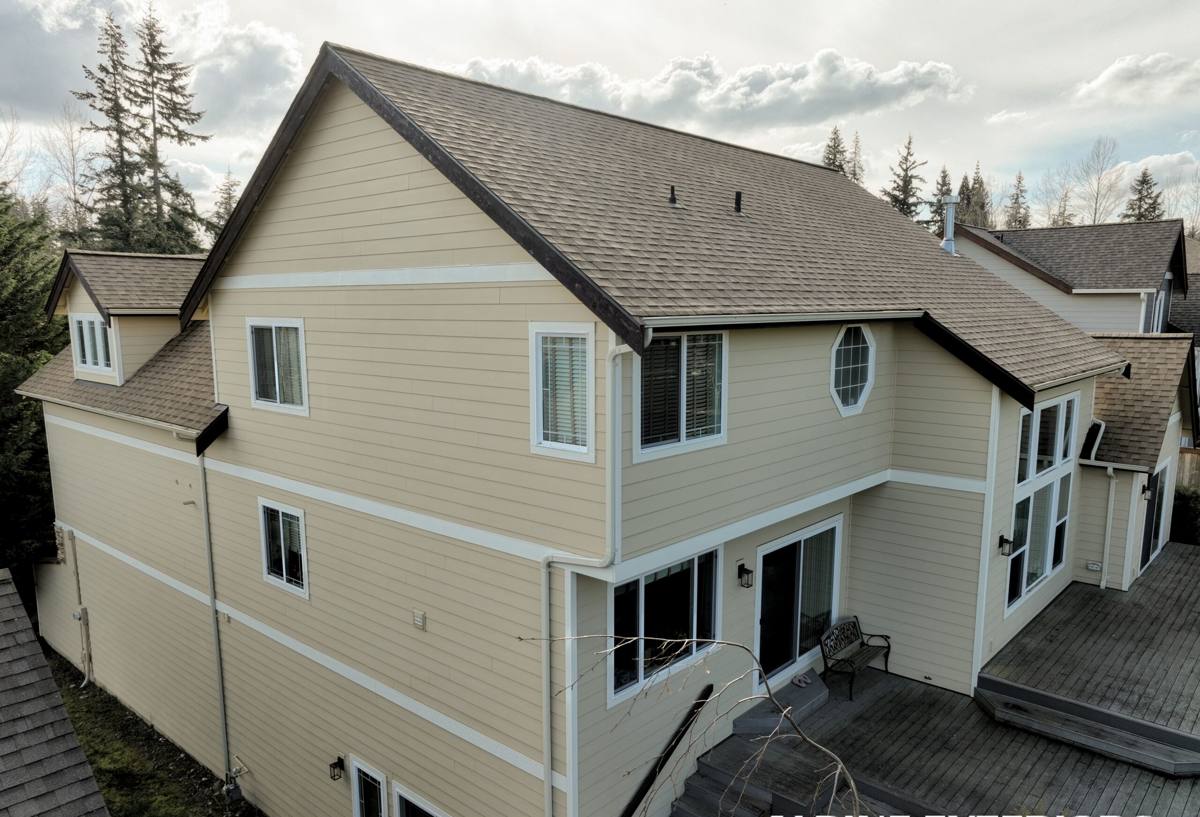
Repair or Replace? How to Tell
Not every tired-looking deck needs a full teardown. But there's a point where patching boards or re-staining stops being a real fix and just delays the inevitable — usually while hiding a bigger problem underneath. Here's how we sort it out on a typical visit.
Signs that point to repair
- A handful of boards are cupped, splintering, or discolored, but the framing underneath is dry and solid
- Railings are loose but the posts themselves aren't rotted at the base
- Surface graying or mild moss growth with no soft spots when probed
Signs that point to full replacement
- A screwdriver sinks into the ledger board, rim joist, or posts with light pressure
- Multiple footings have shifted, cracked, or show signs of frost heave
- The deck was built without proper ledger flashing, which is common on older Bellingham homes and almost always means water has been getting behind the house for years
- Fasteners are rusted, bleeding, or breaking off when tested
- The deck predates current bracket and connection standards, which changed significantly over the past two decades
The honest answer is usually somewhere in between, and part of our estimate process is telling you plainly which category your deck falls into rather than defaulting to whichever answer sells more work.
What a Correct Deck Replacement Actually Involves
A deck replacement done right in this climate is mostly about what's invisible once the decking boards go down. The visible surface is the easy part.
Ledger board and flashing
Where the deck attaches to the house is the single most common failure point we see in this area. Correct flashing — a proper ledger flashing profile with the house wrap or siding lapped over it, not just caulk and hope — is what actually keeps water from migrating into the rim joist and wall framing behind it. This step gets skipped or done poorly more often than any other part of deck construction, and it's the reason so many "10-year-old" decks have rot problems that should never have started.
Footings and framing
Whatcom County's freeze-thaw cycles and clay-heavy soils in parts of the area mean footings need to be set below frost depth and sized correctly for the load. We use fasteners and structural connectors rated for exterior and, where salt exposure is a factor, corrosion resistance beyond the bare minimum — galvanized is not the same as stainless, and the difference shows up as rust streaks within a few wet seasons if the wrong hardware gets used in the wrong spot.
Ventilation and drainage
A deck built low to the ground or against a slope without a way for air to move underneath will hold moisture longer after every rain. Grading, gaps, and in some cases a drainage system underneath a deck used as covered outdoor space all factor into how long the structure actually lasts.
Decking Material Options: What Holds Up Here
Every material has trade-offs. Our job is to give you the honest version of those trade-offs for this specific climate, not just push whatever has the best margin.
| Material | Moisture & Rot Behavior | Moss/Algae Susceptibility | Maintenance | Typical Lifespan Here |
|---|---|---|---|---|
| Pressure-treated wood | Good if sealed and maintained; end cuts and fastener holes are vulnerable points | Moderate — needs periodic cleaning | Annual sealing/staining recommended | 10-15 years with upkeep |
| Cedar | Naturally rot-resistant heartwood, but still needs sealing against constant rain exposure | Moderate to high in shaded areas | Sealing every 1-2 years, more in shade | 15-20 years with consistent care |
| Composite/PVC decking | Does not rot or absorb water into the board itself | Can still grow surface algae in shade — cleans off, doesn't penetrate | Periodic washing, no sealing/staining | 25+ years, varies by product warranty |
Composite and PVC products have become popular here specifically because they remove wood rot from the equation, which matters more in a marine, high-moisture climate than it would somewhere drier. That said, composite is not maintenance-free — it still needs to be kept clear of trapped organic debris in shaded corners, and not every composite product handles our specific moisture-and-shade combination the same way. We'll walk you through which lines have held up well in Whatcom County conditions and which specs actually matter (moisture warranty terms, fastening system, hidden vs. face-screwed) versus which are just marketing language.
Our Process, Start to Finish
- On-site assessment — we probe the ledger, framing, and footings, not just look at the surface, and tell you honestly whether you're looking at repair or replacement
- Written estimate — a clear scope covering demolition, framing, flashing, decking material, and railings, with material options priced separately so you can compare
- Permit handling — we pull the required permit through the applicable jurisdiction and schedule inspections at the right points in the build
- Demolition and disposal — old decking, framing, and footings removed and hauled off
- Framing and flashing — the structural work that determines whether this deck lasts 10 years or 25
- Decking, railings, and finish work — installed to the manufacturer's specifications for whichever material you've chosen
- Final walkthrough — we go over the finished deck with you, including what maintenance it will and won't need
Permits and Local Requirements
Deck replacement in and around Bellingham typically requires a building permit once you're beyond very small, low, freestanding structures — the exact threshold depends on height, size, and whether the deck is attached to the house. Whatcom County and the City of Bellingham each have their own permitting process, setback rules, and inspection points, and getting this wrong can mean a stop-work order mid-project or problems later when you go to sell the house. We handle the permit application and coordinate inspections as part of the job, so you're not the one tracking down which department to call.
Maintaining Your New Deck in This Climate
Whatever material you choose, a little seasonal attention goes a long way in a climate that stays wet as much of the year as ours does.
- Clear leaves and debris from between boards before fall rains set in — trapped organic matter is what feeds moss and holds moisture against the surface
- Rinse or sweep off moss and algae growth in shaded areas at least once during the wet season rather than letting it build up over winter
- Check railings, stair connections, and any visible fasteners once a year for looseness or early rust
- For wood decking, plan on resealing or restaining on the schedule appropriate to that species — skipping a cycle in this climate costs you more than one cycle's worth of protection
- Keep gutters and downspouts near the deck clear so runoff isn't discharging directly onto or under the structure
Why a Local Crew Matters for This Job
Deck replacement isn't a job where a crew unfamiliar with this specific stretch of coast can just show up and build to a national standard and call it good. A contractor who works Whatcom County regularly already knows which flashing details actually keep water out in a marine climate, which fastener grades hold up against salt air instead of just looking fine for the first year, and which decking products have a track record here versus which ones just have good marketing. That local knowledge shows up in decisions you'd never think to ask about — the kind that separate a deck that needs attention again in eight years from one that doesn't.
If your deck is showing its age, or you're just not sure whether you're looking at a repair or a full rebuild, we're happy to take a look and give you a straight answer. Reach out for a free, no-pressure estimate using the form below.