 Birch Bay Roofing
 Why "20 to 30 Years" Doesn't Mean Much in Birch Bay
Every shingle manufacturer prints a lifespan estimate on the wrapper, and every one of those numbers comes from a lab, not a roof sitting three blocks from Birch Bay's shoreline. Manufacturer estimates assume moderate weather, decent attic ventilation, and a roof that isn't fighting salt spray, near-constant moisture, and shade-grown moss for half the year. Whatcom County roofs don't get that easy ride. We inspect roofs all over Birch Bay and the surrounding county, and the honest pattern we see is that coastal and heavily treed properties often lose several years off the "expected" lifespan of their roofing material — sometimes more, depending on exposure and how the roof was originally built and vented.
This page walks through what actually determines how long a roof lasts here, what shortens that life faster than it should, and the signs that tell you where your own roof stands in that timeline. None of this is meant to scare anyone into a premature replacement — plenty of roofs here perform well into their expected range or beyond. The point is understanding your own risk factors so you're not caught off guard.
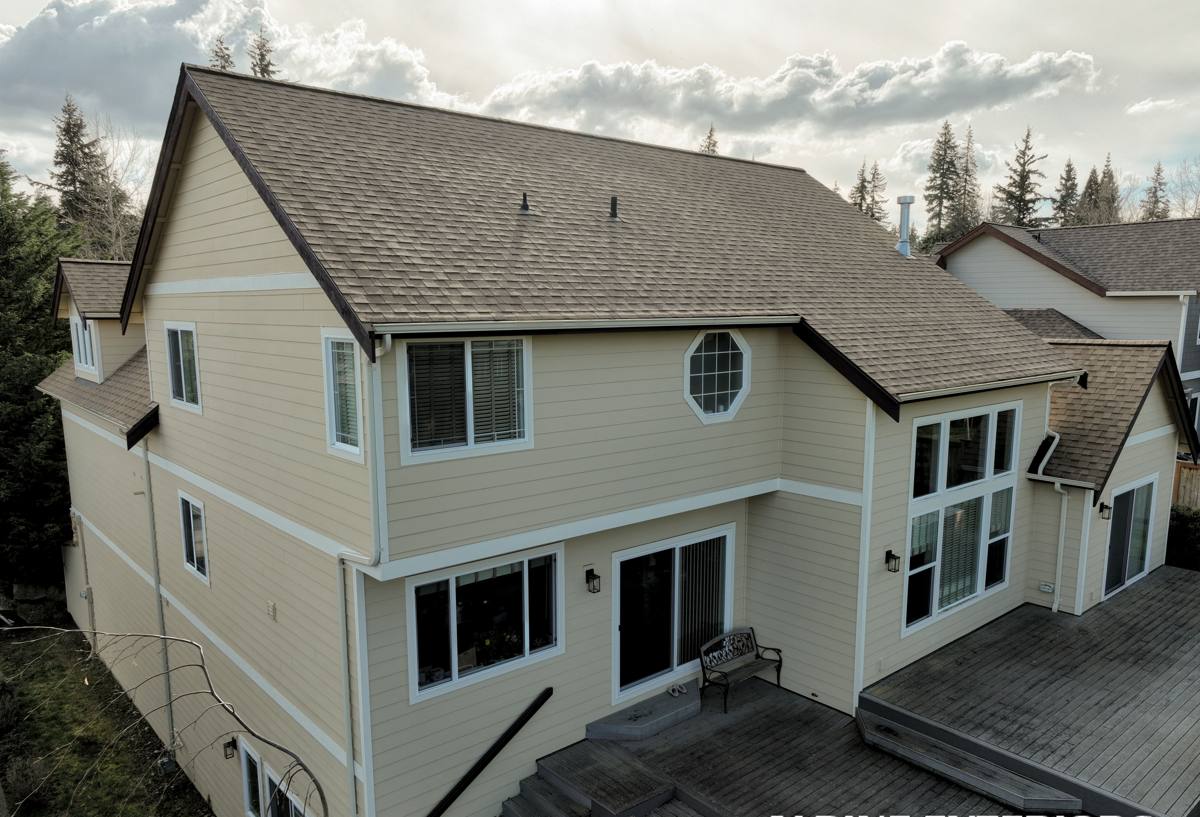
The Three Things Working Against Your Roof in Birch Bay
Salt Air
Properties close to the water deal with airborne salt that settles on roofing surfaces and works its way into metal fasteners, flashing, gutters, and any exposed metal components. Over years, that accelerates corrosion in ways an inland roof never experiences. It's not usually dramatic — it's a slow, steady process that shows up first in rusted nail heads, pitted flashing, and corroded gutter hangers well before the shingles themselves show their age.
Driving Rain
Whatcom County doesn't just get a lot of rain — it gets a lot of wind-driven rain, pushed sideways by storms coming off the Strait of Georgia and the Salish Sea. Wind-driven rain finds every weak point in a roof system: under-lapped shingles, marginal flashing details, nail pops, and aging underlayment. A roof that would shed a straight-down rain just fine can still take on water when that same rain is being pushed sideways at 30-40 mph. This is why flashing quality and underlayment condition matter more here than in drier, calmer climates.
Moss Season
Birch Bay's mix of moisture, mild temperatures, and tree cover creates ideal moss-growing conditions for a big chunk of the year, especially on north-facing slopes and roofs shaded by cedar and fir. Moss isn't just cosmetic. It holds moisture against the roofing surface, lifts shingle edges as it grows, and — on wood or aging composition roofs — traps enough water to accelerate rot in the decking underneath. A moss-covered roof is aging faster than a clean one, even if nothing looks dramatically wrong yet.
Average Lifespan by Material — Adjusted for This Climate
The table below shows typical manufacturer lifespan ranges alongside what we honestly see play out on exposed or heavily shaded Birch Bay properties versus well-protected, well-maintained ones.
| Material | Typical Manufacturer Range | Realistic Range — Exposed/Shaded Sites | Realistic Range — Protected, Maintained Sites |
|---|---|---|---|
| 3-Tab Asphalt Shingle | 20-25 years | 13-18 years | 18-22 years |
| Architectural (Dimensional) Shingle | 25-30 years | 18-22 years | 25-28 years |
| Metal (Standing Seam) | 40-50+ years | 30-40 years (fastener/coating dependent) | 40-50 years |
| Cedar Shake | 25-30 years | 15-20 years (moss/moisture dependent) | 20-25 years |
| Torch-Down/TPO (Low-Slope) | 15-20 years | 12-15 years | 15-20 years |
The gap between those two "realistic" columns is almost entirely explained by exposure and maintenance — not luck. A roof on a shaded, north-facing slope near the water, with gutters that never get cleaned, will age on the low end of every category above. A roof with good sun exposure, clean gutters, and a couple of inspections over its life tends to land on the high end.
What Actually Shortens a Roof's Life
Weather sets the baseline stress a roof has to handle, but a few other factors decide how well it holds up against that stress:
Attic Ventilation
Poor ventilation traps heat and moisture in the attic, which cooks shingles from underneath and encourages condensation on the decking. This is one of the most common — and most fixable — reasons a roof underperforms its expected lifespan, and it's rarely visible from the ground.
Installation Quality
Nailing pattern, underlayment overlap, flashing details around chimneys and valleys, and starter course installation all matter more in a driving-rain climate than in a mild one. A roof installed to the letter of the manufacturer's spec, with attention to the details specific to wind-driven rain, will simply outlast one that was installed quickly to a lower standard — even using the identical shingle.
Tree Cover
Shade keeps a roof cooler, which is good, but it also keeps a roof wet longer after every rain and feeds moss growth. There's a real trade-off between the two, and the honest answer is that heavily shaded roofs need more frequent moss and debris management to hit their expected lifespan.
Gutter and Drainage Condition
Clogged gutters back water up under the shingle edge and keep the roof edge wet far longer than it should be. This is one of the simplest maintenance items to stay on top of and one of the most damaging to ignore.
Warning Signs Your Roof Is Aging Faster Than It Should
Most roof failures don't happen suddenly — they show early signs for months or years before a leak actually shows up inside the house. Worth checking for periodically:
- Granules collecting in gutters or at downspout outlets (a sign the shingle surface is wearing down)
- Shingle edges curling, cupping, or lifting, especially on south and west-facing slopes
- Dark streaking or thick moss growth, particularly on shaded or north-facing sections
- Rust staining around flashing, vents, or fastener heads
- Soft or spongy spots when walked on (decking rot underneath)
- Daylight visible through the roof deck from inside the attic
- Sagging along roof lines or in valleys
- Interior ceiling stains, especially after wind-driven storms rather than straight rain
Any one of these on its own isn't necessarily an emergency, but a roof showing two or three of them together is usually past the point where maintenance alone will fix it.
Maintenance That Actually Extends Roof Life Here
Given the specific stress our climate puts on a roof, a few maintenance habits do more good here than in a drier region:
- Clean gutters at least twice a year — more often on heavily treed lots — so water isn't backing up under shingle edges.
- Address moss before it becomes a mat — light moss growth is manageable; a thick, established mat has already been holding moisture against the roof for a while.
- Check flashing and fasteners for corrosion every couple of years on properties close to the water, since salt-driven corrosion is gradual and easy to miss.
- Keep attic ventilation clear — insulation or debris blocking soffit vents defeats the ventilation system even if the vents themselves look fine from outside.
- Trim back tree limbs that overhang the roof, both to reduce shade-driven moisture and to prevent physical abrasion damage during wind.
Repair or Replace? A Practical Way to Think About It
This is the question nearly every homeowner eventually asks, and the honest answer depends on where the damage is concentrated, not just the roof's age.
| Situation | Usually Points To |
|---|---|
| Isolated leak, one flashing detail, roof otherwise sound | Repair |
| Granule loss and curling limited to one slope | Partial repair or slope replacement, depending on age |
| Widespread granule loss, multiple leak points, roof near or past expected lifespan | Full replacement |
| Soft decking found in more than one area | Full replacement — underlying structure is compromised |
| Roof under 10 years old with an isolated issue | Repair, and check whether it's covered under manufacturer or workmanship warranty |
A roof approaching the end of its realistic lifespan with only minor issues can sometimes get another few years out of targeted repairs. A younger roof with a serious installation defect, on the other hand, may need more extensive correction than its age would suggest. There's no substitute for someone actually getting on the roof and looking, rather than guessing from age alone.
Choosing Materials With This Climate in Mind
When it's time to replace, the material decision matters more here than in a mild, dry climate. Our standard is to steer clients toward products and installation details proven to hold up against sustained moisture and wind-driven rain — good starter strip coverage, properly lapped underlayment, and flashing details sized for real water volume rather than the minimum code requirement. We're generally cautious about roofing choices that carry a heavier ongoing maintenance burden in a wet, moss-prone climate, or that depend on very precise, moisture-sensitive installation to perform as advertised — not because any particular product is bad, but because the margin for error is smaller here than in a drier region, and a maintenance-heavy roof only pays off if that maintenance actually happens year after year.
What This Means for Your Roof
The biggest variable in how long your roof lasts isn't the brand name on the shingle wrapper — it's exposure, ventilation, installation quality, and how consistently the small maintenance items get done. Two identical roofs installed the same year, one shaded and neglected, the other sun-exposed and maintained, can end up a decade apart in real-world performance.
If you're not sure where your own roof stands in that range — whether it's aging on schedule, running ahead of expectations, or already showing signs it's behind — we're happy to take a look. We offer a free, no-pressure estimate and inspection for homeowners in Birch Bay and the surrounding Whatcom County area, with a straight answer about what we see and what, if anything, it calls for.