 Birch Bay Roofing
 Exterior Work in an Unusual Corner of Whatcom County
Point Roberts sits in a strange spot on the map: part of Washington State, but cut off from the rest of the mainland U.S. by water and by the Canadian border. It's still Whatcom County, still subject to the same building climate as Birch Bay and the rest of the Salish Sea shoreline, but getting work done out there takes a contractor who plans ahead instead of showing up and hoping for the best. We treat Point Roberts as a real part of our service area, not an afterthought, and we schedule roofing, siding, window, and deck projects out there the same way we would anywhere else in our territory: with a clear plan, the right materials loaded before we leave, and a crew that knows what the exposure out there does to a house.
Homes on the Point face the same core threats as anywhere along this stretch of coastline: salt-laden air, driving rain that comes in sideways off the water, and a moss season that runs longer than most homeowners expect. What changes from house to house is how exposed the lot is, which direction the prevailing weather hits from, and how old the existing roof, siding, or windows are. That's what we look at first.
What the Marine Climate Does to a House Over Time
Salt Air and Corrosion
Being surrounded by water on three sides means salt is in the air more consistently than it is a few miles inland. Salt accelerates corrosion on exposed metal — flashing, fasteners, gutter hardware, deck hardware — faster than most homeowners realize until they see rust streaks or a fastener that's failed years before it should have. It's not that metal can't be used near the water; it's that the wrong grade of metal or the wrong fastener in the wrong location shortens the life of the whole assembly around it.
Driving Rain
Wind off Boundary Bay and the Strait of Georgia doesn't just bring rain straight down — it pushes it sideways, up under laps in siding, and into any gap around a window or door that isn't properly flashed and sealed. A roof or wall system that would perform fine in a sheltered, inland yard can leak on an exposed Point Roberts lot simply because the water is being driven into details that were never built to handle horizontal pressure.
Moss and Prolonged Dampness
Between the marine humidity and the Pacific Northwest's long wet stretch of the year, moss and algae get a head start here and don't let up. Moss holds moisture against roofing material, works into shingle laps and seams, and — left unchecked — can lift edges and hold water exactly where a roof needs to shed it fastest. It's less a cosmetic issue than a moisture-management one.
Roofing Services
We handle full roof replacements, roof repairs, and roof inspections for Point Roberts homes, working with the roofing systems that make sense for this climate — asphalt composition shingle, metal roofing, and low-slope membrane systems for flat or near-flat sections. What matters more than the specific product line is how the roof is detailed at the vulnerable points: valleys, penetrations, eave and rake edges, and anywhere a chimney, skylight, or vent stack breaks the roof plane. Those are the spots that fail first in a wind-driven-rain climate, regardless of what shingle is on the field of the roof.
For homes with heavier tree cover or persistent shade, we also talk through moss prevention as part of the job — proper ventilation, zinc or copper strip options where appropriate, and a realistic cleaning interval — rather than treating moss removal as a one-time fix that never gets revisited.
Signs a Point Roberts Roof Needs Attention
- Moss buildup concentrated on the north-facing or shaded slopes
- Granule loss showing up in gutters or at downspout outlets
- Rust staining below metal flashing or fasteners
- Soft spots or discoloration on ceilings below roof valleys
- Shingles that are curling, cracking, or lifting at the edges
- Visible daylight or gaps around vent boots and chimney flashing
Siding Built for Salt Air and Driving Rain
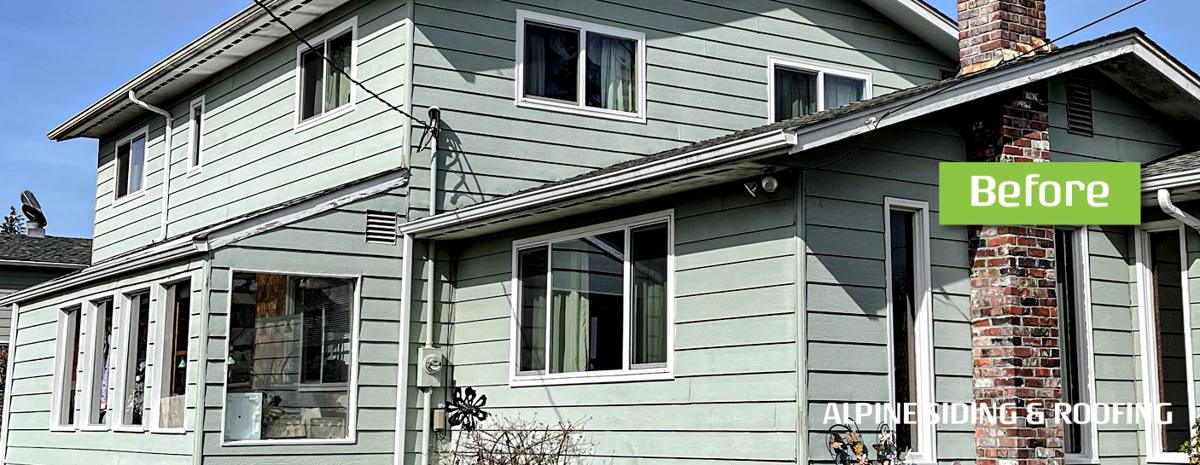
Siding on an exposed coastal lot has two jobs: look good and manage water at every seam. We install and repair fiber cement, engineered wood, and traditional lap siding systems, and for every project we pay close attention to the water-resistive barrier and flashing details behind the siding, not just the finish coat. On a sheltered inland lot, a minor gap in house wrap might never cause a problem. On a Point Roberts lot facing open water, the same gap can let driving rain behind the siding within a season or two.
We generally steer homeowners away from siding materials that are especially sensitive to installation errors or that trap moisture against the wall assembly in a high-humidity marine environment. That's not a knock on any particular manufacturer — it's a standard we hold ourselves to because callbacks and premature failures in this climate almost always trace back to a moisture path, not the product label. Fiber cement and properly detailed engineered wood systems give us the durability and paint-holding performance this location calls for, with maintenance schedules homeowners can actually keep up with.
Windows: Keeping Wind-Driven Moisture Out
Window failures near the water are rarely about the glass — they're almost always about the flashing and sealant around the frame. Wind-driven rain finds any weak point in the perimeter seal, and once water gets behind a window frame, it can sit there and damage framing long before a homeowner sees a stain on the interior wall. When we replace windows on a Point Roberts home, we treat the flashing integration with the wall assembly as the most important part of the job, not an afterthought once the window is set.
We work with vinyl, fiberglass, and wood-composite window lines depending on the home's style and the homeowner's budget, always with an eye toward corrosion-resistant hardware given the salt exposure. For homes on the most exposed lots, we'll also talk through impact-resistant or heavier-duty glazing options where wind load is a real consideration, rather than assuming a standard residential window spec is automatically the right fit.
Decks in a Marine Environment
A deck on Point Roberts spends its life in damp air, direct salt exposure, and — depending on the lot — a lot of sun reflecting off open water. That combination is hard on both wood and hardware. We build and repair decks using either quality pressure-treated or cedar framing with proper ground clearance and airflow underneath, or composite decking systems for homeowners who want to minimize the sanding-and-sealing cycle that untreated wood decks need out here.
Fastener choice matters as much as the decking material itself. Standard fasteners corrode fast in this air; we use hardware rated for coastal or marine exposure so the connections don't become the weak point of an otherwise solid deck. Railings, stairs, and ledger board connections — the structural parts of a deck — get the same attention, since a deck that looks fine on the surface can still have a compromised connection underneath if the wrong hardware was used originally.
Getting a Crew to Point Roberts: Why Local Experience Matters
Point Roberts isn't a quick in-and-out job site. A crew driving out has to plan around the border crossing, bring everything they need for the day, and account for the fact that running back for a forgotten part or material isn't a fifteen-minute errand the way it would be on a job in Birch Bay or Blaine. Contractors who don't regularly work out there sometimes underbid the logistics, then either cut the job short, show up without the right materials, or pass the friction along to the homeowner in delays.
We build that reality into how we schedule and stage Point Roberts projects — materials confirmed and loaded before the crew leaves, enough time budgeted for the crossing in both directions, and a plan for the whole scope of work rather than piecemeal trips. It's part of why we treat this as a real service area with its own planning, not a place we squeeze in when convenient.
What Drives Cost on These Projects
Every home and lot is different, but a few factors consistently move the price on roofing, siding, window, and deck projects in this area. This isn't a quote — it's meant to help you understand what a contractor is actually pricing when they walk your property.
| Factor | Why It Matters |
|---|---|
| Exposure of the lot | Homes facing open water directly need heavier detailing at flashing, seams, and fasteners than sheltered lots |
| Roof or wall complexity | More valleys, dormers, and penetrations mean more vulnerable points that need proper flashing |
| Existing moisture damage | Rot or corrosion found once material is removed adds repair scope beyond the original estimate |
| Material choice | Fiber cement, metal roofing, and composite decking cost more upfront but reduce the maintenance cycle |
| Access and staging | Point Roberts logistics factor into scheduling and crew time more than a typical mainland job |
| Scope bundling | Combining roofing, siding, window, or deck work in one visit reduces repeat trips and total site setup time |
A Seasonal Maintenance Checklist for Point Roberts Homeowners
Marine climates reward homeowners who stay ahead of small problems. This is a general checklist, not a substitute for a professional inspection, but it's a reasonable baseline for a home in this environment.
- Clear gutters and downspouts at least twice a year, more often under trees
- Check shaded roof slopes for moss buildup each fall and spring
- Inspect caulking and sealant around all windows and doors annually
- Look for rust staining near metal flashing, fasteners, and deck hardware
- Walk the deck surface and railings for soft spots, loose boards, or corroded connectors
- Check attic or crawlspace ventilation to make sure moisture isn't trapped indoors
- Have siding seams and butt joints checked after major wind events
Working With a Crew That Knows This Coastline
Homeowners on Point Roberts don't need a contractor who treats their address as a hassle to work around. They need one who understands why a roof valley that's fine in Bellingham might not be fine on an exposed waterfront lot, and who prices and plans the job accordingly the first time. That's the standard we hold every roofing, siding, window, and deck project to, whether it's in Birch Bay or out on the Point.
If you're weighing a repair, a full replacement, or just want an honest read on where your roof, siding, windows, or deck stand, we're glad to come take a look. Reach out for a free, no-pressure estimate using the form below.