 Birch Bay Roofing
 Building Decks for a Peninsula Climate
Point Roberts sits on its own peninsula at the far northwest edge of Whatcom County, surrounded by water on three sides and cut off from the rest of Washington by land — the only way in or out by car is through Canada. That geography does more than make Point Roberts a unique place to live. It puts homes here, and anything built onto them, in near-constant contact with salt-laden marine air, wind that has nothing to slow it down before it hits a house, and driving rain that comes in sideways as often as it falls straight down. Add a moss and algae season that runs long on this part of the coast, and a deck built to a generic spec simply doesn't hold up the way it would a few miles inland.
We build custom decks for homes in Point Roberts and the surrounding Birch Bay area with that exposure in mind from the first framing decision to the last fastener. A deck out here isn't just an outdoor living space — it's a structure that has to shed water, resist corrosion, and stay safe underfoot through a long wet season, year after year.
What This Climate Does to a Deck
Salt Air and Corrosion
Being surrounded by water means Point Roberts homes take on more direct salt exposure than most of inland Whatcom County. Salt accelerates the corrosion of nails, screws, joist hangers, and structural connectors far faster than a drier or more sheltered site. A deck built with standard-grade hardware in this environment can start showing rust streaks and weakened connections well before the decking surface itself shows any wear — and a deck is only as strong as the fasteners holding its frame together.
Driving Rain and the Ledger Board
Wind off the water pushes rain sideways into every seam, joint, and attachment point on a deck. The single most important — and most often mishandled — detail on any deck is the ledger board, the framing member that bolts the deck to the house. If that connection isn't flashed correctly, wind-driven rain works its way behind it and into the house's rim joist and wall framing, causing rot that can go undetected for years because it's hidden behind the decking above it.
Moss, Algae, and Slip Risk
A long moss season affects more than roofs and siding. Horizontal deck surfaces collect standing moisture, shade, and organic debris, which makes them a prime spot for moss and algae growth — and unlike a mossy roof, a mossy deck board is a direct slip hazard for anyone walking on it barefoot or in wet shoes. Proper board spacing, airflow underneath the deck, and material choice all affect how much moss becomes a season-long problem versus an occasional cleaning task.
What a Correctly Built Deck Involves
Footings and Framing Sized for Wind Exposure
A deck on an exposed peninsula lot needs footings set to proper depth and spacing, and framing sized to handle wind loads that a sheltered, tree-lined lot inland wouldn't see. We size joists, beams, and footing spacing to the actual exposure of the site rather than defaulting to the bare minimum the code allows, because the bare minimum was written for average conditions, not for a lot with water on three sides.
Ledger Flashing Done Right
Correct ledger attachment means proper flashing integrated with the house's existing weather-resistive barrier, not just a bead of caulk behind the board. We also space the ledger off the wall slightly where the design allows, so water has somewhere to go instead of sitting trapped against the house framing. This is the detail that determines whether a deck stays a simple outdoor structure or becomes the source of a hidden rot problem inside the wall.
Fasteners and Hardware Rated for Salt Exposure
Standard electro-galvanized fasteners aren't enough this close to the water. We use stainless steel or heavy hot-dip galvanized fasteners and connectors rated for corrosive, coastal exposure, matched to whatever decking and framing material is used. It costs more upfront than builder-grade hardware, and it's the difference between a deck frame that's still sound in twenty years and one that's showing rust-weakened connections in five.
Decking Material Choice
Pressure-treated lumber, cedar, and composite or PVC decking all behave differently in a salty, wet, moss-prone climate, and each comes with real trade-offs rather than one obvious right answer. Wood is less expensive upfront and can be refinished, but it needs regular cleaning and sealing to keep moss and rot at bay. Composite and PVC decking cost more initially and don't rot, but they still need periodic cleaning to stay ahead of surface algae and can get just as slick as wood when moss takes hold. We walk homeowners through those trade-offs honestly rather than pushing whichever material has the better margin.
Design Choices That Matter on an Exposed Site
Beyond the structural basics, a handful of design decisions make a real difference on a lot this exposed. None of them are complicated, but skipping them is where a deck that looks fine on day one starts causing problems by year three.
Railings and Guardrails
Any deck with a guardrail needs hardware that can take sustained wind load without loosening over time, and the connection points between posts and framing are exactly the spots where undersized fasteners or missed blocking show up first. On a windy lot, we pay particular attention to post attachment, since a wobbly guardrail post is both a safety issue and usually a sign that the framing behind it wasn't built for the exposure.
Elevated Decks and View Sites
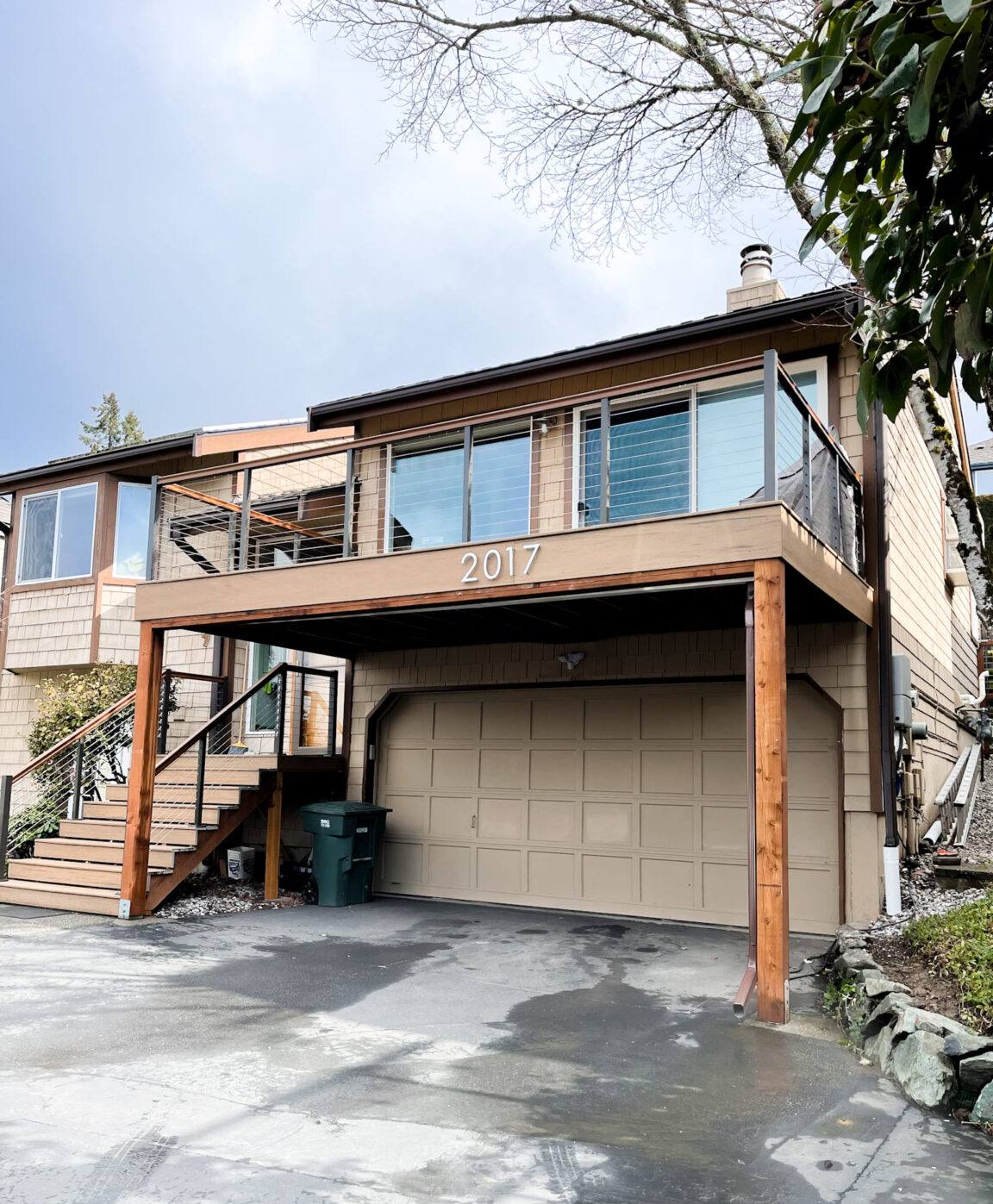
A number of Point Roberts properties are valued for their water views, which often means a deck that's elevated or built out toward more open exposure rather than tucked against a sheltered wall. That's exactly the kind of deck that benefits most from the extra attention to footing depth, beam sizing, and wind bracing described above — the more exposed the deck, the less room there is for cutting corners on the frame underneath it.
Airflow Underneath the Deck
Ground clearance and skirting design affect how well air moves under a deck, which in turn affects how fast the underside framing dries out after a storm. Skirting that's sealed up tight looks clean but can trap moisture against the framing; skirting designed with enough venting keeps air moving without leaving the underside exposed. It's a small design choice with a real effect on how long the frame lasts.
Comparing Decking Materials for This Climate
| Material | Upfront Cost | Moisture & Salt Air Behavior | Moss/Algae Maintenance | Typical Longevity Here |
|---|---|---|---|---|
| Pressure-treated lumber | Lower | Prone to checking, cupping, and fastener corrosion without upkeep | Needs regular cleaning and periodic sealing | 15–20 years with consistent maintenance |
| Cedar | Moderate | Naturally rot-resistant but still absorbs moisture readily | Higher; refinishing needed to hold color and shed water | Shorter without diligent upkeep |
| Composite decking | Higher | Doesn't rot or absorb water into the core | Moderate; surface algae still needs periodic washing | 25+ years, capped products hold up best |
| PVC decking | Higher | Fully synthetic, essentially impervious to moisture | Low to moderate; smooth surfaces shed algae more easily | 25+ years |
Permits and Building Code
Point Roberts is unincorporated and falls under Whatcom County's building code and permitting process, the same as Birch Bay and the rest of the county. Most decks above a certain height or attached to the house require a permit, proper guardrail and stair design where applicable, and inspection of the footings and ledger connection before the decking goes down. We handle that permitting process as a normal part of the job rather than something the homeowner has to chase down separately, and we build to pass inspection the first time rather than treating the inspector as an obstacle.
Why Hiring a Crew That Already Works in Point Roberts Matters
Point Roberts' geography that makes it a beautiful place to have a deck is the same geography that makes it inconvenient for a lot of contractors to service. Getting a crew, tools, and materials there means crossing the border, and doing that reliably on a build schedule — framing lumber one day, decking material the next, hardware and finish work after that — is enough of a logistical hassle that some contractors from the mainland side of the county simply won't take the job, or will pad the price and timeline to cover the hassle.
A crew that already works Point Roberts regularly has that logistics problem solved before your project ever starts. Just as importantly, we already know how this specific stretch of coastline behaves — how far wind-driven rain travels under an eave, how fast standard hardware corrodes here versus a sheltered inland lot, and where moss tends to take hold first on a shaded deck. That familiarity shows up in the build details that determine whether a deck lasts one wet season or several decades.
Our Process
We start with an on-site visit to look at the site itself — sun and wind exposure, drainage, how the deck will attach to the house, and what the existing structure, if any, tells us about how the site has handled moisture over time. From there we put together a clear written scope covering framing, fastener grade, decking material, and permitting before any work begins. During the build, ledger flashing, footing depth, and corrosion-rated hardware are handled as standard practice, not optional upgrades priced separately.
A Checklist Before Hiring for a Point Roberts Deck
- Ask what fastener and hardware grade they use, and whether it's rated for coastal salt exposure
- Confirm they'll pull the required Whatcom County permit and handle inspections
- Ask specifically how they'll flash and attach the ledger board to the house
- Ask how often they actually work in Point Roberts, given the border-crossing logistics involved
- Get a written scope covering framing, decking material, and hardware before signing anything
If you're planning a new deck or replacing one that's showing its age on a Point Roberts property, we're glad to walk the site with you and give an honest read on what it needs. Reach out below for a free, no-pressure estimate.