 Birch Bay Roofing
 New-Construction Windows in Birch Bay Village: Getting It Right the First Time
If you're building or framing a home in Birch Bay Village, the windows going into those rough openings aren't a simple swap-and-seal job. New-construction windows are installed before the siding or stucco goes on, with a nailing flange that gets integrated directly into the house wrap and flashing system. That's different from replacement windows, which get set into an existing finished opening after the original unit is removed. Get the sequencing and flashing wrong on a new build, and you're not looking at a minor leak — you're looking at water intrusion behind the siding that can sit hidden for years before it shows up as rot, mold, or a soft spot in the wall.
Birch Bay Village sits close enough to the water that the marine environment isn't background noise — it's a real design factor. Salt-laden air, wind-driven rain off Georgia Strait and Semiahmoo Bay, and Whatcom County's long, damp moss season all put more stress on window assemblies here than they would on a similar home twenty miles inland. Getting the product, the flashing details, and the installation sequence right at framing stage is a lot cheaper than fixing it after the siding is on.
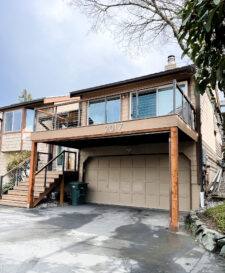
Why Birch Bay's Marine Climate Changes the Job
A window is only as good as the assembly around it. In a coastal community like Birch Bay Village, three conditions do most of the damage over time:
- Salt air accelerates corrosion on exposed fasteners, hinges, and low-grade hardware, and it can degrade certain finishes faster than manufacturers rate them for inland use.
- Wind-driven rain doesn't fall straight down — it gets pushed sideways and upward under eaves and into gaps that would stay dry in a calmer climate. This is the single biggest reason sill flashing details matter so much here.
- Moss and moisture season in Whatcom County runs long. Anything that traps water against wood trim, sheathing, or framing — a poorly lapped house wrap, a missing sill pan, a caulk-only seal — gets months of standing moisture exposure instead of days.
None of this means new construction here is harder than anywhere else. It means the margin for error on flashing and product selection is smaller, and it rewards a crew that treats those details as non-negotiable rather than optional.
Choosing the Right Window for a Coastal Whatcom County Build
There's no single "best" window brand — there's a best window for your budget, your home's exposure, and how it's going to be installed. For new construction in Birch Bay Village, we're mainly weighing frame material, glazing package, and hardware quality against long-term maintenance.
| Frame Material | Coastal Performance | Maintenance | Typical Cost Position |
|---|---|---|---|
| Vinyl | Good — won't corrode or rot; performance depends on quality of the extrusion and welds | Low — no painting, occasional cleaning | Entry to mid-range |
| Fiberglass | Excellent — very stable in temperature swings and salt exposure, holds paint well if color changes are wanted later | Low to moderate | Mid to upper-mid range |
| Wood-clad aluminum/vinyl | Good exterior durability, but interior wood needs protection from any humidity intrusion | Higher — interior wood care, seal integrity checks | Upper range |
| Bare aluminum | Prone to corrosion pitting in salt air over time unless heavily anodized/finished | Moderate to high | Varies widely |
For most Birch Bay Village new builds, we steer homeowners toward vinyl or fiberglass frames with a marine-rated or heavily corrosion-resistant hardware package — stainless or coated fasteners and locks rather than bare steel. On glazing, dual-pane with a Low-E coating is standard for our climate zone; homeowners who want extra sound dampening from wind or road noise sometimes step up to a laminated or upgraded gas-fill package, which we're happy to price out alongside the standard option.
A Note on Product Choice
We don't push a single manufacturer on every job. What we do insist on is that whatever unit you choose has documented performance ratings appropriate for a coastal exposure and a warranty structure that holds up in practice — some warranties have installation requirements that void coverage if flashing isn't done a specific way, which is another reason the install crew and the product decision shouldn't be separated.
The Flashing Details That Actually Prevent Leaks
This is the part of a new-construction window install that homeowners rarely see and almost never get shown in a sales pitch, but it's the difference between a window that stays dry for thirty years and one that starts leaking in five.
Sill Pan Flashing
Every new-construction opening should get a sloped sill pan — a rigid or flexible flashing membrane at the bottom of the rough opening that sheds any water that gets past the window itself out and away from the framing, instead of letting it pool on the sill. In a wind-driven rain climate like Birch Bay's, skipping this step is one of the most common causes of hidden rot we see in older homes.
House Wrap Integration (Shingle-Lap Sequencing)
Flashing tape and house wrap need to be layered like shingles — each layer overlapping the one below it — so water is always directed downward and outward, never funneled behind the layer beneath. The head flashing goes over the house wrap above the window; the jamb and sill flashing go under it. Done out of order, water finds the seam.
Fastening and Shimming
Windows need to be set plumb, level, and square, shimmed at the manufacturer's specified points, and fastened through the flange per that product's installation instructions — not just "nailed until it feels solid." Over- or under-shimming can bow a frame slightly, which affects both operation and the seal over time.
Sealant as a Backup, Not the Primary Defense
Caulk and sealant matter, but they're the last line of defense, not the main one. A window assembly that depends on a bead of sealant to stay dry is going to fail eventually — sealant degrades, especially with UV and salt air exposure. The flashing and lapping sequence underneath is what does the real work.
Our New-Construction Window Installation Process
- Rough opening check. We verify the opening is square, correctly sized, and structurally ready before the window ever gets set.
- Sill pan flashing. A sloped pan flashing goes in first, directing any incidental water back out of the wall assembly.
- Window placement and shimming. The unit is set plumb, level, and square, and shimmed at the manufacturer's load points.
- Fastening. Flange fasteners go in per the manufacturer's schedule and spacing — this affects both structural performance and warranty validity.
- Flashing integration. Jamb flashing, then head flashing, are lapped with the house wrap in the correct shingle sequence.
- Sealant and backer rod. Interior and exterior sealant is applied as the final, secondary barrier — not a substitute for the flashing work.
- Function and seal check. Every window is operated, checked for square operation, and inspected before we sign off.
Energy Code and Egress Requirements for New Builds
New-construction windows in Whatcom County need to meet current Washington State Energy Code performance requirements for U-factor and, where applicable, solar heat gain — this varies by orientation and glazing area on the home, so it's worth confirming per opening rather than assuming one spec covers the whole house. Bedrooms and other habitable spaces also have egress requirements: a minimum clear opening size and a maximum sill height, so occupants can get out and first responders can get in during an emergency. On a new build, this is far easier to plan for correctly during framing than to retrofit later, which is another reason window selection should happen alongside — not after — the framing plan.
Why a Crew That Already Works Birch Bay Village Matters
A contractor who's done window installs elsewhere in Whatcom County but never specifically in Birch Bay Village is still going to be dealing with the same wind and moisture patterns, but local familiarity still counts for something practical: knowing how exposed a given lot is to prevailing wind and rain direction, understanding what inspectors in the county are looking for at framing stage, and — if Birch Bay Village has HOA or community design covenants — knowing to check those before finalizing window style, color, or trim so you're not reworking anything after the fact. We'd rather ask the HOA question up front than have a homeowner find out about a covenant after the windows are ordered.
Living With New Windows Through Moss Season and Salt Exposure
A correctly installed window in this climate shouldn't need much from you, but a little seasonal attention extends its life:
- Rinse accumulated salt film off exterior glass and frames periodically, especially on wind-exposed elevations.
- Keep gutters and any nearby roof valleys clear so runoff isn't sheeting directly across window heads during heavy rain.
- Check exterior sealant lines annually for cracking or separation — catching a failed bead early is a five-minute fix, not a wall repair.
- Keep an eye on moss or algae buildup on nearby trim and siding; moss holds moisture against wood longer than bare exposure would.
- Operate each window a few times through the year so weatherstripping and hardware don't seize up from disuse.
What a Correct New-Construction Window Job Should Include
- Verified, square rough openings before any window is set
- Sloped sill pan flashing at every opening
- Proper shingle-lap sequencing between flashing and house wrap
- Manufacturer-specified shimming and fastening, not "good enough" placement
- Sealant used as backup protection, not the primary water barrier
- Product selection matched to coastal exposure and hardware corrosion resistance
- Confirmation of energy code and egress compliance per opening
- A final function and seal check before the crew leaves the site
If you're planning a new build or major addition in Birch Bay Village and want windows installed the way this climate actually demands, we're happy to walk the site, look at your plans, and put together a free, no-pressure estimate. There's a form below to get that started.