 Birch Bay Roofing
 Why Semiahmoo Decks Wear Out Faster Than Most
Semiahmoo sits right up against the water, and that changes what a deck goes through year to year compared to a deck a few miles inland. The salt-laden air off the bay accelerates corrosion on anything metal — nails, screws, joist hangers, bolts — long before the wood itself shows obvious damage. Add Whatcom County's driving rain, which comes in sideways off the water more often than it falls straight down, and you get moisture finding its way into joints, end grain, and fastener holes that a typical deck design never accounts for.
Then there's moss. Birch Bay's long, wet shoulder seasons give moss and algae months to establish themselves on any shaded or north-facing deck surface. Once moss takes hold, it holds moisture against the boards constantly, which is exactly the condition that rots wood and rusts hardware fastest. A deck in a drier inland climate might go a decade without a real problem. A Semiahmoo deck exposed to salt air and moss can develop hidden issues in half that time if it isn't inspected and maintained with that exposure in mind.
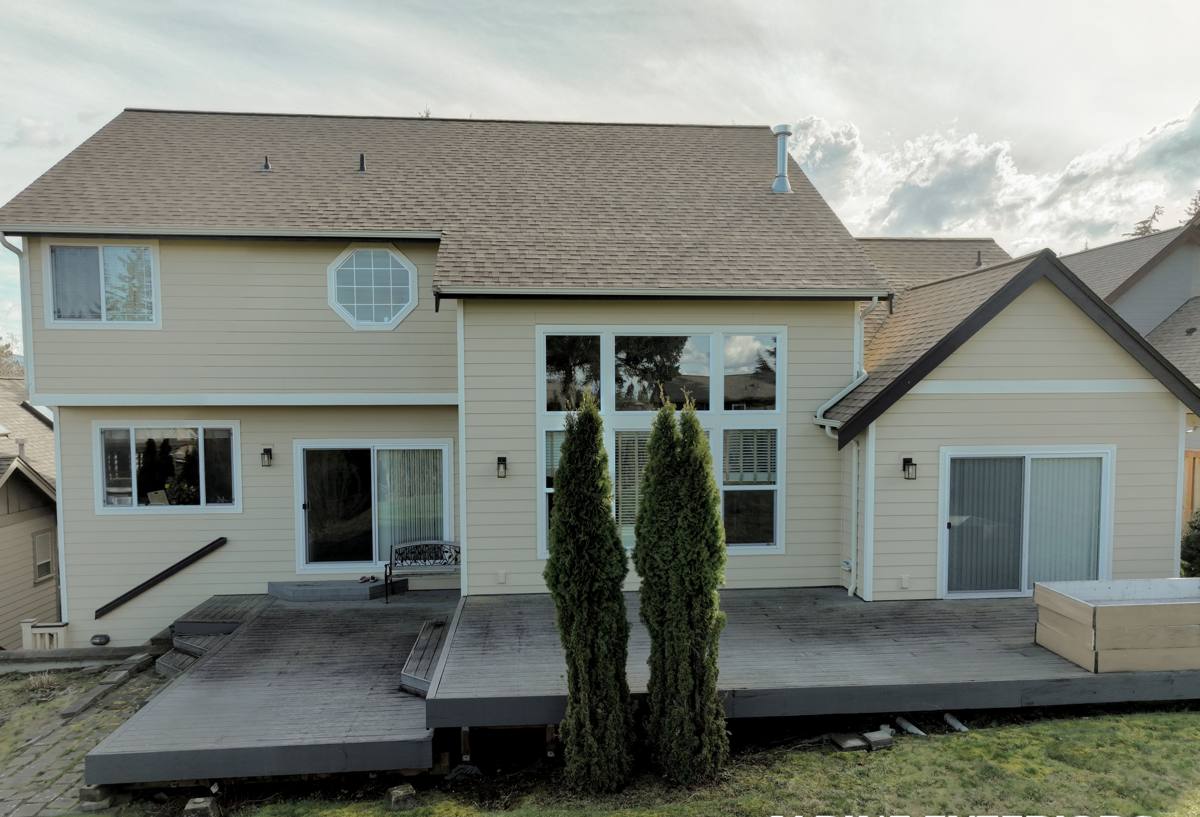
Signs a Semiahmoo Deck Needs Repair
Most deck failures don't announce themselves with a collapse — they show up as small warning signs first. Knowing what to look for, and when a problem is cosmetic versus structural, is the difference between a manageable repair and a full rebuild.
Surface-Level Signs
- Graying, splintering, or cupped boards, especially on the shaded side of the deck
- Moss or dark algae staining that keeps coming back after cleaning
- Rust streaks below screw heads or around joist hangers
- Loose or wobbly railings, stairs, or individual boards
- Gaps opening up between boards or at the ledger board where the deck meets the house
Structural Signs That Need Immediate Attention
- Soft or spongy spots underfoot, which usually mean rot in the framing below
- Visible sagging in the deck surface or beams
- Cracked or split ledger board, or any separation between the ledger and the house
- Posts that have shifted, rotated, or show rot at the base where they meet the ground or a footing
- Corroded or missing joist hangers and structural fasteners
The first list is worth addressing for appearance and to head off bigger problems. The second list means the deck's structural integrity is in question and should be looked at before the deck sees regular use.
What a Correct Deck Repair Actually Involves
A lot of deck "repairs" amount to swapping out a few obviously bad boards and calling it done. That approach misses the point in a marine climate like Semiahmoo's, because the boards are rarely the first thing to fail — the fasteners and framing underneath usually go first, and a new board screwed into a rusted hanger or a soft joist doesn't hold for long.
A proper repair starts with an inspection, not a bid
Before we replace anything, we get underneath the deck and check the framing: joists, beams, posts, footings, and the ledger connection to the house. We're checking for rot, checking fastener condition, and checking whether the structure is actually sound enough to build on top of. This is the step that gets skipped when a repair is quoted from the surface alone.
Matching fasteners and hardware to the exposure
Standard fasteners corrode faster in salt air. Any hardware we install or replace on a Semiahmoo repair — screws, bolts, joist hangers, post bases — needs to be rated for coastal or treated-lumber exposure, not just whatever is standard elsewhere in the county. Mixing incompatible metals (for example, the wrong screw in treated lumber, or a hanger that reacts with the fastener holding it) causes accelerated corrosion that can undo a repair within a couple of seasons.
Addressing the moisture path, not just the symptom
Rot and moss are downstream of moisture that isn't draining or drying the way it should. That can mean a ledger flashing detail that was never installed correctly, boards laid too tight to allow airflow, or a low spot in the framing that holds water. A repair that replaces the damaged wood without fixing why it got wet in the first place is a repair that fails again.
Repair vs. Replacement: How We Make the Call
| Situation | Usually Repairable | Usually Needs Replacement |
|---|---|---|
| Framing condition | Joists and beams are solid, isolated rot spots | Widespread rot, sagging, or repeated soft spots |
| Ledger board | Sound, properly flashed, minor fastener corrosion | Cracked, separated from house, or improperly flashed from original build |
| Decking boards | Some graying, splintering, isolated bad boards | Cupping, splitting, or soft boards across most of the surface |
| Posts and footings | Stable, no rot at base, footings intact | Rot at post base, undersized or shifting footings |
| Overall age and history | Deck built or re-decked within the last 10-15 years | Original deck is decades old with no record of hardware upgrades |
We'll always tell you honestly which side of that table your deck falls on. A deck with sound framing and a few tired boards is a straightforward, cost-effective repair. A deck with structural problems at the ledger, posts, or framing usually isn't worth chasing with patch repairs — that money is better spent on a rebuild that's flashed and fastened correctly the first time.
Our Deck Repair Process
- On-site inspection — We check the deck from above and below, including framing, fasteners, ledger connection, posts, and footings.
- Honest scope and estimate — You get a clear breakdown of what's cosmetic, what's structural, and what your realistic options are, with no pressure toward the more expensive option.
- Repair or rebuild the framing first — Any rot, corrosion, or connection problems get addressed before new decking goes down. A new deck surface on a bad frame just hides the problem.
- Install with coastal-rated hardware — Fasteners and connectors are chosen for salt air exposure, not generic hardware store stock.
- Correct moisture management — Flashing, board spacing, and drainage details are set up so water sheds instead of sitting.
- Final walkthrough — We show you what was done and what to watch for going forward, including moss-prone areas that will need periodic attention.
Decking Material Considerations for a Semiahmoo Exposure
Not every decking material handles salt air, constant damp, and moss pressure the same way. When we're repairing or replacing sections, the right material depends on your existing deck, your budget, and how much upkeep you want to take on.
| Material | How It Handles This Climate | Trade-Off to Know |
|---|---|---|
| Pressure-treated lumber | Resists rot well when properly maintained; the most common repair match | Needs periodic sealing/staining and is more prone to visible moss growth if not cleaned |
| Cedar | Naturally rot- and insect-resistant, ages well in coastal air | Softer wood, more sensitive to fastener choice and requires regular finish maintenance |
| Composite decking | Doesn't rot and resists moss staining better than wood | Higher upfront cost; still needs correct framing and fastener details underneath |
We're straightforward about the trade-offs here rather than pushing one product. A well-maintained treated-lumber deck can last for decades in this climate — it just needs the maintenance. Composite costs more up front but shifts some of that maintenance burden off your plate. Either way, the framing and hardware underneath matter more than the surface material.
Why a Crew That Already Works Semiahmoo Matters
Deck repair isn't the same job everywhere in Whatcom County. A contractor who mostly works drier, inland properties can miss the specific failure patterns that show up on a deck exposed to bay-front salt air and near-constant moss pressure — because they simply don't see it as often. A crew that regularly works Semiahmoo and the greater Birch Bay area knows which fastener grades hold up here, which flashing details actually keep water out in driving rain, and where moss tends to establish itself first on a coastal deck.
That familiarity also means a faster, more accurate estimate. We're not guessing at how this climate affects a deck — we're accounting for it from the first inspection, so the repair you get quoted is the repair that actually holds up.
Keeping a Semiahmoo Deck in Good Shape Between Repairs
- Sweep debris and standing leaves off the deck regularly, especially in fall and winter — trapped debris holds moisture against boards
- Clean moss and algae off shaded areas at least once a year, before it has a chance to spread
- Check railings, stair stringers, and any loose boards a couple of times a year and tighten or flag them early
- Reseal or restain wood decking on the schedule recommended for the product — don't wait until it visibly fails
- After any major windstorm or heavy rain event, do a quick visual check for new gaps, movement, or water pooling
- Have the framing and ledger connection inspected every few years, even if the surface looks fine
If your Semiahmoo deck has soft spots, loose railings, persistent moss, or you just haven't had it looked at in a while, we're happy to come take a look. Estimates are free and there's no pressure — just an honest read on what your deck actually needs.