 Birch Bay Roofing
 Roofing for the Nooksack Area Isn't the Same Job as Roofing Somewhere Dry
Homes in and around Nooksack sit inside a stretch of Whatcom County that stays wet for most of the year. Rain doesn't just fall here — it drives sideways in winter storms, sits in shaded valleys and tree cover longer than it does in open country, and keeps roof surfaces damp enough, long enough, for moss and algae to take hold. Add the salt-tinged air that moves inland off the Strait of Georgia and Birch Bay on windy days, and you've got a combination that wears out the wrong roofing material faster than most homeowners expect.
We're a Birch Bay-based crew, and Nooksack is part of our regular service area, not a place we drive out to occasionally. That matters more with metal roofing than with almost any other roofing material, because metal rewards correct installation and punishes shortcuts — and the mistakes that cause problems don't usually show up until year three or four, long after the crew that made them has moved on.
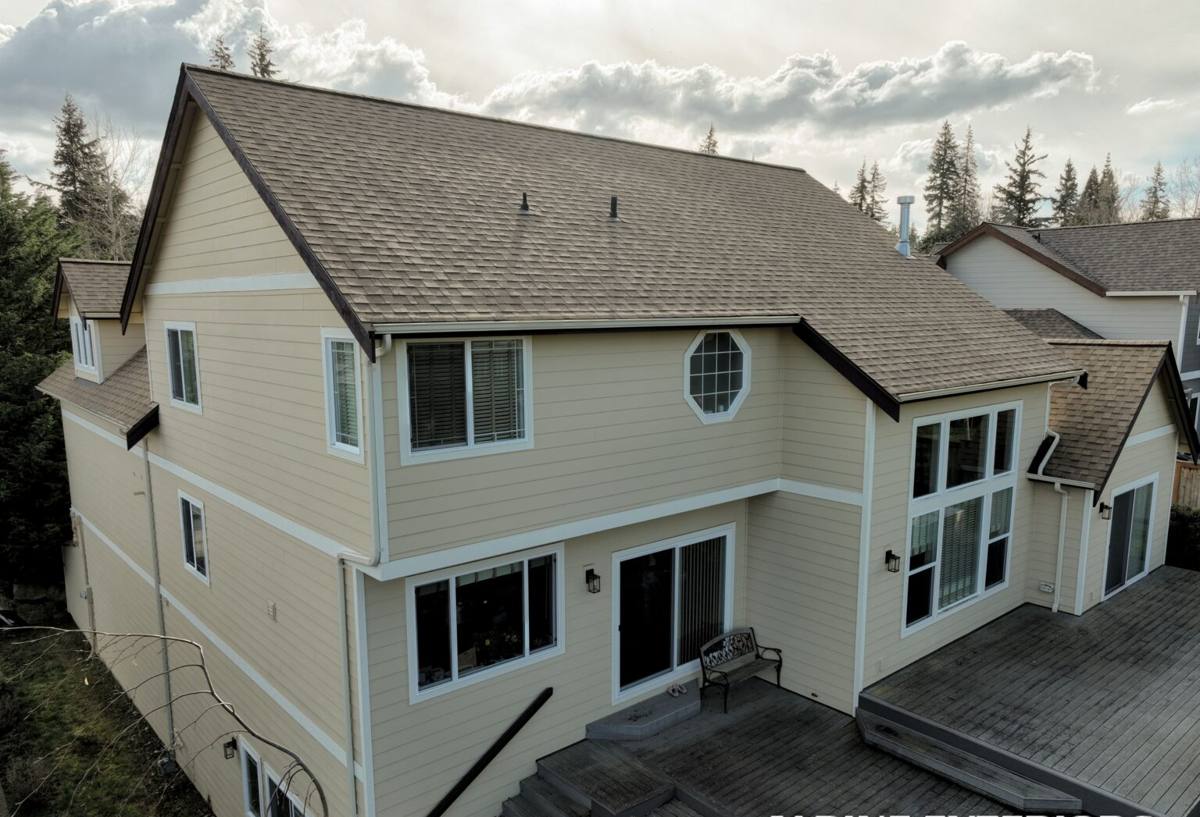
What This Climate Actually Does to a Roof
Wind-Driven Rain
Rain that comes in at an angle finds its way under laps, around fasteners, and into any seam that wasn't detailed correctly the first time. On a standard shingle roof, this is the single biggest cause of hidden leaks. On a metal roof, it's the reason panel overlap, seam type, and fastener placement matter so much more than the panel material itself.
Moss and Sustained Moisture
Whatcom County's long wet season gives moss and algae plenty of time to establish on any roof that holds moisture or sits in shade. Moss on asphalt shingles works its way under the tab edges and lifts them, which is how a moss problem turns into a leak. Metal doesn't give moss the same foothold, but it isn't immune — algae staining and moss buildup in valleys and against debris still happen on a poorly designed metal roof, especially where panels meet a roof-to-wall transition or sit under overhanging branches.
Salt-Tinged Air
Homes closer to Birch Bay and the water see more of this than homes further inland, but wind can carry salt-laden moisture well past the shoreline during storms. Salt air accelerates corrosion on any exposed metal fastener, flashing, or panel edge that isn't properly coated or protected. This is one of the main reasons fastener quality and finish selection matter as much as the panel gauge.
Why Metal Roofing Fits This Area Well — When It's Done Right
Metal roofing has real advantages for a climate like this: it sheds water fast instead of absorbing it, it doesn't give moss the organic surface it needs to root, and a quality finish resists the corrosion that salt air and constant moisture cause. It also handles wind uplift better than asphalt when it's installed with the correct fastening pattern, which matters during the winter windstorms that come through this part of the county.
None of that happens automatically just because the roof is metal. A metal roof installed with the wrong panel system, undersized fasteners, or poor flashing detail can leak worse and corrode faster than a well-installed asphalt roof. The material is only half the equation — the installation is the other half.
Standing Seam vs. Exposed-Fastener Panels
These are the two main metal roofing systems homeowners choose between, and the difference matters a lot in a climate this wet.
- Standing seam panels interlock along raised seams with no exposed screws on the roof field. Water has no fastener holes to work into over time, which makes this the stronger long-term choice for a house that sees a lot of driving rain.
- Exposed-fastener panels are screwed directly through the panel face with rubber-washered screws. They cost less up front, but every screw is a potential future leak point once the washer gasket hardens and shrinks — which happens faster under repeated wet-dry cycling and UV exposure.
We'll recommend standing seam for most full roof replacements in this area for that reason. Exposed-fastener panels still have a place on outbuildings, shops, and lower-budget projects where the trade-off is understood going in.
What a Correct Metal Roofing Installation Actually Involves
A metal roof is a system, not just a layer of panels. Skipping any of the following is where the leaks and premature corrosion start:
- Tear-off (or a verified suitable substrate) down to solid, dry decking — metal should not go over failing sheathing
- A synthetic underlayment rated for the panel type, with special attention to ice and water shield at eaves, valleys, and roof-to-wall transitions
- Panel layout planned to minimize seams in high-water-flow areas like valleys
- Fasteners matched to the panel metal to avoid galvanic corrosion between dissimilar metals
- Properly formed and lapped flashing at every penetration — chimneys, vents, skylights, and wall transitions
- Correct fastening pattern and clip spacing for wind uplift resistance in this exposure
- Ventilation checked and corrected where needed, since trapped attic moisture will condense on the underside of metal panels
Choosing the Right Panel and Finish
Panel material and coating decide how the roof holds up against salt air and constant moisture over the decades it's expected to last. Here's how the common options compare for a home in this part of Whatcom County:
| Option | Corrosion Resistance Here | Typical Use | Trade-Off |
|---|---|---|---|
| Galvanized steel | Good, depends on coating quality | Standard residential standing seam | Needs a quality paint finish to hold up long-term near the water |
| Galvalume steel | Very good | Most common residential choice | Slightly higher cost than plain galvanized |
| Aluminum | Excellent — doesn't rust | Homes closer to Birch Bay's salt exposure | Higher material cost, softer metal |
| Painted vs. bare finish | Painted lasts significantly longer | Painted recommended for this climate | Bare/mill finish will streak and corrode faster in wet, salt-influenced air |
For most Nooksack-area homes, a Galvalume panel with a quality painted finish gives the best balance of cost and durability. Homes with more direct salt exposure closer to the water are often better served by aluminum, even at the higher material cost, simply because it removes rust from the list of long-term concerns entirely.
What It Costs — and What Actually Drives the Price
Metal roofing costs more up front than asphalt shingles, and the final number depends on more than square footage. These are the factors that move the price the most on jobs in this area:
| Cost Factor | Why It Matters Here |
|---|---|
| Panel system (standing seam vs. exposed fastener) | Standing seam costs more but eliminates fastener-related leak points |
| Roof complexity (valleys, dormers, penetrations) | More transitions mean more custom flashing labor |
| Tear-off and deck condition | Wet climates increase the odds of hidden deck damage under old roofing |
| Panel material (steel vs. aluminum) | Aluminum costs more but removes rust risk near the water |
| Access and roof pitch | Steeper, harder-to-access roofs take more labor time |
We give firm, itemized quotes after an actual roof inspection rather than a phone estimate, because two roofs of the same size in Nooksack can price out very differently once complexity and deck condition are factored in.
How We Handle a Metal Roofing Job
- On-site inspection of the existing roof, decking, and ventilation — not a drive-by estimate
- A written quote that specifies panel type, gauge, finish, and underlayment so you know exactly what you're buying
- Tear-off and deck repair where needed, with any rot or soft spots addressed before a single panel goes down
- Underlayment and flashing installed at every vulnerable point first
- Panel installation with the fastening pattern and layout suited to this area's wind exposure
- A final walkthrough where we show you the completed flashing details and answer questions before we consider the job done
Maintenance: Metal Still Needs Some Attention
A correctly installed metal roof needs far less maintenance than asphalt, but "less" isn't "none." In this climate, we recommend:
- Clearing debris and leaf buildup from valleys once or twice a year so water doesn't pool against seams
- Trimming back branches that overhang the roof, since constant shade is what lets moss gain a foothold even on metal
- A visual check of flashing and sealant points every year or two, since sealant is the one component on a metal roof that does age faster than the panels themselves
- Keeping gutters clear so water sheds off the roof edge instead of backing up under it
Why It Matters That We Already Work Nooksack
Metal roofing mistakes are slow mistakes — a poorly lapped seam or an undersized fastener pattern might not show a problem until the next big windstorm or the next full wet season. That's exactly why we stand behind the work we do in this area: we're not driving in from out of the region for one job and disappearing. We see how roofs we've installed hold up through Whatcom County winters, and we build every metal roof to handle the driving rain, moss pressure, and salt-influenced air that Nooksack and the greater Birch Bay area deal with year after year.
If you're weighing metal roofing against a shingle replacement, or you already know metal is the right call and want it done correctly the first time, we're happy to walk your roof with you and give you a straight answer. Reach out for a free, no-pressure estimate using the form below.