 Birch Bay Roofing
 Building Decks That Actually Hold Up Near Birch Bay
Sumas homeowners near Birch Bay ask for the same thing whether they're planning a small entry deck or a full-size outdoor living space: something that looks good the first summer and still looks good ten summers later. That second part is the harder problem in this part of Whatcom County. Salt air off the water, driving rain that comes in sideways more often than straight down, and a moss season that can stretch across most of the year all work against an outdoor structure in ways that don't show up in a glossy catalog photo. A deck built without those conditions in mind will usually look fine at handoff and start showing real problems within a few seasons — soft spots, corroded fasteners, ledger rot, slick decking. A deck built for this specific climate ages slowly and predictably instead.
This page is about deck building specifically for the Sumas area near Birch Bay — what the local conditions demand, what a correctly built deck actually involves below the surface, how we run the job from first call to final walkthrough, and why local experience matters more on decks than almost any other exterior project.
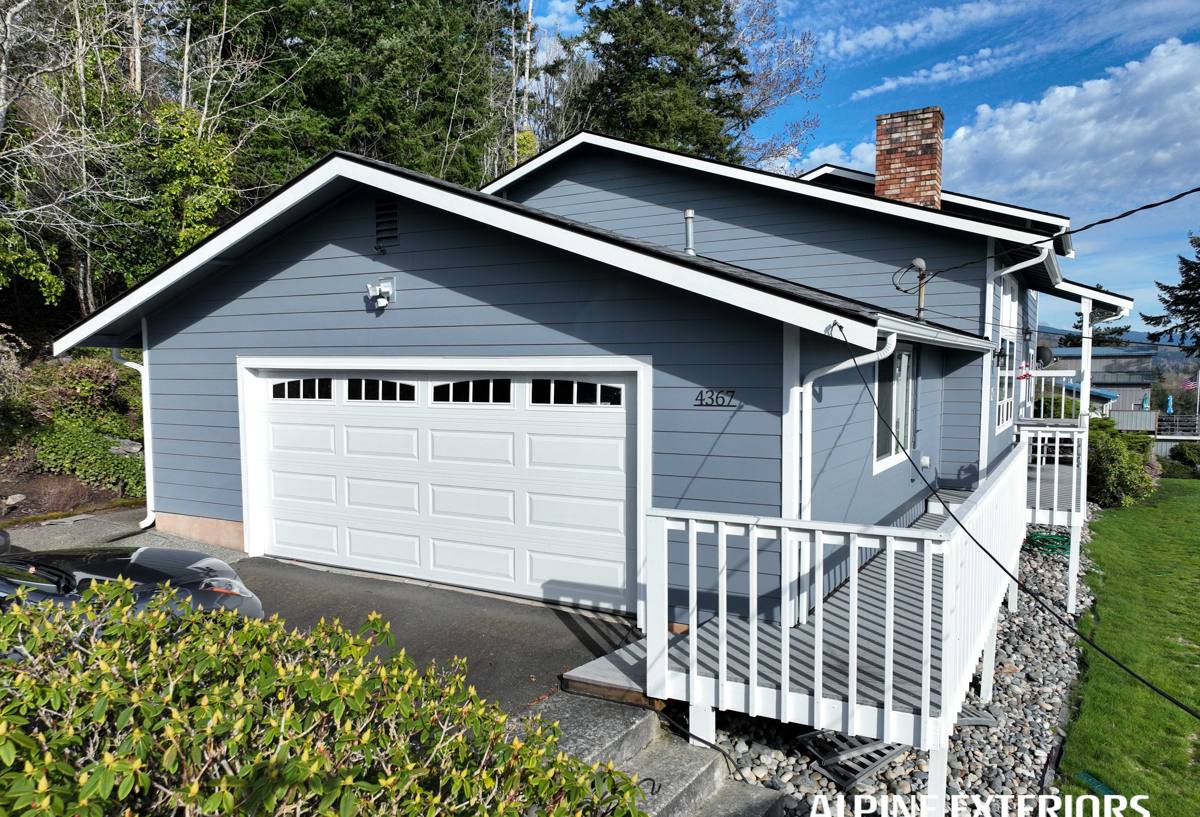
What Salt Air, Rain, and Moss Actually Do to a Deck
Salt Air and Corrosion
Proximity to the water means airborne salt settles on everything outside, including deck hardware. Standard fasteners, brackets, and connectors that would be fine forty miles inland can start corroding here within a few years if they weren't rated for it. Corrosion doesn't announce itself — it works quietly inside joist hangers and post bases until a connection is weaker than it looks from above. On a structure that's supporting people, furniture, and sometimes a hot tub, that's not a cosmetic issue.
Driving Rain and Water Intrusion
Wind-driven rain in this part of Washington rarely falls straight down, which matters most where a deck meets the house. The ledger board connection — where the deck attaches to the structure — is the single most common failure point on decks in this region, and it's almost always a flashing and water-management problem, not a lumber problem. Rain pushed sideways by wind finds any gap in that connection and works its way behind siding or into framing, often for years before anyone notices.
A Long Moss Season
Shaded decking, north-facing stairs, and anything under tree cover stays damp longer here than homeowners expect, and that extended damp period is exactly what moss and algae need to take hold. Beyond looking bad, moss-covered decking gets genuinely slick and holds moisture against the board surface, which shortens the life of both wood and composite decking if it isn't managed.
Freeze-Thaw and Ground Movement
Whatcom County gets enough cold snaps each winter that ground moisture in footings can freeze and shift slightly. Footings set below the frost depth and poured correctly won't move; shortcuts on footing depth or concrete quality tend to show up later as a deck that's slowly gone out of level.
What a Correctly Built Deck Involves
A deck that's going to hold up near Birch Bay isn't just a different set of materials — it's a different set of construction decisions from the ground up.
Footings and Framing
- Footings poured to proper frost depth, sized for the actual load the deck will carry
- Post bases and hardware rated for exterior and coastal exposure, not standard interior-grade fasteners
- Joist spacing and beam sizing engineered for the decking material chosen, not a generic default
- Proper ledger flashing where the deck ties into the house, integrated with existing siding and building paper rather than just caulked over the top
Water Management
Every horizontal surface on a deck needs a way for water to leave it. That means a slight slope away from the house on the decking itself, gapped boards or a drainage system underneath if the space below will be used, and flashing details at the ledger and any post-to-beam connections that shed water outward instead of trapping it. This is the part of a deck build that's invisible once the project is done, and it's also the part that determines whether the structure is still sound in fifteen years.
Fasteners and Hardware
Given the salt air here, we use corrosion-resistant fasteners and connectors rated for coastal exterior exposure as standard practice, not an upgrade option. Mixing metals — for example, an incompatible fastener against a treated lumber connector — can accelerate corrosion through galvanic reaction, so hardware compatibility gets checked as part of the build, not assumed.
Railings and Stairs
Railings and stair stringers take direct weather exposure and repeated load, so post connections get the same attention as the main structure. Stair treads in particular need a surface and slope that stays safe when wet, since this region's rain and shade mean stairs are rarely bone-dry.
Decking Material Choices for This Climate
There's no single "correct" decking material for every project — it depends on budget, maintenance appetite, and how the space will be used. Here's how the common options actually perform under salt air, driving rain, and a long moss season.
| Material | How It Handles Local Conditions | Maintenance Reality |
|---|---|---|
| Pressure-treated lumber | Handles moisture well when properly sealed; needs re-sealing to resist moss and graying | Periodic cleaning, re-staining or sealing every few years |
| Cedar | Naturally rot-resistant and handles the wet climate well, but softer and more prone to surface wear near salt air | Regular sealing or oiling to maintain appearance and resistance |
| Composite decking | Resists moisture and moss buildup better than wood; some early-generation composite boards had issues with mold in shaded, damp spots — modern capped composites handle it far better | Occasional washing; no sealing or staining required |
| PVC decking | Fully synthetic, essentially immune to moisture damage and salt corrosion; performs consistently in shaded, damp areas | Lowest maintenance of the common options; higher upfront cost |
For fully shaded decks or ones tucked under tree cover — where moss and prolonged dampness are the biggest concern — we usually steer homeowners toward composite or PVC decking. For decks that get more sun and airflow, a well-maintained wood deck can perform just fine and costs less upfront, as long as the homeowner is realistic about the sealing schedule.
Design Considerations Specific to Sumas Properties
Sun, Shade, and Airflow
Where a deck sits relative to the house and any tree cover changes how it ages. A deck that gets some direct sun and cross-breeze dries out after rain much faster than one boxed in by shade, which directly affects how bad the moss problem will be and how often it needs cleaning.
Proximity to the Water
Homes closer to the water get more salt exposure and more direct wind-driven rain, which pushes the hardware and fastener decisions harder toward marine-rated components. Homes set back further inland still deal with the same regional rain and moss patterns, just with somewhat less salt load on metal components.
Integration With the House
A deck attached to the house needs its ledger connection to work with whatever siding is already there — fiber cement, vinyl, wood, or engineered wood siding all flash slightly differently at that joint. Getting that detail wrong is the single most common source of hidden water damage behind a home's exterior wall, right at the deck connection.
Our Process, Start to Finish
- On-site assessment — we look at sun exposure, drainage, existing structure (for replacements or repairs), and how the deck will connect to the house
- Design and material discussion — honest conversation about decking material trade-offs, layout, railing style, and realistic budget ranges before any commitment
- Permitting — most deck projects in this area require a permit; we handle that process rather than leaving it to the homeowner
- Footings and framing — footings poured to proper depth, framing built to code and sized for the actual load and material chosen
- Ledger flashing and water management — the connection to the house gets built and flashed correctly the first time, since it's the hardest part to fix later
- Decking, railing, and stairs — installed with fasteners and hardware rated for this climate
- Final walkthrough — we go over the finished deck with the homeowner, including what maintenance (if any) the chosen material needs
What to Expect Cost-Wise
Deck pricing depends heavily on size, height above grade, material, and railing style, so we won't quote a number without seeing the site. As a general guide, pressure-treated lumber decks tend to sit at the lower end of the cost range, cedar sits in the middle, and composite or PVC decking cost more upfront but less over the life of the deck once you factor in sealing and staining labor. A deck built on a slope or requiring significant footing work will cost more than a simple ground-level deck of the same size, regardless of decking material.
A Practical Checklist Before You Hire Anyone for Deck Work
- Ask what fastener and hardware grade they use, and whether it's rated for coastal/salt exposure
- Ask how they'll flash the ledger connection to the house — this should be a specific, confident answer, not a vague one
- Confirm footing depth meets local frost-depth requirements
- Ask whether they pull permits themselves or leave that to you
- Get decking material trade-offs explained honestly, including maintenance requirements, not just the upfront price
- Ask how they handle drainage for the area underneath the deck if you plan to use that space
Why Local Experience Matters More on Decks
Decks fail in specific, regional ways. A crew that mostly builds in a drier climate may not default to marine-rated hardware, may not think through ledger flashing with the same seriousness, and may not steer homeowners away from decking materials that struggle in constant shade and moisture. None of that shows up as a problem on day one — it shows up two, five, or ten years later as corrosion, soft framing, or a slick, moss-covered surface. Building decks in Sumas and around Birch Bay for any length of time means seeing exactly which shortcuts cause which failures, and building around them from the start rather than learning the hard way on a customer's project.
If you're planning a new deck or need an existing one assessed, we're happy to take a look and give you a straightforward, no-pressure estimate. There's no cost to have us come out, walk the site, and tell you honestly what a correctly built deck for your property would involve.