 Birch Bay Roofing
 Why Terrell Creek Asks More of an Asphalt Shingle Roof
Terrell Creek sits close enough to the water that salt-laden air is a constant, low-grade stressor on every exterior surface, roofs included. Add Whatcom County's long wet season, driving rain that comes in sideways off Georgia Strait during winter storms, and the shaded, moisture-holding tree cover common around the creek corridor, and you have a roofing environment that punishes shortcuts. Asphalt shingles can absolutely hold up here for their full service life, but only when the installation accounts for what this specific location does to a roof over time.
Three things drive most of the early roof problems we see in this neighborhood: salt air accelerating corrosion on fasteners and metal flashing, prolonged dampness feeding moss and algae growth on shaded slopes, and wind-driven rain finding its way under shingles that weren't sealed or fastened with coastal conditions in mind. None of these are exotic problems. They're well understood, and they're preventable with the right materials and technique.
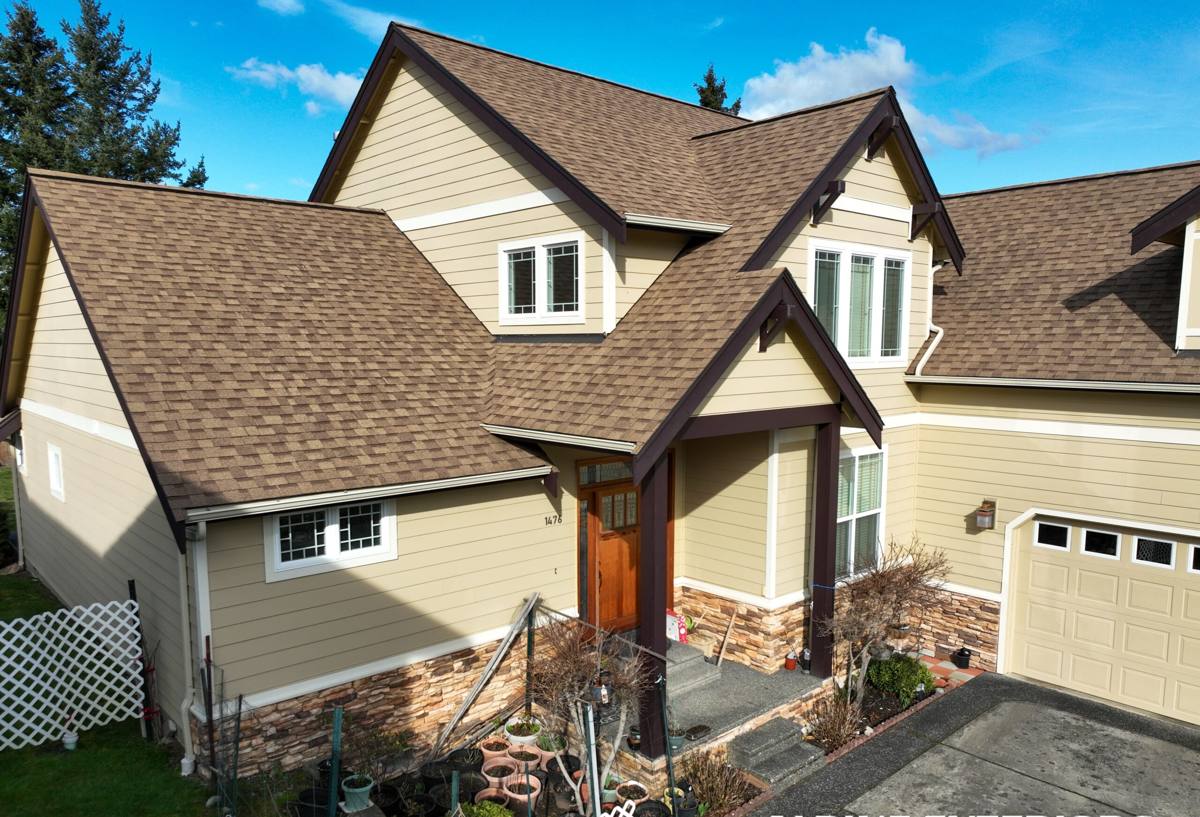
What a Correctly Installed Shingle Roof Needs Here
Fasteners and Metal That Won't Corrode
Standard electro-galvanized nails and cheap flashing corrode faster near the coast than they would inland. On Terrell Creek roofs we spec hot-dip galvanized or stainless fasteners and metal flashing rated for coastal exposure, particularly at valleys, chimneys, and any transition where water concentrates. It costs a little more up front and saves the roof from rust streaks and fastener failure years before the shingles themselves are due for replacement.
Underlayment and Water-Shedding Detail
Because rain here often arrives at an angle instead of straight down, we don't treat underlayment as an afterthought. A synthetic underlayment with good tear resistance, ice-and-water shield at eaves and valleys, and properly lapped and sealed seams matter more on a wind-exposed Terrell Creek roof than they would on a calm, inland lot. This is the layer that saves the deck when a shingle tab lifts in a storm.
Ventilation That Actually Balances
Moisture problems on shingle roofs are often an attic ventilation problem wearing a roofing disguise. A balanced intake-and-exhaust system keeps the underside of the deck dry, which matters in a climate where the air itself carries a lot of moisture most of the year. We check existing ventilation on every reroof rather than assuming it was done right the first time.
Algae-Resistant Shingles for Shaded, Damp Slopes
Many Terrell Creek lots have tree cover that keeps part of the roof shaded and slow to dry. On those slopes, algae-resistant (AR) shingles — which use copper-releasing granules to discourage the dark streaking caused by algae — are worth the modest upcharge. It's a maintenance decision, not a cosmetic one: streaking doesn't hurt the shingle structurally, but the moisture-holding growth that often comes with it can shorten shingle life on a shaded roof.
Signs a Terrell Creek Roof Needs Attention
- Moss establishing on north-facing or tree-shaded slopes, especially where it's thick enough to hold water against the shingle surface
- Granules collecting in gutters or at downspout outlets, a sign shingles are aging or were damaged by wind or debris
- Shingle tabs that look lifted, curled, or cupped, particularly after a windy winter storm
- Rust-colored streaking at flashing points, chimneys, or valleys
- Soft or discolored ceiling spots inside the home, which usually mean water has already gotten past the roof covering
- Daylight or drafts in the attic where there shouldn't be any
Any one of these on its own isn't necessarily an emergency, but on a coastal, moss-prone lot they tend to compound quickly if ignored through a full wet season.
How Our Process Works
Inspection and Honest Scope
We start by getting on the roof, not just looking at it from the ground. We check the deck for soft spots, evaluate existing flashing and ventilation, and look at how the current roof has actually performed under Terrell Creek conditions — not how a roof performs in a showroom. You get a straight answer on whether you need a full reroof, a targeted repair, or maintenance now with a plan for later.
Tear-Off and Deck Check
Full reroofs start with a complete tear-off so we can inspect the deck itself, not just cover over hidden rot. Any damaged sheathing gets replaced before a single shingle goes down — skipping this step is the single most common shortcut that leads to early roof failure in wet coastal climates.
Underlayment, Flashing, and Ventilation First
Before shingles go on, we install the underlayment system, ice-and-water shield at vulnerable areas, and corrosion-resistant flashing, and we correct any ventilation imbalance we found during inspection. This is the part of the job that determines whether the roof handles a wet Whatcom County winter well or poorly, long before it's visible from the street.
Shingle Installation
Shingles are installed to manufacturer fastening specs adjusted for wind exposure common near the water, with attention to nailing pattern, sealant strip activation, and proper alignment at valleys and hips. We don't rush starter courses or ridge caps — these are the spots most likely to fail first in wind-driven rain.
Cleanup and Walkthrough
We clear the site of old materials and debris, including a magnetic sweep for stray nails, and walk the finished roof with you so you know what was done and what to watch for going forward.
Choosing the Right Shingle for This Microclimate
| Shingle Type | Typical Lifespan | Best Fit for Terrell Creek | Trade-Offs |
|---|---|---|---|
| 3-tab asphalt | 15-20 years | Budget-conscious projects, secondary structures | Lower wind resistance, less algae resistance available |
| Architectural (laminate) asphalt | 25-30 years | Most Terrell Creek homes, especially wind-exposed lots | Higher upfront cost than 3-tab |
| Algae-resistant (AR) architectural | 25-30 years | Shaded, tree-covered, or north-facing slopes | Modest upcharge; doesn't eliminate moss on its own |
| Impact-rated (Class 4) architectural | 25-30+ years | Homes wanting extra durability and possible insurance credit | Higher material cost; check with your insurer on discounts |
Most homes in this neighborhood do best with an architectural shingle carrying algae resistance, given how much shade and dampness the creek corridor holds through the year. Impact-rated shingles are worth discussing if you want maximum durability against wind-borne debris, but they're an upgrade, not a requirement.
Maintenance That Actually Matters in a Moss-Prone Environment
- Keep overhanging branches trimmed back to reduce shade and debris buildup on the roof surface
- Clear gutters and downspouts at least twice a year so water isn't backing up under the shingle edge
- Have moss removed by a professional using proper technique — scraping or pressure-washing moss off a shingle roof can strip granules and do more harm than the moss itself
- Schedule a roof check after major windstorms, since lifted or cracked shingles are easy to miss from the ground
- Watch for rust streaking at flashing points as an early warning sign near the coast
Cost Factors on a Terrell Creek Reroof
| Factor | Why It Affects Cost |
|---|---|
| Roof size and number of planes | More area and more valleys/hips mean more material and labor |
| Deck condition | Rotted or soft sheathing found during tear-off adds replacement cost |
| Shingle grade chosen | 3-tab vs. architectural vs. impact-rated changes material pricing |
| Access and pitch | Steep or hard-to-access roofs take more time and safety setup |
| Ventilation or flashing corrections | Fixing an underlying issue found during inspection adds scope but prevents repeat problems |
| Existing moss or moisture damage | Extensive moss growth can hide deck damage that adds to the job once uncovered |
We'd rather give you a real number after seeing the roof than a broad estimate that doesn't hold up once we're actually on it. Most homeowners want a ballpark first, and that's fair — but the honest range depends heavily on deck condition, which you often can't know until tear-off.
Why Hiring a Crew That Already Works Terrell Creek Matters
A roofer who mostly works inland doesn't always think in terms of salt-air corrosion or moss management by default — it's not wrong, it's just a different set of habits shaped by a different climate. A crew that regularly works Birch Bay and the Terrell Creek area already knows to spec corrosion-resistant fasteners without being asked, checks ventilation as a matter of course, and recognizes moss and algae patterns specific to this shoreline rather than treating them as an afterthought. That local pattern recognition is the difference between a roof that's built to last here and one that's built to last somewhere else and happens to be installed here.
We also know how Whatcom County permitting and inspection timelines typically run, which keeps a reroof project on schedule instead of stalled waiting on paperwork nobody anticipated.
Warranty and What's Included
Every asphalt shingle installation includes manufacturer material warranty coverage plus our workmanship warranty on the installation itself. We'll walk you through exactly what's covered, what voids coverage (like unapproved roof-cleaning methods), and what maintenance keeps your warranty intact, before any work begins — not buried in fine print afterward.
If your Terrell Creek roof is showing moss, granule loss, or storm damage, or you're simply planning ahead for a reroof, we're happy to take a look and give you a straightforward, no-pressure estimate. Use the form below to get started.