 Birch Bay Roofing
 Why Ferndale Homes Need Windows Built for This Climate
Ferndale sits close enough to the water that salt air is part of daily life, and close enough to the Cascade foothills that rain shows up sideways more often than most manufacturers' warranties assume. Add in the long stretch of grey, damp months that Whatcom County gets every year, and you've got a climate that is genuinely hard on windows — not because any one storm is extreme, but because the moisture and salt exposure never really stop. A window that's rated fine for a dry inland climate can start failing here years ahead of schedule.
Energy-efficient windows aren't just about a lower power bill, though that's real too. In this area, the bigger issue is usually moisture management: keeping driving rain out of the wall assembly, keeping condensation off the glass and frames, and keeping salt-laden air from corroding hardware and breaking down seals early. A window that handles Ferndale's climate well will also, almost as a side effect, run more efficiently — because a tight, well-sealed window is doing both jobs at once.
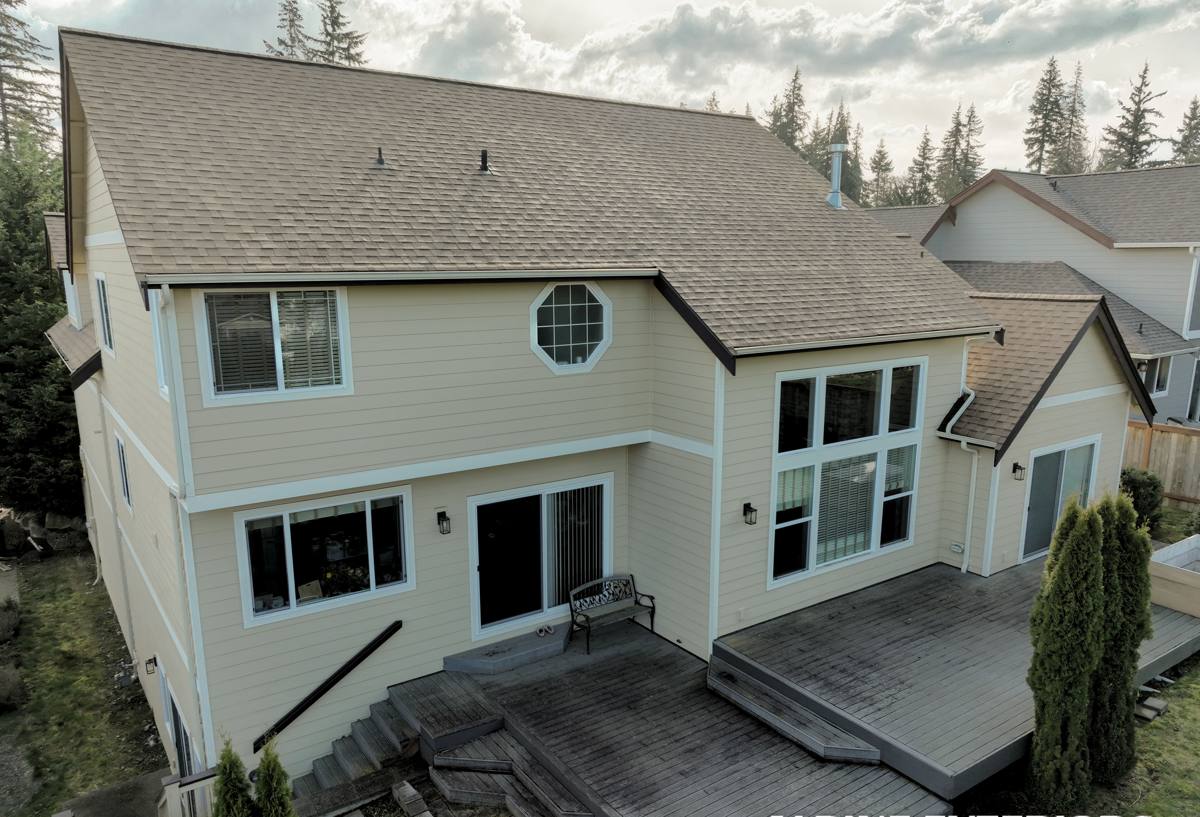
What Salt Air, Driving Rain, and Moss Season Actually Do to Windows
It helps to understand the specific ways this climate wears windows down, because it changes what "correct installation" actually means here.
Salt Air
Being this close to Puget Sound and the Strait of Georgia means the air carries fine salt particles, especially on windy days. Over years, that salt accelerates corrosion on metal hardware — hinges, locks, balance systems, screws — and it can degrade lower-grade weatherstripping and seals faster than an inland install would see. Vinyl and fiberglass frames hold up better against this than bare aluminum or unprotected wood.
Driving Rain
Storms off the water don't just fall straight down here — wind pushes rain sideways and up under trim, sills, and poorly sealed flashing. This is the single biggest cause of window-related water damage we see: not a bad window itself, but a window that wasn't flashed and sealed correctly for wind-driven rain. Water finds any gap and works its way behind the siding, where it can rot sheathing and framing long before anyone notices a problem inside.
Moss and Prolonged Dampness
Whatcom County's long moss season is usually talked about in the context of roofs, but the same conditions — cool temperatures, shade, and months of surface moisture — affect window sills, trim, and the caulking around frames. Organic growth on window exteriors traps moisture against wood trim and can accelerate rot if it isn't cleaned off and the sealant isn't kept in good condition.
What "Energy-Efficient" Actually Means for a Ferndale Window
Energy efficiency in a window comes down to a handful of measurable factors, not marketing language. The two numbers that matter most in this climate are U-factor (how well the window resists heat loss — lower is better) and SHGC, or Solar Heat Gain Coefficient (how much solar heat passes through the glass). In a marine climate like ours, where winters are damp and cool but summers are mild, a moderate SHGC with a strong U-factor is usually the right balance — you're not fighting brutal summer heat, but you are fighting months of heat loss and condensation risk.
Frame Material Matters as Much as the Glass
We get asked a lot whether frame material really makes a difference. In this climate, it does — mostly because of how each material handles sustained moisture and salt exposure over time.
| Frame Material | How It Handles This Climate | Maintenance |
|---|---|---|
| Vinyl | Doesn't corrode from salt air, won't rot; performs well in coastal, damp climates | Low — occasional cleaning |
| Fiberglass | Very stable in temperature and moisture swings, strong resistance to warping | Low — occasional cleaning |
| Wood / Wood-Clad | Good insulator but vulnerable to moisture and moss if seals or paint fail | Higher — regular sealing/painting |
| Aluminum | Prone to corrosion from salt air and conducts heat/cold readily | Moderate — watch for corrosion |
We're not saying wood or aluminum windows are bad products — plenty of homeowners like the look of wood-clad windows and are willing to keep up the maintenance. Our job is to be upfront about what each material asks of you here: wood-clad windows need someone staying on top of the exterior finish, or moisture will find the seams. Vinyl and fiberglass ask a lot less of you long-term, which is why we lean toward them for most Ferndale replacement projects.
Glass Packages
Double-pane windows with low-E coatings and argon or krypton gas fill are the standard for energy efficiency now, and they make sense for nearly every home here. Triple-pane is worth discussing for north-facing rooms or homes right along the water where wind exposure is highest, but it's a real cost jump and isn't necessary for every window in a house.
Signs Your Current Windows Are Losing the Fight
- Condensation forming between the panes (a sign the seal has failed, not something you can fix with cleaning)
- Fogging or a hazy film that won't wipe away
- Drafts you can feel near the frame, especially during windy, rainy weather
- Soft or discolored trim and sills, or paint that keeps failing in the same spot
- Windows that are hard to open, close, or lock — often a sign hardware has corroded
- Visible gaps or cracked caulking around the exterior frame
- Noticeably higher heating bills compared to similar homes nearby
Any one of these on its own might not mean much. Several of them together, especially on the side of the house that takes the worst weather, usually means the window's ability to manage moisture and air has broken down.
How a Correct Installation Works Here
The window itself only accounts for part of how well it performs. Installation quality — especially flashing and sealing — is what determines whether a good window actually keeps water out for the next twenty years.
Our process
- Assessment. We look at the existing window, the surrounding trim and siding, and check for any signs of water intrusion or rot before quoting the job.
- Removal. Old windows come out carefully so we can inspect the rough opening and framing underneath — this is often where hidden moisture damage shows up.
- Repair if needed. Any soft or damaged framing gets addressed before a new window goes in. Installing a new window over damaged framing just hides the problem.
- Flashing and weather barrier. This is the step that matters most for driving rain. Proper flashing tape and weather-resistant barrier integration route water away from the opening instead of letting it sit against the frame.
- Setting and sealing the window. The window is shimmed level and plumb, fastened per manufacturer spec, and sealed with exterior-grade sealant rated for sustained moisture exposure.
- Interior and exterior trim. Trim is finished and caulked to shed water, not trap it.
- Final check. We confirm the window operates smoothly and the seal is complete before we consider the job done.
Skipping or rushing the flashing step is the most common cause of window failures we're called out to fix on other people's installs. It's also the step that's invisible once the trim goes back on — which is exactly why it matters who's doing the work.
Choosing the Right Windows for a Ferndale Home
- Confirm the frame material fits your maintenance expectations, not just your budget
- Ask what U-factor and SHGC ratings the window carries, and whether they're appropriate for a marine climate
- Check that the glass package includes low-E coating and gas fill — not just double-pane glass alone
- Ask how the installer handles flashing and weather barrier integration, specifically
- Make sure hardware (locks, hinges, balances) is rated for coastal or corrosion-prone environments
- Get the warranty in writing — both the manufacturer's product warranty and the installer's labor warranty
- Ask about lead times, since window orders can take several weeks depending on size and style
What Affects the Cost
| Factor | Why It Changes the Price |
|---|---|
| Frame material | Vinyl is typically the most affordable; fiberglass and wood-clad cost more upfront |
| Window size and style | Larger openings, custom shapes, and operable styles (casement, awning) cost more than standard sliders or single-hungs |
| Glass package | Triple-pane and specialty coatings add cost over standard double-pane low-E |
| Condition of the opening | Rot repair or reframing adds labor beyond a straightforward swap |
| Number of windows | Whole-house replacements typically bring a better per-window rate than one-off replacements |
We won't quote a number here that means nothing without seeing your house — every home's mix of window sizes, styles, and condition is different. What we will say honestly: the cheapest window on the market is rarely the cheapest option once you account for how fast a poorly sealed or low-grade unit fails in this climate.
Why It Matters That We Already Work in Ferndale
A lot of window problems here trace back to installers who do good work in drier climates but don't adjust their approach for wind-driven rain and salt exposure. A crew that regularly works Ferndale and the broader Birch Bay area already knows which directions catch the worst weather on a given lot, what kind of flashing detail holds up through a real Whatcom County winter, and which materials are worth the extra cost versus which ones are just marketing. That local experience shows up in the details — the flashing lap, the sealant choice, the hardware spec — that you can't see once the job is finished but that determine whether it holds up.
We're not going to tell you every window on the market is wrong for this climate, or that one brand is the only right answer. What we will do is walk you through the real trade-offs for your specific home, be straight about maintenance expectations, and install the work the way this climate actually requires — not the way a generic install manual assumes.
If your windows are drafty, fogged, hard to operate, or just old enough that you're wondering, we're happy to take a look. Reach out for a free, no-pressure estimate — we'll walk the exterior with you, answer your questions honestly, and give you a clear picture of your options before you decide anything. The form below is the easiest way to get started.