 Birch Bay Roofing
 Why Sandy Point Siding Takes More Punishment Than People Expect
Sandy Point sits close enough to the water that salt air is part of daily life, not an occasional nuisance. Airborne salt settles on exterior surfaces, holds moisture against them, and accelerates corrosion on anything metal — fasteners, flashing, trim caps — that isn't rated for it. Add Whatcom County's driving rain, which tends to come in sideways off the Strait of Georgia during winter storms, and siding here has to shed water horizontally, not just vertically like a textbook installation assumes.
Then there's moss. The long, wet shoulder seasons in this part of Washington give moss and algae months to establish themselves on north-facing walls, under eaves, and anywhere sun doesn't reach. On the wrong siding material, that moss holds moisture against the surface for weeks at a time. Combined with salt exposure and wind-driven rain, that constant damp shade is what causes early paint failure, swelling, and rot at the bottom courses and around windows.
None of this is unique to any one house. It's the baseline condition for exterior materials anywhere near Birch Bay's shoreline, and it's the reason we treat a Sandy Point siding job differently than we would inland.
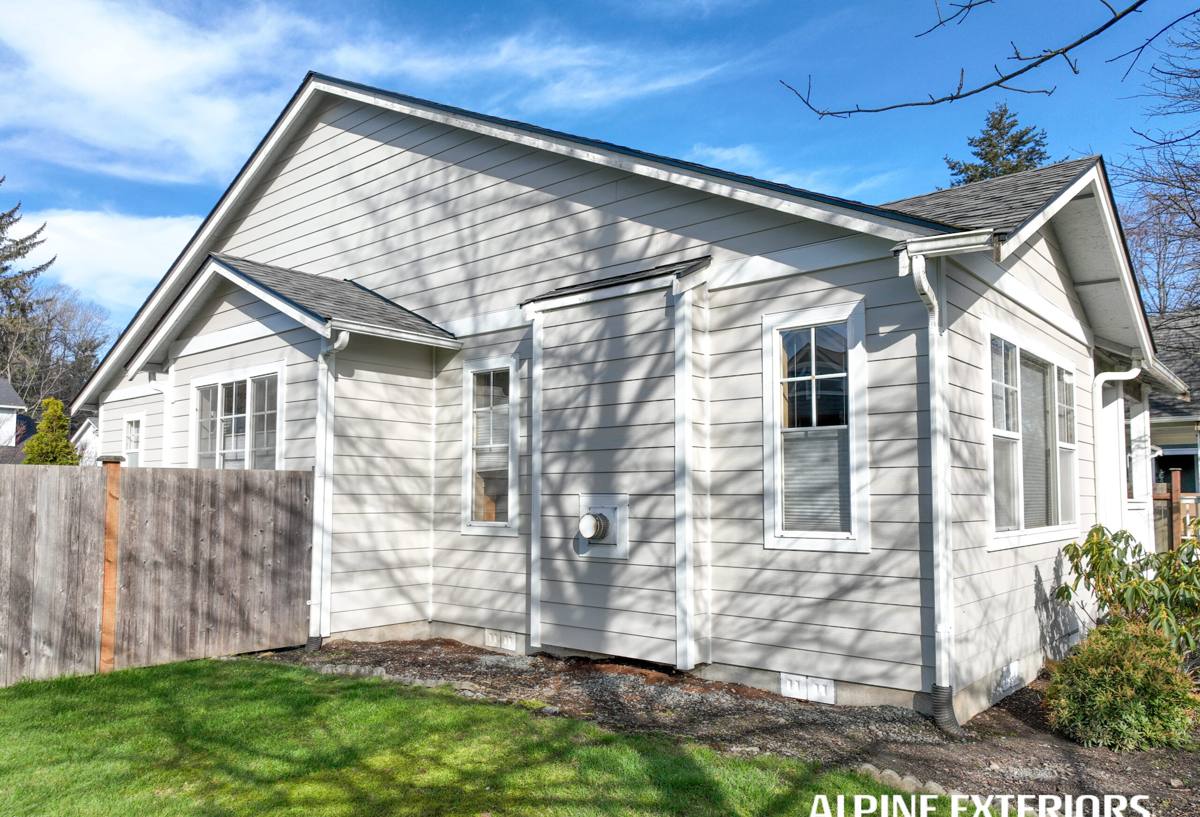
Why This Crew Installs Only James Hardie Fiber Cement
We don't install vinyl, LP SmartSide, Cemplank, Allura, primed spruce, or cedar. That's a deliberate standard, not a sales preference, and it's worth explaining honestly rather than just asserting it.
What the alternatives get right, and where they struggle here
Vinyl is inexpensive and low-maintenance in mild climates, but it expands and contracts with temperature swings, can crack in impact-prone spots, and its seams and butt joints give wind-driven rain more places to work its way behind the panel. Wood siding, cedar or primed spruce, looks great fresh and can be repainted almost any color, but it's the material most vulnerable to the exact conditions Sandy Point has in abundance: sustained moisture plus shade equals rot, and repainting every few years is a real, recurring cost. Engineered wood products like LP SmartSide resist some of wood's weaknesses but are still a wood-based substrate, meaning cut edges and fastener penetrations need to stay sealed or moisture will eventually find a way in.
Why James Hardie is what we put on homes instead
Fiber cement doesn't rot, doesn't attract insects, and won't ignite from an ember — a real consideration during dry summer stretches even in a generally wet region. James Hardie's ColorPlus finish is baked on at the factory under controlled conditions, which gives it more consistent adhesion and fade resistance than field-applied paint, and it comes with its own finish warranty separate from the product warranty. For our marine-exposure work we specify Hardie's HZ5 product line, engineered for wetter, harsher climates rather than the HZ10 formulation built for hot, dry regions — the plank itself is matched to the weather it has to survive, not a generic national spec.
What a Correct Installation Actually Involves
Fiber cement siding is only as good as the water management system installed behind it. A large share of siding failures we get called out to inspect, regardless of brand, trace back to installation shortcuts rather than the material itself.
The drainage plane comes first
Before a single plank goes up, the wall needs a weather-resistant barrier and, in most cases on a home this close to the water, a rain screen gap that lets any water that does get behind the siding drain and dry out instead of sitting against the sheathing. Skipping or shortcutting this step is the single most common cause of hidden rot behind siding that looks fine from the curb.
Fasteners and flashing rated for salt air
Standard galvanized fasteners corrode faster in a marine environment. We use fasteners and flashing components rated for coastal exposure, and we pay particular attention to flashing at every horizontal surface: window heads, door trim, deck ledgers, and roof-to-wall transitions, since that's where wind-driven rain gets forced upward and behind trim if the flashing detail is wrong.
Joints, gaps, and caulking done to spec
James Hardie's installation instructions specify exact gaps at butt joints, trim, and penetrations, along with which sealants are compatible with the ColorPlus finish. Caulking every seam solid isn't correct practice; the material needs to be able to move slightly with temperature changes, and some joints are designed to be back-primed and left with a controlled gap rather than sealed shut. Getting this wrong voids warranty coverage and creates trapped moisture, which is the opposite of what the rain screen was there to prevent.
Cost Factors on a Sandy Point Job
Every home is different, but the line items that actually move the price on a local James Hardie install are consistent. This isn't a quote; it's what to expect a contractor to walk through with you before one is written.
| Factor | Why It Matters Here |
|---|---|
| Tear-off vs. new construction | Removing failed siding, checking sheathing for hidden moisture damage, and disposal add labor a fresh install doesn't require |
| Sheathing and framing repair | Salt air and prior moss cycles sometimes mean soft sheathing or framing turns up once old siding comes off |
| Trim complexity | Homes with more windows, dormers, and roof-to-wall transitions need more flashing detail and labor time |
| Siding profile chosen | Lap siding, panel siding, and shingle-style Hardie products differ in material and install time |
| Color and finish | Factory ColorPlus finishes cost more up front than primed-for-paint boards but eliminate a repaint cycle |
| Site access | Waterfront and hillside lots around Birch Bay can limit staging and scaffolding options, affecting labor time |
Signs Your Current Siding Is Already Losing the Fight
Most siding failure in this climate is gradual, and homeowners often don't notice until it's visible from the street. Worth checking for before that point:
- Soft or spongy spots when you press on siding near the bottom courses or below windows
- Paint that's bubbling, peeling, or chalking heavily, especially on north- and west-facing walls
- Persistent moss or algae staining that comes back within weeks of cleaning
- Visible gaps, warping, or separation at butt joints and corner trim
- Rust streaking below nail heads or metal flashing
- A musty smell or staining on interior walls that share an exterior wall with heavy moss growth
- Siding that flexes or feels hollow when tapped, which can indicate rot in the substrate behind it
Any one of these on its own isn't necessarily an emergency, but a few together usually mean water has been getting behind the siding for a while.
How the Process Works, Start to Finish
Inspection and estimate
We walk the exterior, check for moisture damage at the usual failure points — sill areas, window heads, and roof-wall intersections — and give a straight assessment of what's actually needed versus what could wait. If there's hidden damage, we tell you before work starts, not after we've already opened up a wall.
Prep and tear-off
Old siding comes off, sheathing gets inspected and repaired where needed, and any compromised framing is addressed before anything new goes on. Covering a problem with new siding just delays it and makes the eventual repair more expensive.
Water management installation
Weather-resistant barrier, rain screen furring where called for, and flashing at every penetration and horizontal surface go in next. This stage doesn't show in the finished product, but it's the part that determines whether the siding lasts fifteen years or forty.
Hardie installation to manufacturer spec
Planks or panels go up with the correct fastener pattern, gaps, and trim details per James Hardie's published instructions for our climate zone — the steps that keep the manufacturer's warranty intact.
Final walkthrough
We go over the finished job with you, point out anything worth knowing for future maintenance, and make sure caulking, trim, and touch-up paint at cut edges are complete.
Maintenance in This Climate: What Actually Helps
James Hardie siding is low-maintenance, not no-maintenance, and the maintenance that matters most near Birch Bay is different from what a manual written for a dry inland climate would tell you.
- Rinse salt residue off exterior walls a couple of times a year, particularly walls facing the water
- Keep gutters clear so overflow doesn't run down the face of the siding and feed moss growth
- Trim back vegetation and tree limbs that shade walls and keep them damp longer than the rest of the house
- Address moss with a gentle wash rather than pressure-washing, which can force water behind laps and trim
- Recaulk trim joints if you notice gaps opening up, using a sealant compatible with ColorPlus finishes
Why a Crew That Already Works Sandy Point Matters
Marine-exposure siding work isn't a different product; it's the same James Hardie system installed with more attention to the details that matter in this specific environment: fastener corrosion resistance, flashing at every horizontal surface, and a drainage plane that can actually handle sideways rain. A crew that's done this repeatedly in Birch Bay and along the rest of the Whatcom County shoreline has already seen where the shortcuts show up years later, and builds around them from the start rather than learning it on your house.
James Hardie's product and finish warranties are also only as good as the installation behind them; improper fastening or flashing can void coverage regardless of the material's quality. Working with an installer familiar with the manufacturer's requirements for coastal exposure protects that warranty as much as it protects the wall behind the siding.
Ready for a Straight Answer on Your Siding
If you're not sure whether your current siding is holding up or just looking okay for now, a walk-around inspection will tell you more than guessing from the driveway. We'll give you an honest read on what's there, what James Hardie siding would involve for your specific home, and a free, no-pressure estimate using the form below.