 Birch Bay Roofing
 James Hardie Siding, Installed for Life on the Spit
Semiahmoo sits out on a narrow spit between Semiahmoo Bay and Drayton Harbor, at the edge of Blaine in the far northwest corner of Whatcom County. It's one of the more exposed residential settings in the county — water pressing in from more than one side, open wind with little to slow it down, and a marine climate that keeps siding wet more often than it keeps it dry. A siding job that holds up fine on a sheltered inland lot doesn't get the same free pass out here, and that's the reason this page exists: James Hardie fiber cement siding, installed specifically for what Semiahmoo's exposure does to a house.
We install James Hardie exclusively, on every home we side, in every part of Whatcom County we work. On Semiahmoo specifically, that choice matters more than it does in a lot of neighborhoods, because the gap between a correctly installed Hardie system and a corner-cut one shows up faster here — often within a single wet season — than it would on a more protected lot a few miles inland.
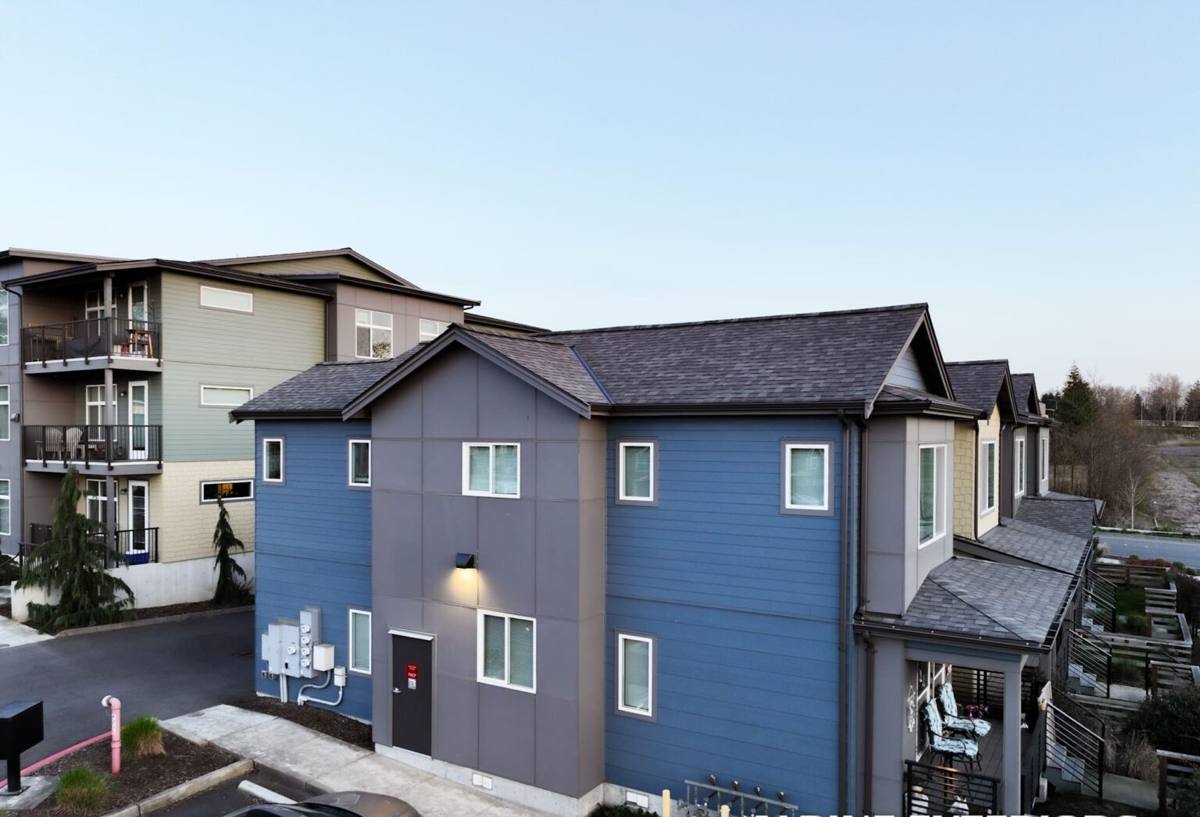
What Semiahmoo's Exposure Demands From a Siding System
Salt Air From More Than One Direction
Because the spit has water on more than one side, homes here take on salt-laden air from multiple directions instead of a single prevailing exposure. Salt accelerates corrosion in fasteners, flashing, and any exposed metal trim, and it wears down lower-quality finishes faster than a drier site would. On a siding job specifically, that means fastener grade and flashing material aren't cosmetic decisions — they're the difference between hardware that's still sound in twenty years and hardware that's rusting through in five.
Wind-Driven Rain With Little to Break It
With almost no windbreak, rain out here rarely falls straight down. It gets pushed sideways into siding joints, window and door flashing, and anywhere two building materials meet. That sideways pressure is what separates a wall assembly that's actually watertight from one that only looks watertight until the next windstorm. Board overlaps, caulked joints, and flashing laps that would be forgiving on a calm inland lot have to be built tighter here, because Semiahmoo's wind gives water a way in that a still day never would.
A Moss Season That Doesn't Really End
Mild temperatures and near-constant humidity add up to a moss and mildew season that runs most of the year across this stretch of Whatcom County. Shaded, north-facing walls are usually the first to show it. Any siding material that's even slightly porous becomes a growth surface over time, which is one more reason the material itself — not just the paint on top of it — needs to be dimensionally stable and resistant to moisture absorption.
Matching the Right Hardie Product Line to a Semiahmoo Home
James Hardie makes several siding profiles, and picking the right one is partly aesthetic and partly practical on a waterfront property.
- HardiePlank lap siding — the most common choice on Semiahmoo homes; horizontal overlapping boards shed wind-driven rain effectively when installed with correct overlap and fastening.
- HardiePanel vertical siding — often used on gables, dormers, or as a modern accent; fewer horizontal laps means fewer potential water-entry points on a wall section taking direct wind exposure.
- HardieShingle — used for a more traditional, textured look; more seams than plank siding, which means joint and flashing detail matters even more on an exposed elevation.
Why HZ5 Is the Right Formulation for This Location
We install Hardie's HZ5 product line on every home we side in the Pacific Northwest, including Semiahmoo. HZ5 is engineered for regions with heavy moisture exposure and freeze-thaw cycling, which describes this part of Whatcom County accurately. It's a different board formulation than Hardie's products for hot, humid, or arid climates — using the correct HZ line isn't a detail installers can skip or substitute without changing how the board performs against this exact climate.
What a Correct Installation Actually Involves
Fiber cement only performs the way it's engineered to when it's installed to Hardie's published specifications. On an exposed property like this, the installation details matter more than the product choice itself — a Hardie board installed loosely will still develop moisture problems in Semiahmoo's climate. Here's what we treat as non-negotiable on every install:
| Detail | Why It Matters on the Spit | What Correct Looks Like |
|---|---|---|
| Fastener type and spacing | Salt air corrodes undersized or wrong-grade fasteners faster here than inland | Corrosion-resistant fasteners at Hardie's specified spacing and depth, not "close enough" |
| Clearance from grade and roof lines | Standing water and splash-back add moisture load in an already wet climate | Minimum clearances held on every elevation, not just the street-facing wall |
| Drainage plane / rain-screen detailing | Wind-driven rain gets past the outer layer more often here than on sheltered lots | A drainage gap and clear path for incidental moisture to escape behind the siding |
| Joint treatment | Open or under-caulked joints are where wind-driven rain finds its way in first | Factory-mitered corners where possible; properly backer-rodded and caulked field joints elsewhere |
| Flashing at penetrations and transitions | Every penetration is a place water can travel past the siding plane | Correctly lapped, sequenced flashing at windows, doors, and roof-to-wall intersections |
None of this is exotic — it's Hardie's own installation spec, applied consistently. It matters more here than in some other places because Semiahmoo's exposure doesn't leave much room for a shortcut to go unnoticed. A gap in flashing or a missed clearance tends to announce itself faster on a wall taking direct wind and salt exposure than it would on a calm, tree-sheltered inland lot.
Our Process for a Semiahmoo Hardie Installation
- On-site assessment. We look at the existing siding or sheathing, note how the wall has handled moisture and salt exposure so far, and check for rot or damage that needs to be addressed before new material goes on.
- Written scope and product selection. We confirm product line, profile, and color, and put the full scope — including flashing and drainage details — in writing before anything is ordered.
- Tear-off and substrate prep. Old siding comes off, sheathing gets inspected and repaired where needed, and any existing moisture damage gets addressed rather than covered over.
- Weather-resistive barrier and drainage plane. This layer goes on correctly lapped and sealed before a single piece of Hardie board is hung, since it's the backup system if incidental moisture gets past the siding.
- Installation to spec. Fastening, clearances, joint treatment, and flashing follow Hardie's published requirements for HZ5 board, not a generalized "good enough" standard.
- Final walk-through. We go over the finished job with the homeowner, including where key flashing and drainage details are located, so there's a clear record of what's behind the finish.
What Drives Cost on a Semiahmoo Hardie Project
| Factor | What Drives It | Notes for This Location |
|---|---|---|
| Tear-off and disposal | Amount and type of existing siding being removed | Older wood or vinyl siding on waterfront homes sometimes hides moisture damage that adds prep work |
| Sheathing and substrate repair | Condition of the wall once old siding is off | More common on homes that have taken years of direct salt and wind exposure without a drainage plane |
| Product line and texture | Plank vs. panel vs. shingle, smooth vs. cedarmill | Shingle profiles add labor time for joint and flashing detail on exposed elevations |
| Home complexity | Number of gables, dormers, window and door openings | More penetrations means more flashing detail, which takes longer to do correctly |
| Access and site conditions | Multi-story walls, tight lot lines, staging space | Some Semiahmoo lots have limited staging room, which affects scheduling and equipment |
We give a firm, written estimate after the on-site assessment rather than a rough number over the phone, since the factors above vary enough from house to house that a phone quote isn't a real number.
Why a Crew That Already Works Semiahmoo Matters
A crew that regularly sides homes on this specific stretch of Whatcom County coastline already knows how salt air, open wind, and sustained moisture behave differently here than they do even a few miles inland in Blaine proper. That shows up in small decisions — which fastener grade gets used without being asked, where extra drainage detailing gets added even though it's not the cheapest option, how flashing gets sequenced at a window on a wall that takes direct wind. Those are exactly the details a crew installing here for the first time is most likely to underestimate, because they don't look different from a standard install until the first real storm tests them.
Before You Hire for a Hardie Installation on Semiahmoo
- Ask whether the crew installs James Hardie regularly, and ask them to walk through how they'd detail flashing on your specific home
- Confirm the written estimate includes drainage plane and rain-screen detailing, not just board and labor
- Ask what fastener type and spacing they use, and whether it's rated for coastal salt exposure
- Confirm current Washington contractor licensing and active liability insurance
- Get the full scope of work in writing, including product line, HZ formulation, and color, before signing anything
If you're weighing a James Hardie siding project on Semiahmoo, we're happy to walk the exterior with you and give an honest, specific read on what your home needs. Reach out below for a free, no-pressure estimate.