 Birch Bay Roofing
 Metal Roofing Built for Blaine's Coastal Climate
Blaine sits right on the water, just south of the Canadian border along Semiahmoo Bay and Drayton Harbor. That location gives homes a lot to love and a lot to deal with. Salt-laden air moves inland off the water year-round, wind-driven rain comes in sideways during winter storms, and the shaded, damp stretches of the year keep moss and algae active longer than they are further inland. A roof in Blaine isn't just shedding water — it's fighting corrosion, wind uplift, and organic growth at the same time.
Metal roofing handles that combination better than most materials when it's specified and installed correctly. It sheds water fast, resists wind far better than shingles, and doesn't give moss the same foothold that granulated asphalt does. But "metal roofing" covers a wide range of products and installation quality, and not every metal roof performs the same way two blocks from the water. This page covers what actually matters for a metal roof on a Blaine home — the materials, the details, and the process — not a generic overview.
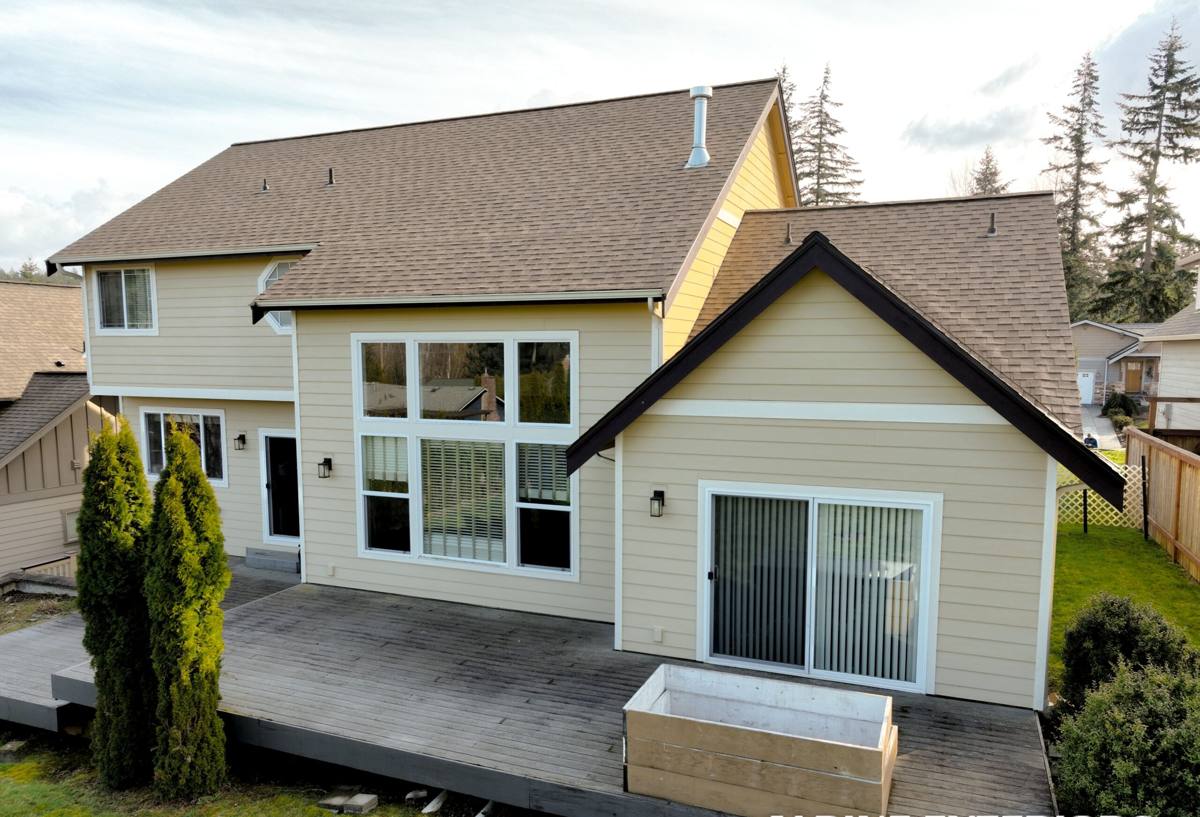
What Salt Air and Marine Exposure Do to a Roof Over Time
Homes near Semiahmoo Bay and Drayton Harbor sit in a corrosive microclimate compared to roofs even a few miles inland in Whatcom County. Airborne salt accelerates corrosion at any exposed metal edge, fastener, or scratch in a coating. It's not dramatic — it's slow, and it shows up years later as rust bleeding from screw heads, pitting at cut edges, or coating failure at panel seams that weren't detailed correctly.
This is why material choice and finish quality matter more here than on a roof set back from the water. A metal panel that would be perfectly fine on the east side of the county can underperform on a Blaine roof if the coating, fastener hardware, or flashing metal isn't matched to the exposure.
The three things salt exposure changes about the job
- Fastener and flashing metal should be corrosion-rated to match the panel — mixing incompatible metals at fasteners and flashings is where galvanic corrosion starts
- Cut edges and field-drilled holes need to be sealed and coated, not left bare, since exposed steel or aluminum at a cut edge corrodes first
- Coating quality (the paint system on the panel, not just the base metal) is a bigger factor in coastal exposure than in drier, inland areas
Panel Types and What We Actually Recommend for Blaine Homes
Homeowners usually come to us having heard "standing seam" and "metal roofing" used interchangeably, but they're not the same decision. The table below is how we walk Blaine homeowners through the real trade-offs.
| Option | How it's fastened | Best fit | Coastal consideration |
|---|---|---|---|
| Standing seam | Concealed clips, no exposed fasteners on the field of the panel | Full roof replacements, homes close to the water | Fewest penetration points for salt-driven corrosion to start; our default recommendation near Semiahmoo Bay and Drayton Harbor |
| Exposed-fastener panel | Screws through the panel face into the deck or purlins | Budget-conscious projects, outbuildings, shops | Fastener gaskets age and need inspection over time; more penetration points to maintain in a salt-air setting |
| Metal shingle / shake profile | Interlocking panels, concealed fasteners | Homes wanting a traditional look with metal's durability | Performs well if flashing detail at valleys and transitions is done correctly — that's where most failures start |
For most full roof replacements on Blaine homes, we lean toward standing seam specifically because it minimizes the number of exposed fasteners exposed to salt air. That's not a knock on exposed-fastener systems — they have a legitimate place on outbuildings and budget-driven projects — it's a maintenance and longevity call for a shoreline exposure.
What a Correct Metal Roof Installation Actually Involves
The panels get the attention, but panels are the easy part. Most metal roof problems we get called out to fix — anywhere in Whatcom County, not just Blaine — trace back to what's underneath and around the panels, not the panels themselves.
The details that determine whether a metal roof lasts
- Underlayment: a high-temp synthetic or self-adhered membrane rated for metal roofing, not a generic felt, especially at eaves and valleys where wind-driven rain pushes water uphill under the panel edge
- Deck condition: any soft, rotted, or moisture-damaged decking gets replaced before panels go down — sealing metal over a bad deck just hides the problem
- Ventilation: proper intake and exhaust venting so the attic space doesn't trap moisture against the underside of the deck, which is a bigger issue in our humid marine climate than in drier regions
- Flashing at penetrations and transitions: valleys, chimneys, vents, and wall-to-roof transitions are where nearly every roof leak actually starts, metal or otherwise
- Fastener spacing and clip selection: matched to the panel manufacturer's wind-load specs, which matters on a shoreline where sustained wind and gusts off the water are a real design load, not a theoretical one
We don't cut corners on the underlayment or flashing package to hit a lower number. On a coastal roof, that's exactly where a "cheaper" install turns into an expensive repair five or ten years out.
Moss, Algae, and Maintenance in a Long Moss Season
Whatcom County's moss season runs long — shaded, north-facing slopes and roofs near tree cover stay damp for months at a time. Metal roofing doesn't feed moss the way granulated asphalt shingles do, since there's no granule surface for spores to root into, but that doesn't mean a metal roof is maintenance-free.
Debris still collects in valleys and at panel-to-wall transitions, gutters still need clearing so water isn't backing up against panel edges, and any spot where organic debris sits wet against a seam for months at a time is worth checking. The maintenance burden on a well-installed metal roof is genuinely lower than shingles in this climate — it's just not zero.
Simple upkeep that protects a Blaine metal roof
- Clear gutters and valleys of needles and leaf debris at least once or twice a year
- Rinse off built-up salt film and grime periodically, especially on roofs with direct water-facing exposure
- Walk the roofline visually after major windstorms to check for lifted flashing or debris strikes
- Have penetrations and sealant points inspected every few years rather than waiting for a visible leak
Our Process for a Blaine Metal Roofing Project
The process is the same discipline we apply on every roof, adjusted for what a shoreline exposure demands.
- On-site assessment: we look at deck condition, existing ventilation, exposure direction relative to the water, and any signs of prior moisture or corrosion damage
- Material and system recommendation: panel profile, gauge, and coating matched to the home's exposure and the homeowner's budget — explained in plain terms, not a sales pitch
- Written estimate: scope, materials, and price broken out so you know what you're paying for and why
- Deck prep and underlayment: any damaged decking replaced, underlayment installed correctly at eaves, valleys, and penetrations before a single panel goes on
- Panel installation: fastener spacing and clip system per manufacturer spec, with attention to the coastal-specific details covered above
- Final walkthrough: we go over the finished roof with you, including what maintenance to expect and how to spot issues early
What Metal Roofing Costs and What Moves the Price
We won't quote a number without seeing the roof, but here's what actually drives cost on a metal roofing project so you're not guessing.
| Factor | Why it matters |
|---|---|
| Panel type and gauge | Standing seam typically costs more than exposed-fastener panel; heavier gauge costs more but resists denting and wind better |
| Roof complexity | Valleys, dormers, and multiple roof planes add labor and flashing detail — a simple gable roof is more straightforward than a cut-up roofline |
| Deck condition | Rot or soft decking found during tear-off adds material and labor to replace before installation continues |
| Coating and finish grade | Higher-grade coatings cost more up front and hold up longer against salt exposure — a real factor for shoreline homes |
| Tear-off vs. re-cover | Removing an existing roof versus installing over sound existing material (where code and roof condition allow) changes both cost and long-term performance |
Metal roofing typically costs more up front than asphalt shingles, but it's a longer-lived system with less recurring maintenance — worth weighing against your timeline for staying in the home.
Why a Crew That Already Works in Blaine Matters
A lot of what makes a metal roof succeed or fail near the water isn't in a manufacturer's install manual — it's judgment built from seeing how roofs actually age in this specific exposure. Knowing which details to over-build for wind, where salt corrosion shows up first, and how long moss season actually runs here comes from working Blaine and the surrounding Birch Bay and Whatcom County shoreline directly, not from a general contractor's playbook written for a different climate.
We're a local crew, which means when you call about a maintenance question three years after installation, you're talking to the people who know what's under your panels — not starting over with someone new.
Before you hire anyone for a metal roof near the water, check for:
- Manufacturer certification or documented training on the specific panel system being installed
- A written scope that specifies underlayment type, fastener/flashing metal compatibility, and ventilation plan — not just "metal roof installation"
- Local references or completed work in coastal Whatcom County, not just inland projects
- Clear answers about warranty coverage — what's covered by the manufacturer versus the installer
- Proper licensing and insurance, verifiable before work starts
If you're weighing metal roofing for a home in Blaine, we're happy to take a look and walk you through what your specific roof needs — no pressure, no hard sell. Use the form below to request a free estimate.