 Birch Bay Roofing
 Why Siding Wears Out Faster Near Cherry Point
Homes along the Cherry Point stretch of Whatcom County sit close enough to the water that siding takes a different kind of beating than it does further inland. The salt-laden air off the Strait of Georgia settles on exterior surfaces year-round, and it doesn't take a direct ocean view for it to matter — a fine mist of salt travels well past the shoreline on prevailing winds and slowly works on caulking, fasteners, and any siding material that isn't built to handle it.
Add to that the driving rain that comes through in fall and winter storms, often blown sideways into wall assemblies rather than falling straight down, and you've got a climate that punishes any weak point in a siding system: a gap in flashing, a caulk joint that's failed, a panel that was never properly sealed at the edge. Then there's the moss and algae season, which in this part of Whatcom County can run eight months or longer given the tree cover, humidity, and limited direct sun many lots get. Moss doesn't just look bad — it holds moisture against the siding surface, which accelerates rot in wood-based products and staining in almost anything.
None of this means Cherry Point homes need exotic materials. It means the materials and the installation details both have to be right for a marine-influenced Pacific Northwest climate, not just "good enough" for a drier region.
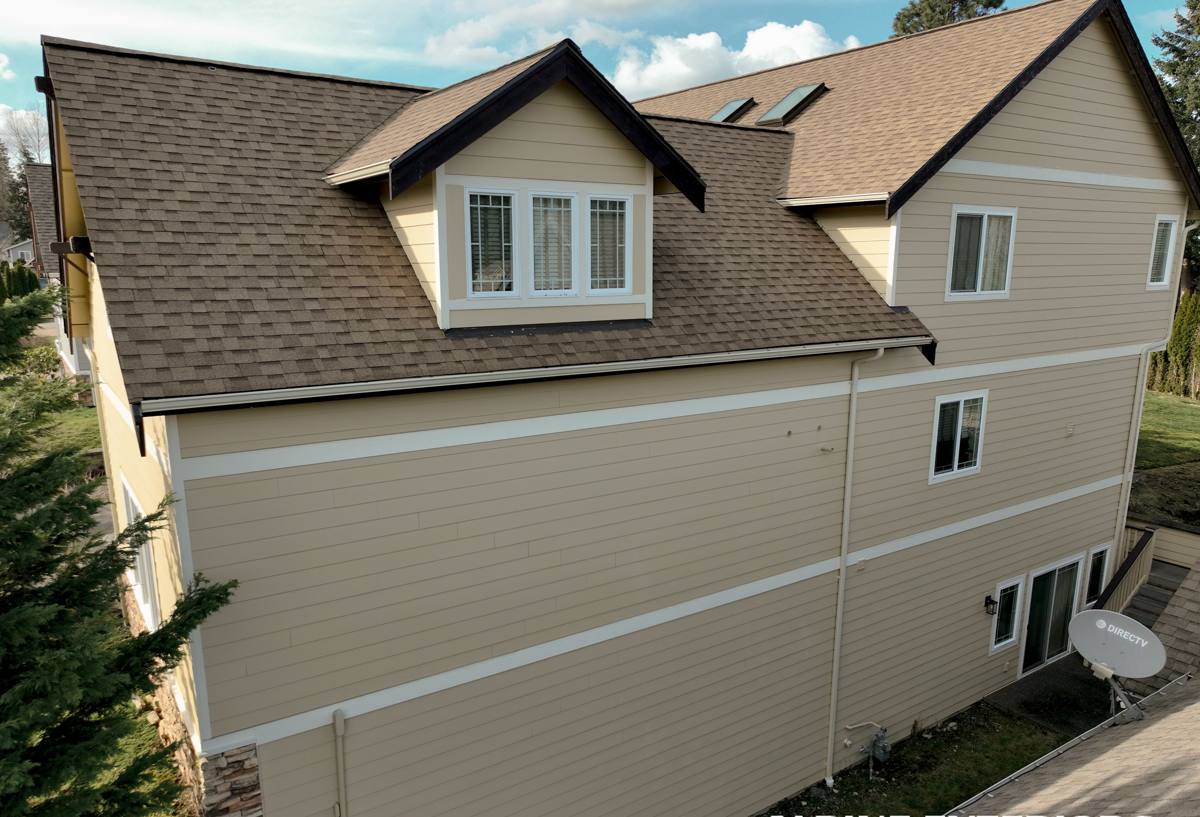
Signs Your Siding Needs Replacement, Not Just Repair
Not every siding problem calls for a full tear-off. But there's a point where patching stops making sense — where the labor and material cost of repeated repairs starts to rival replacement, and where the underlying wall assembly is at risk. Here's what tips a home from the repair column into the replacement column:
- Soft or spongy spots when you press on siding, especially near the bottom courses or around window and door trim
- Visible cracking, warping, or buckling across multiple sections rather than one isolated board
- Paint that won't hold anymore no matter how often it's redone — a sign the substrate underneath is failing
- Persistent moss or algae growth that returns within a season or two of cleaning
- Gaps opening up at seams, corners, or trim where caulking has pulled away repeatedly
- Any sign of moisture intrusion inside the home on exterior-facing walls — staining, musty smell, or soft drywall
- Siding that's simply reached the end of its practical service life, even if it hasn't failed outright yet
If you're seeing two or more of these, it's worth having someone look at the whole wall system rather than chasing individual spots.
Why We Only Install James Hardie Fiber Cement
We made a deliberate decision to install James Hardie fiber cement siding exclusively, and it's worth explaining why rather than just stating it. Fiber cement is non-combustible, which matters in a region where wildfire smoke and fire risk have become a bigger part of the conversation across Washington. It doesn't feed insects the way wood-based products can, and it holds paint and factory finish far longer than wood or vinyl because the material itself is dimensionally stable — it doesn't expand and contract with moisture and temperature the way wood does, and it doesn't soften or distort in heat the way vinyl can.
For a climate like Cherry Point's, that stability is the whole point. Hardie's HZ5 product line is specifically engineered for climates with higher moisture exposure and freeze-thaw cycling, which describes marine Whatcom County well. The factory-applied ColorPlus finish is baked on under controlled conditions rather than field-painted, which means better adhesion and color consistency over time — especially relevant somewhere that gets a real amount of rain exposure every single year.
We also value that Hardie backs its product with a strong, transferable limited warranty, which matters if you ever sell the home. We don't install LP SmartSide, vinyl, Cemplank, Allura, or primed wood siding. Each of those has legitimate uses in the right context, but they involve trade-offs — moisture sensitivity, maintenance burden, or installation tolerances — that we're not willing to install and then hand you the risk on. Hardie is what we put on homes because it's what we're willing to warranty our workmanship against.
What a Correct Siding Replacement Actually Involves
Fiber cement siding is only as good as what's underneath it and how it's installed. A rushed or corner-cutting install can undermine even the best material. Here's what a correct job includes, start to finish:
Tear-off and inspection
Old siding comes off in full, not patched around. This is the point where sheathing, framing, and any hidden moisture damage get exposed and assessed — which is often the most important part of the whole project, because it tells us what we're actually building on.
Weather-resistive barrier
A proper water-resistive barrier goes over the sheathing before any siding touches the wall. In a driving-rain climate, this layer is what keeps incidental moisture that gets past the siding from reaching the structure. It has to be installed with correct overlaps and sealed penetrations, not just stapled up quickly.
Flashing at every penetration
Windows, doors, hose bibs, vents, light fixtures — every place something punches through the wall plane needs flashing detailed to shed water outward, not trap it behind the siding. This is one of the most common places we find failures on homes we're replacing siding on.
Rainscreen or drainage gap where called for
Given how much rain this area sees, a drainage gap behind the siding — allowing any moisture that does get in to drain and dry out rather than sit against the wall — is a meaningful upgrade over a direct-to-sheathing install, especially on more exposed elevations.
Correct fastening and joint treatment
Hardie siding has specific fastener requirements — type, spacing, and depth — along with manufacturer-specified joint treatment at butt seams and corners. Installed off-spec, even the right material won't perform the way it's designed to.
Our Process for Cherry Point Homes
We start with an on-site inspection, not a phone estimate. Salt exposure, tree cover, sun exposure, and how exposed a given elevation is to prevailing wind and rain all factor into what we recommend for that specific house. From there:
- Walk the exterior with you and point out what we're seeing — problem areas, moisture risk, condition of trim and flashing
- Provide a written scope and estimate before any work starts, no pressure to decide on the spot
- Schedule tear-off and confirm what we expect to find once old siding comes off (and flag anything that changes the scope before we proceed)
- Install weather barrier, flashing, and Hardie siding to manufacturer spec
- Final walkthrough with you before we consider the job done
We don't sell a bigger job than a house needs, and we don't quote a smaller one than it actually requires once we've seen the sheathing underneath.
What Drives Cost
Every siding replacement is priced around the specifics of the house, but the same handful of factors move the number up or down on nearly every project:
| Factor | Why It Matters |
|---|---|
| Home size and wall complexity | More square footage and more corners, gables, and trim details mean more material and labor |
| Condition of the sheathing underneath | Rot or moisture damage found during tear-off adds repair scope before new siding can go on |
| Siding profile and trim selection | Lap width, trim style, and accent details affect both material cost and install time |
| Number of stories and access | Second-story and steep-lot homes require more scaffolding and time |
| Existing exterior condition | Full tear-off versus a wall that's already down to sheathing changes labor scope |
| Color and finish choice | Factory ColorPlus finishes come in a range of standard colors; custom field-painting adds cost |
We'll walk through all of this with you during the estimate so there aren't surprises once work starts — and we'll tell you plainly if we find something during tear-off that changes the picture, before we move forward with it.
Why Local Experience in Cherry Point Matters
A crew that's worked this specific stretch of Whatcom County knows things a generalist doesn't have to think about: how much wind-driven rain a west-facing wall near the water actually takes in a winter storm, how fast moss comes back on a shaded north elevation here versus a sunnier lot inland, and what flashing details tend to fail first on homes exposed to this kind of salt and moisture load. That's not something you learn from a manual — it's something you learn from doing the work on houses like yours, in this exact area, season after season.
It also means we're not guessing at permitting, local weather patterns, or how a given product line actually holds up here versus how it performs on a spec sheet written for a different climate. When we recommend HZ5 over a standard Hardie line, or flag an elevation that needs extra flashing attention, it's based on what we've actually seen hold up — and what hasn't — on homes near Cherry Point.
Protecting Your Investment After Installation
A correctly installed Hardie system is low-maintenance, but "low-maintenance" isn't "no-maintenance." A little attention keeps it performing the way it's designed to for the long haul:
- Rinse siding down once or twice a year to clear salt residue and organic buildup before it becomes a moss problem
- Keep gutters clear so overflow isn't running down the siding face during heavy rain
- Trim back vegetation and tree limbs that keep siding shaded and damp longer than it needs to be
- Inspect caulking at trim and penetrations every year or two and touch up as needed
- Address any impact damage or chipping promptly rather than letting moisture find its way in
If you're weighing whether your current siding still has life left in it or it's time to plan a replacement, we're glad to take a look and give you a straight answer either way. Reach out for a free, no-pressure estimate using the form below.