 Birch Bay Roofing
 When a Bellingham Home Needs Full Siding Replacement, Not Another Repair
Most siding jobs in Bellingham don't start as "let's replace the whole house." They start with a homeowner noticing one soft spot near a downspout, one section of paint that keeps bubbling no matter how many times it gets touched up, or one wall that just looks tired next to the rest of the house. Sometimes that's genuinely a repair. Often, once we're actually up on a ladder with a moisture meter, it turns out to be the first visible sign of something that's been happening under the surface for years across the whole exterior. Full replacement becomes the right call when the siding material itself has reached the end of what it can do — not because one board failed, but because the material class it belongs to has run out of road in this climate.
That distinction matters because replacing siding is a bigger decision than repairing it, in cost, disruption, and how long the result needs to last. We'd rather tell a Bellingham homeowner honestly that a section can be repaired than push a full replacement that isn't needed yet. But we'd also rather tell you the truth when patch-and-paint has stopped being a real fix and started being a way to delay a decision that's coming anyway.
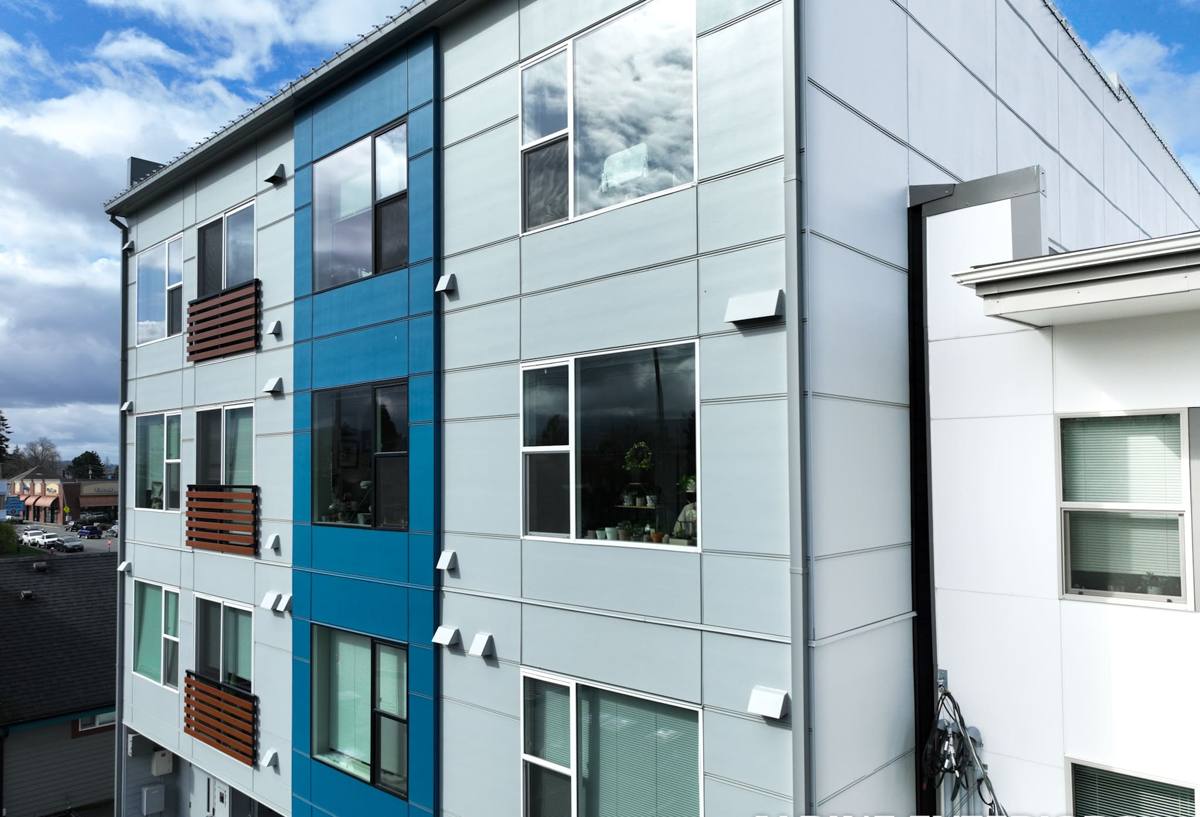
What Salt Air, Driving Rain, and a Long Moss Season Do to Old Siding
Salt-Laden Air and Slow Corrosion
Bellingham sits close enough to the water that salt-tinged marine air is a constant, low-grade stress on anything metal on the outside of a house — nail heads, flashing, trim fasteners, hose bib fittings. On older siding, especially wood-based products fastened decades ago with whatever hardware was standard at the time, that slow corrosion shows up as rust streaking down from fastener heads, loosened trim, and metal flashing that's thinned enough to stop doing its job even though it still looks intact from the ground.
Wind-Driven Rain Finding Old Seams
Rain here rarely falls straight down. Wind off the bay and the Salish Sea pushes it sideways into walls, which means every seam, joint, and butt end on a siding installation is under more pressure than it would be in a drier, calmer climate. A seam that was cut tight and caulked twenty years ago has almost certainly opened up by now — caulk shrinks, wood moves, and what was once a sealed joint becomes a small but steady point of entry every time it rains sideways, which in Bellingham is often.
A Moss Season That Runs Most of the Year
Shaded walls, tree-covered lots, and north-facing exposures in Whatcom County stay damp long after a sunnier climate would have dried out. That extended dampness is exactly what moss and mildew need, and on older siding it doesn't just look bad — it holds moisture against the material for extended stretches, which accelerates whatever decay process was already underway. By the time moss is visibly established on a wall, the siding underneath has usually been wet more often than it's been dry for a long time.
Repair or Replace? How We Actually Make That Call
We don't default to "replace everything" because it's a bigger job. We look at how much of the wall is still sound, how much has failed, and whether repairing the failed sections would actually solve the problem or just delay it a season or two.
| Situation | Usually Repair | Usually Full Replacement |
|---|---|---|
| Damage location | Isolated to one section or wall face | Spread across multiple walls or the whole exterior |
| Material condition | Sound material, isolated impact or fastener damage | Material itself is deteriorating (swelling, delaminating, soft throughout) |
| Moisture history | No sign of ongoing moisture intrusion behind the wall | Repeated staining, soft sheathing, or past patch jobs failing again |
| Age of siding | Well within its expected service life | At or past the age where this material typically starts failing here |
| Paint/finish condition | Holding up with normal maintenance | Chronic peeling or bubbling despite repainting |
When a home lands mostly in the right-hand column, replacement isn't us upselling a bigger job — it's us telling you that continuing to patch is spending money without buying you real time.
What's Usually Hiding Behind Old Siding Once It Comes Off
This is the part homeowners are rarely prepared for, and it's also the reason we treat tear-off as an inspection, not just demolition. Once old siding comes off a Bellingham wall, we're commonly looking at some combination of the following: sheathing that's gone soft or delaminated in spots where water has been getting behind the siding unnoticed, a water-resistive barrier that's torn, missing, or was never lapped correctly in the first place, insulation that's damp or compressed in the same areas, and framing that shows staining or early rot at sill plates and around window openings. None of that is visible from the outside. It only becomes visible once the old material is off the wall — which is exactly why a full replacement is also the point where problems that have been quietly developing for years finally get found and fixed, instead of getting covered over again.
How We Approach a Full Siding Replacement
Tear-Off and Wall Assessment
We remove the old siding wall by wall rather than stripping the whole house at once, which limits how much of the structure is exposed to weather at any given time — a real consideration in a climate where rain can show up with little warning. As material comes off, we assess the sheathing, framing, and existing water-resistive barrier underneath and flag anything that needs repair before new siding goes up.
Repairing What Tear-Off Reveals
Any soft sheathing, damaged framing, or compromised insulation gets addressed before the wall is closed back up. Installing new siding over an unrepaired wall just buries the same problem under new material, which defeats the point of a full replacement in the first place.
Rebuilding the Drainage Plane
A correctly lapped water-resistive barrier and a drainage gap behind the siding give any moisture that does get past the surface a way to dry out instead of sitting against the wall. This layer does more long-term work than the visible siding itself, and it's also the layer most likely to have been done wrong or skipped on an older installation.
Installing New James Hardie Siding to Spec
We install fiber cement siding to James Hardie's published requirements for this climate zone — correct fastener type and spacing, correct clearances at trim and grade, correctly flashed penetrations at every window, door, and utility fixture. These aren't optional refinements; they're the difference between siding that performs for decades and siding that starts showing the same problems the old material had, just on a newer timeline.
Trim, Flashing, and Final Finish
Corners, trim boards, and flashing at transitions get finished to match, and every field-cut edge is primed before installation since that's the one place the factory finish doesn't already cover. We walk the completed job with you before calling it done.
Signs Your Bellingham Home May Be Due for Siding Replacement
- Paint that keeps failing in the same spots no matter how many times it's redone
- Soft or spongy areas when you press on the siding, especially near the bottom of walls or under windows
- Visible warping, cupping, or separation at seams and butt joints
- Persistent moss or mildew staining that comes back shortly after cleaning
- Siding that's original to a home built more than a couple of decades ago
- Rising energy bills with no other obvious explanation, which can point to moisture-compromised insulation behind the siding
- Multiple past repairs to different sections rather than one isolated fix
One or two of these on their own might just mean a repair. Several at once, especially spread across more than one wall, usually mean the material has reached the point where full replacement is the more honest answer.
Cost Factors in a Bellingham Siding Replacement Project
Replacement costs more up front than a repair, but the number depends heavily on what's actually involved on your specific house, not just square footage.
| Factor | Why It Moves the Price |
|---|---|
| Tear-off and disposal | Old siding has to be removed and hauled away before new material goes on |
| Hidden repairs found underneath | Soft sheathing or framing damage found during tear-off needs fixing before re-siding |
| Wall complexity | More corners, dormers, and window openings mean more cutting, flashing, and detail work |
| Access and site conditions | Steep lots, tight setbacks, or limited access can add labor time |
| Siding profile chosen | Lap, shingle-style, and board and batten differ in material and labor per square foot |
| Trim and color selection | Custom trim details and premium factory finishes affect material cost |
We give real numbers off an actual walkthrough of your home rather than a rough estimate over the phone, because two Bellingham homes with the same square footage can land in very different places once wall condition and complexity are factored in.
Why a Crew That Already Works Bellingham Matters
Siding replacement is unforgiving of guesswork, and a crew that's done this work across Bellingham through more than one wet season has already learned things a generic install guide doesn't cover — which orientations on a given lot stay damp longest and need extra attention at the drainage plane, how much clearance actually holds up against wind-driven rain off the bay versus what a spec sheet assumes, and how tear-off scheduling has to work around a forecast that can turn on short notice. That local judgment doesn't show up as a line item on an estimate, but it's a real part of what separates a replacement that looks right on install day from one that still performs correctly ten and twenty years later. We're not driving in from out of the area to bid a job and move on — this is the climate and these are the streets we work in every week.
It also matters for something more practical: being reachable. If a question comes up two years after the job, or a windstorm knocks something loose, a local crew is the one that shows up, not a call center.
Ready When You Are
If your Bellingham home is showing some of the signs above, or you're just not sure yet whether you're looking at a repair or a full replacement, we're glad to come take a look. There's a form below — reach out and we'll set up a straightforward, no-pressure estimate and walk you through exactly what your home needs.