 Birch Bay Roofing
 Windows Built for Point Whitehorn's Weather, Not Just the Catalog
Point Whitehorn sits right up against the Strait of Georgia, and that proximity to open water shapes everything about how windows perform here. Homes catch salt-laden air off the water, long stretches of driving rain that comes in sideways during winter storms, and a moss season that stretches on for months in the shade of the fir and cedar cover common to this part of Whatcom County. A window that's rated fine on paper can still fail early here if it wasn't built, and installed, with this specific exposure in mind. When we talk about "energy-efficient windows" for a Point Whitehorn home, we're talking about a package: glass and frame performance that cuts heat loss, plus hardware and installation detailing that can actually survive the marine environment long enough for that efficiency to matter.
This page focuses specifically on window replacement and upgrades for Point Whitehorn properties — what the climate demands, what a correct install looks like, and how we handle the job from first look to final walk-through.
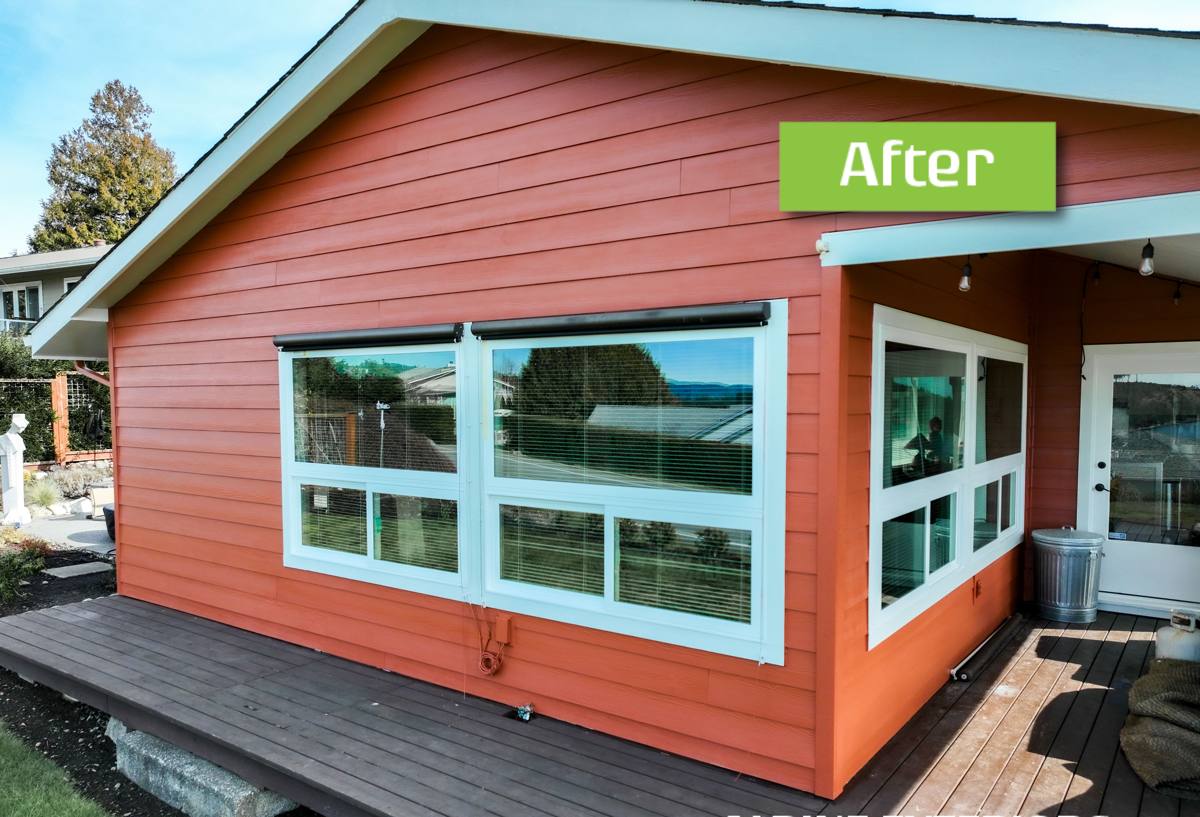
Why Windows Take Extra Abuse Out Here
Salt Air and Hardware Corrosion
Airborne salt from the Strait accelerates corrosion on window hardware — hinges, locks, balance mechanisms, and screws — faster than it does even a few miles inland. Cheap or mismatched fasteners and hardware are usually the first thing to fail on a coastal-exposed window, well before the glass or frame shows any wear. This is one of the biggest, and most overlooked, differences between a window that's "rated for coastal use" and one that's actually detailed for it.
Wind-Driven Rain
Storms coming off the water push rain horizontally into west- and northwest-facing walls, which means water is testing your window seals and flashing far more aggressively than a still, straight-down rain would. A window and installation that would be perfectly adequate in a sheltered inland neighborhood can leak here if the flashing details weren't built for wind-driven exposure.
The Long Moss and Moisture Season
Whatcom County's wet season runs long, and shaded, tree-covered lots — common around Point Whitehorn — stay damp for extended stretches. That prolonged moisture exposure is hard on wood trim, sill areas, and any seal or sealant that wasn't rated for sustained wet conditions. It's also what drives moss and organic growth around window perimeters, which traps moisture against the frame if it isn't cleaned off.
What "Energy-Efficient" Actually Means for a Home Like Yours
Energy efficiency in a window comes down to a handful of measurable factors, and all of them interact with our climate differently than they would in a dry or hot-summer region.
- U-factor — measures how well the window resists heat loss. Lower is better, and it matters more here than solar heat gain, since our climate is defined by cool, wet stretches rather than intense sun.
- Low-E glass coatings — microscopically thin coatings that reduce heat transfer through the glass without noticeably darkening the view. These help keep heat inside during our long heating season.
- Gas fill (typically argon) — sealed between panes to reduce heat transfer compared to plain air. This only stays effective as long as the seal holds, which is why seal quality matters as much as the gas itself.
- Frame material — affects both insulation value and how the window holds up to salt air and moisture over time.
- Air infiltration rating — how much air leaks around a closed window. In a windy, exposed location, a poor infiltration rating shows up fast as a draft you can feel.
Frame Material Comparison for Coastal Whatcom County
| Frame Type | Insulation Performance | Salt Air / Moisture Behavior | Maintenance |
|---|---|---|---|
| Vinyl | Good, consistent | Won't corrode or rot; hardware still needs to be marine-rated | Low — occasional cleaning |
| Fiberglass | Very good, dimensionally stable | Excellent resistance to moisture and salt exposure | Low |
| Wood / Wood-clad | Very good | Vulnerable at exposed edges and end grain if finish isn't maintained | Higher — periodic refinishing |
| Aluminum | Weaker unless thermally broken | Prone to corrosion pitting near salt air over time | Moderate |
We don't push one material as universally "best." The right choice depends on your home's exposure to wind and salt, your budget, and how much upkeep you want to take on. What we won't do is install a frame material or hardware package that we know is a poor match for a Point Whitehorn exposure just because it's cheaper up front — that's a decision we'll walk you through honestly, not make for you silently.
The Install Is What Actually Determines Performance Here
A high-efficiency window with a poor installation will underperform a modest window installed correctly — and that gap is bigger in a wind-driven-rain climate than almost anywhere else. Most window failures we see in this area trace back to installation detailing, not the window unit itself.
What a Correct Install Includes
- Removing the old unit and inspecting the rough opening and sill for hidden rot or water staining before anything new goes in
- Correct flashing sequence — sill pan, jamb flashing, and head flashing layered so water is always directed outward and down, never trapped behind the window
- Proper sealant selection and placement, with weep paths left open so any incidental water can drain instead of pooling
- Shimming and fastening to the manufacturer's specification so the frame isn't racked, which is a common cause of premature seal failure
- Insulating the gap between the window frame and rough opening — a step that's easy to skip and directly affects both efficiency and moisture control
- Interior and exterior trim work sealed and finished to shed water, not just for appearance
Skipping or rushing any one of these steps is how a brand-new, well-rated window ends up with a moisture problem inside two or three wet seasons.
Signs Your Current Windows Are Underperforming
Homeowners often assume window trouble will show up as an obvious leak. In practice, the early signs are quieter.
- A noticeable draft near the window frame even when it's fully latched
- Condensation or fogging between the panes — a sign the seal has failed and the gas fill is gone
- Difficulty opening, closing, or locking, especially on older aluminum or poorly maintained wood units
- Visible corrosion or staining on hardware, hinges, or locks
- Soft or discolored trim, sill, or drywall near the window
- Moss or dark streaking building up on the exterior sill or lower frame
- Rooms near exterior-facing windows feeling noticeably colder or draftier than the rest of the house
Any one of these on its own isn't necessarily urgent, but if you're seeing two or more on the same window, it's worth having it looked at before the next wet season.
How We Approach a Point Whitehorn Window Project
1. On-Site Assessment
We look at each window's exposure individually — a window on a wind-exposed, water-facing wall gets evaluated differently than one tucked under an eave on a sheltered side. We also check the condition of the existing framing and sill, since that affects what prep work is needed.
2. Product and Package Selection
We walk you through frame material, glass package, and hardware options based on your home's specific exposure and your budget — not a one-size list. If a lower-cost option is genuinely adequate for a sheltered opening, we'll say so.
3. Installation
Old units are removed carefully, the opening is inspected and repaired if needed, and the new window goes in with full flashing and sealing detail — not just caulk around the edge.
4. Final Check and Cleanup
We check operation, seal integrity, and trim finish before we consider the job done, and we clean up the work area fully.
What It Costs — and What Drives the Range
Every project is different, but a few factors consistently move the price up or down more than anything else.
| Cost Factor | Why It Matters |
|---|---|
| Frame material chosen | Fiberglass and higher-end wood-clad units cost more than standard vinyl |
| Number and size of openings | Larger and more numerous windows scale cost directly |
| Condition of the existing rough opening | Hidden rot or water damage found during removal adds repair work |
| Exposure level of the wall | Wind- and water-facing walls may call for upgraded flashing and hardware detail |
| Access and site conditions | Upper-story or hard-to-access windows take more time and equipment |
We give straightforward, itemized estimates so you can see exactly what you're paying for and why — no vague lump-sum numbers.
Why a Crew That Already Works Point Whitehorn Matters
A contractor who mostly works drier, more sheltered inland neighborhoods can still do competent general carpentry, but they may not default to the flashing sequence, sealant choice, or hardware spec that a wind-driven-rain, salt-air exposure actually requires — because they haven't had to solve for it as often. Working this stretch of Whatcom County regularly means we've seen how windows age here specifically: where moss builds up, which sills take the worst of the weather, and which shortcuts show up as callbacks two winters later. That experience shapes the products we recommend and the way we detail every install, not just for Point Whitehorn but across Birch Bay and the surrounding coastline.
Maintenance That Extends the Life of Your Investment
Even a correctly installed, well-built window benefits from basic upkeep in this climate. A little attention twice a year goes a long way:
- Rinse salt residue and debris off frames and glass periodically, especially on wind-exposed walls
- Clear moss and organic buildup from sills and lower frame edges before it holds moisture against the surface
- Check and lightly lubricate hardware — locks, hinges, and balance mechanisms — to slow corrosion
- Inspect exterior caulking and trim seals each fall before the wet season sets in, and touch up as needed
- Watch for condensation between panes, which signals a failed seal worth addressing before it worsens
If you're noticing drafts, fogged glass, sticking hardware, or you're simply overdue for a look at how your windows are holding up against the weather out here, we're happy to take a look. Fill out the form below for a free, no-pressure estimate — we'll assess your specific exposure and give you an honest read on what your home actually needs.