 Birch Bay Roofing
 Why Metal Roofing Makes Sense in Birch Bay Village
Homes in Birch Bay Village sit close enough to the water that the roof takes a different kind of beating than a house ten miles inland. Salt-laden air moves off Birch Bay and settles on every exposed surface, wind-driven rain gets pushed sideways under poorly lapped flashing, and the long, damp shoulder seasons common to Whatcom County give moss and algae months at a time to get established on anything that stays wet. A roofing material that shrugs off standing water, sheds debris instead of trapping it, and doesn't rely on organic material (like the asphalt in a shingle) that moss can feed on has a real advantage here.
Metal roofing isn't the right fit for every home or every budget, but for Birch Bay Village properties dealing with salt exposure, moss pressure, and heavy seasonal rain, it solves problems that shingles and even quality composite products eventually run into. This page covers what that actually looks like in practice — the materials, the installation details that matter in a marine environment, and what our process looks like from first inspection to final walkthrough.
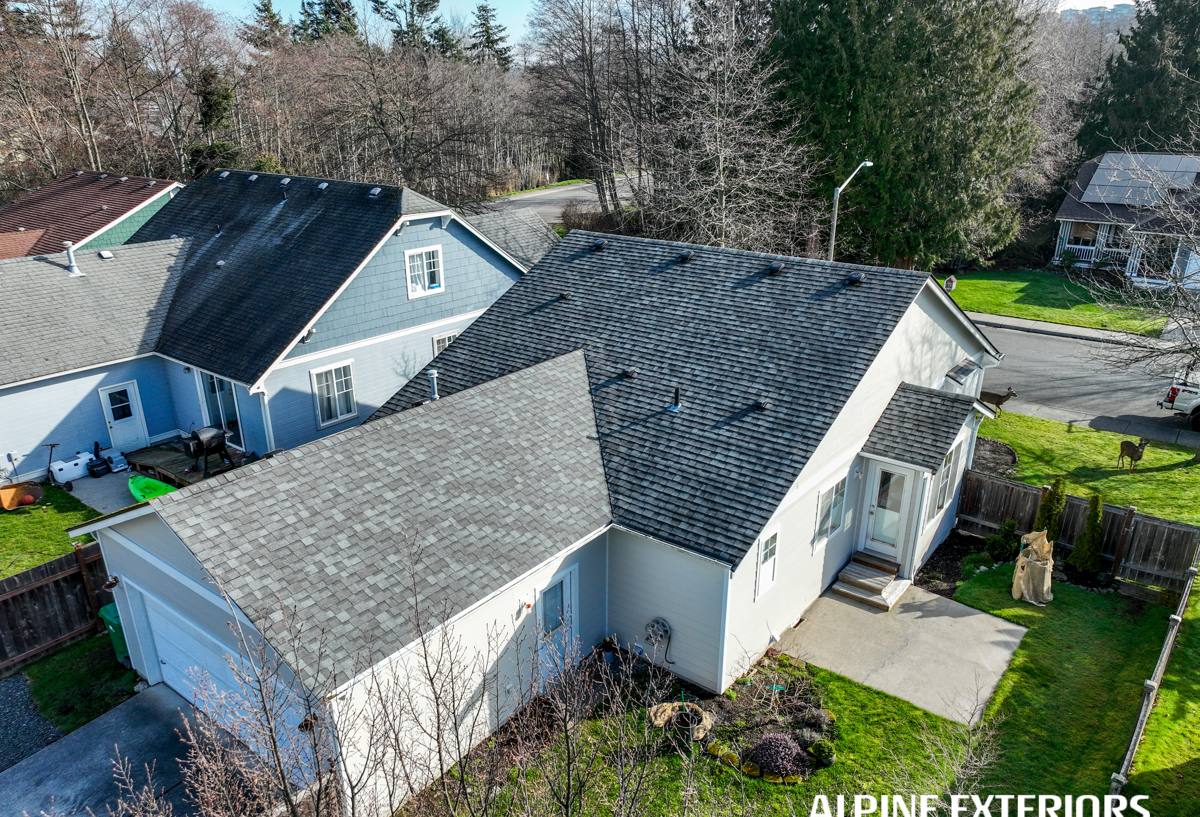
What Coastal Conditions Demand From a Metal Roof
Not all metal roofing is built the same, and the difference matters more here than it would on a home twenty minutes inland. Salt air is corrosive, and a roof that isn't specified correctly for a marine environment can start showing white rust, fastener bleed, or coating breakdown well before it should.
Coatings and Finishes
The paint or coating system on a metal panel is what actually stands between the base metal and the salt air, so it's not a place to cut corners. A quality baked-on finish resists chalking and fading and gives the panel real corrosion resistance over decades, not just a few good-looking years. We steer homeowners toward finishes with a track record in coastal Pacific Northwest conditions rather than the cheapest coil stock available, because the cost difference up front is small compared to what an early recoat or repaint would run.
Fasteners and Flashing Metal
Fasteners are one of the most overlooked failure points on a metal roof near the water. Standard galvanized screws can corrode faster than the panels themselves, streak the finish, and eventually loosen. We use fasteners and flashing metals matched to the panel material specifically to avoid galvanic corrosion — mixing incompatible metals (say, an uncoated steel fastener against an aluminum panel) sets up a reaction that eats away at one of the two metals over time. It's a detail that's invisible on installation day and very visible five years later if it's done wrong.
Standing Seam vs. Exposed-Fastener Panels
Most homeowners in Birch Bay Village end up choosing between standing seam panels and exposed-fastener (screw-down) panels. Both are legitimate metal roofing systems, but they behave differently in a wet, salty, wind-exposed setting, and the right choice depends on budget, roof pitch, and how long you want to go before any maintenance is needed.
| Factor | Standing Seam | Exposed-Fastener |
|---|---|---|
| Fasteners | Hidden, clipped beneath the panel seams | Visible screws driven through the panel face |
| Water resistance | Excellent — seams interlock above the waterline | Good, but relies on screw gaskets that wear over time |
| Maintenance | Minimal; no exposed fasteners to re-tighten or reseal | Gaskets and fastener seals should be checked periodically |
| Upfront cost | Higher | Lower |
| Best fit | Waterfront and wind-exposed roofs, low-slope sections | Detached structures, budget-conscious projects, steeper roofs |
For homes directly exposed to wind coming off the water, we generally recommend standing seam. The lack of exposed fasteners removes the single most common long-term maintenance item on a metal roof, and in a climate that already asks a lot of every penetration and seam, that matters. Exposed-fastener panels are still a sound, durable choice for detached garages, shops, or budget-driven projects — they just come with a maintenance schedule that a homeowner needs to actually keep up with.
The Installation Details That Actually Matter Here
A metal roof is only as good as the details underneath and around it. Most of the problems we get called out to fix on metal roofs in coastal Whatcom County trace back to a handful of installation shortcuts, not the panels themselves.
Underlayment and Ice-and-Water Protection
Even a well-installed metal roof needs a synthetic underlayment underneath capable of handling wind-driven rain that gets past the panel seams during a storm. Eaves, valleys, and any low-slope section get self-adhering ice-and-water membrane, since these are the spots where standing water and wind pressure are most likely to force moisture backward under the panels.
Flashing at Every Penetration
Chimneys, vents, skylights, and wall-to-roof transitions are where nearly every roof leak originates, metal or otherwise. Each penetration gets custom-formed flashing sealed and lapped correctly for water to shed downhill in every condition, not just a straight-down rain. On a property exposed to sideways rain off the water, flashing quality is often the difference between a roof that performs for decades and one that develops slow leaks within a few years.
Ventilation
Metal roofs need a ventilated air space to perform well — without it, condensation can form on the underside of the panels in cold, damp weather and cause deck rot from the inside out. We check existing attic and roof ventilation on every metal roofing project and correct it where it's inadequate, rather than installing a beautiful roof over a ventilation problem that will cause damage no one sees until it's expensive.
Our Process for a Birch Bay Village Metal Roof
- Inspection and assessment — We walk the roof and attic, check existing ventilation, note any deck damage, and evaluate how exposed the property is to wind and salt spray.
- Material and system selection — Based on that assessment, we recommend a panel type, gauge, and coating suited to the home's exposure and the homeowner's budget, and walk through the standing seam vs. exposed-fastener tradeoffs directly.
- Tear-off and deck preparation — Old roofing is removed, the deck is inspected and repaired as needed, and any ventilation corrections are made before anything new goes down.
- Underlayment and flashing installation — Ice-and-water membrane goes down at eaves, valleys, and low-slope areas, followed by synthetic underlayment and properly formed flashing at every penetration.
- Panel installation — Panels are installed with fasteners matched to the panel metal to prevent galvanic corrosion, with attention to consistent seam alignment and proper overlap.
- Final walkthrough — We review the completed roof with the homeowner, confirm the site is cleaned up, and go over what maintenance, if any, the chosen system requires.
Cost Factors to Expect
Metal roofing costs more upfront than asphalt shingles, and the final number depends on several variables specific to the home. Rather than quote a single number that won't apply to most roofs, here are the factors that move the price up or down.
| Factor | Effect on Cost |
|---|---|
| Panel system (exposed-fastener vs. standing seam) | Standing seam typically runs higher due to labor and hidden-clip hardware |
| Panel material (steel vs. aluminum) | Aluminum resists salt corrosion well and can command a premium over coated steel |
| Roof complexity | More valleys, penetrations, and roof planes mean more flashing labor |
| Deck condition | Rot or damage found during tear-off adds repair costs before installation |
| Ventilation corrections | Adding or upgrading attic ventilation adds modest cost but protects the investment |
| Tear-off scope | Removing multiple layers of old roofing costs more than a single-layer tear-off |
We give a firm, itemized number after the inspection — not a rough phone estimate — because guessing on any of these factors either lowballs the homeowner or pads the price to cover unknowns. Neither is fair to you.
Living With a Metal Roof in Birch Bay Village
One of the real advantages of a correctly installed metal roof is how little it asks of you afterward, but "little" isn't "none." A short annual check catches small issues before Birch Bay's wet winters turn them into bigger ones.
- Clear needles, leaves, and debris from valleys and around penetrations so water keeps moving instead of pooling
- Check gutters and downspouts, since a clogged gutter can back water up under the drip edge
- Look for any moss or algae growth in shaded, north-facing sections and remove it gently — metal resists growth far better than shingles, but shaded areas can still collect organic debris that holds moisture
- Inspect exposed fasteners (if you have a screw-down system) every year or two, and re-seat or replace any with worn gaskets
- Watch for any staining or streaking near fasteners or flashing, which can signal an early corrosion issue worth catching before it spreads
None of this requires a specialist visit every year — most of it is a homeowner with a pair of binoculars and a ladder on a dry afternoon. We're happy to do a periodic check for clients who'd rather not get on the roof themselves.
Why Local Experience in Birch Bay Village Matters
A metal roof installed by a crew unfamiliar with marine exposure can look identical to one built for it — until the fasteners start bleeding rust or a flashing detail that works fine inland lets wind-driven rain through during a real Birch Bay storm. We work on homes throughout Birch Bay Village and the surrounding Birch Bay area regularly, so the coastal-specific decisions — fastener compatibility, coating selection, flashing details built for sideways rain, ventilation sized for a damp climate — aren't an afterthought. They're built into how we spec and install every metal roof in this area from the start.
We also know what it's like to have a roofing crew show up, disappear, and leave you chasing them for a warranty callback. We stay reachable after the job is done, and because we're local, a follow-up visit isn't a special trip — it's just part of doing business in the community we work in.
If you're weighing a metal roof for your Birch Bay Village home, we're glad to take a look and walk you through what makes sense for your specific roof, your budget, and how exposed your property is to wind and salt air. Use the form below to request a free, no-pressure estimate.