 Birch Bay Roofing
 Cherry Point's Siding Problem Isn't Like Other Neighborhoods
Cherry Point sits close enough to the water that homes there deal with a combination most inland Whatcom County properties never see: salt-laden air moving off the Strait, driving rain that comes in sideways during winter storms, and a moss season that can run nearly eight months out of the year in shaded, north-facing exposures. Any one of those on its own is manageable. Together, they shorten the life of the wrong siding material fast.
Salt air is corrosive to exposed metal fasteners and hardware, and it accelerates the breakdown of lower-grade paint finishes long before they'd fail somewhere drier. Driving rain doesn't just wet a wall surface — it gets pushed and pulled through gaps, laps, and poorly sealed penetrations that would stay dry in a calmer climate. And moss doesn't just sit on a roof; airborne spores land on siding too, and once they take hold in a damp, shaded corner of a house they hold moisture against the wall surface around the clock.
This page is specifically about fiber cement siding for homes in the Cherry Point area of Birch Bay — not a general siding overview. If you live here, your siding is fighting a slightly different battle than a house ten miles inland, and the material and installation details below reflect that.
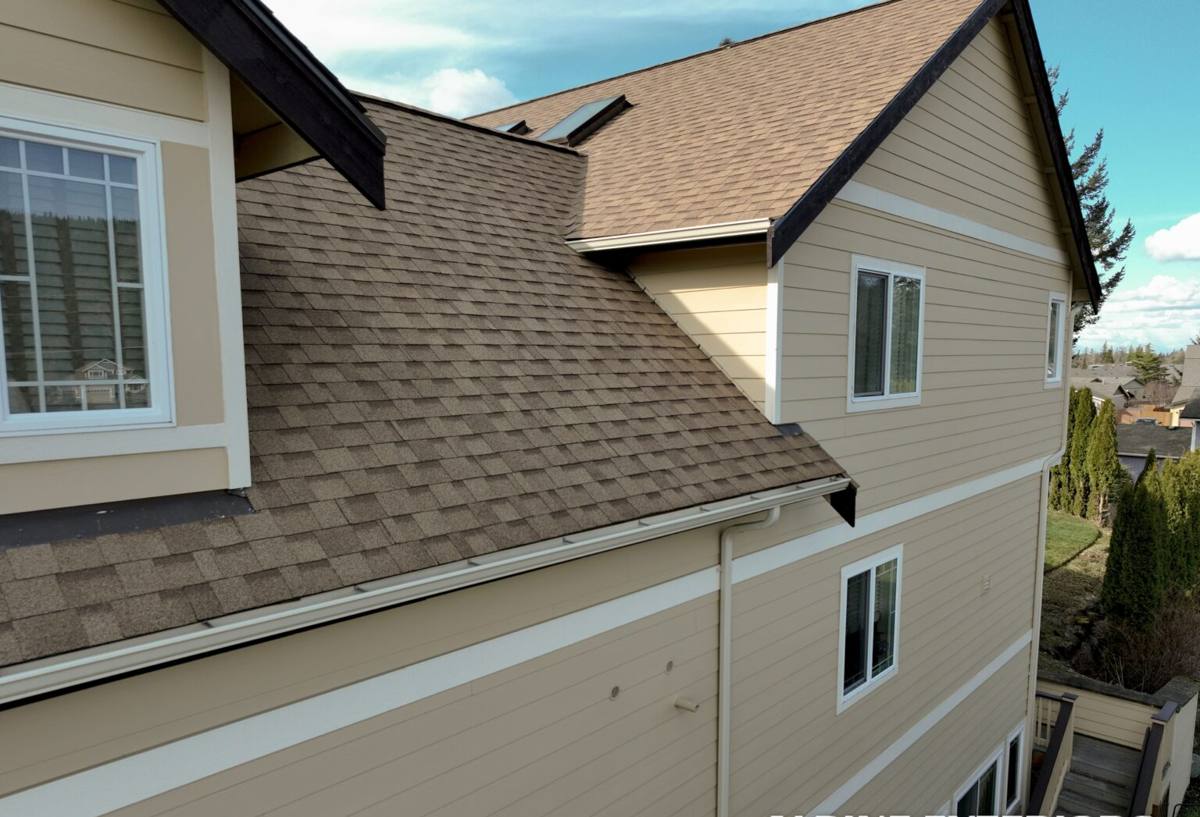
What Fiber Cement Is Actually Built to Handle
Fiber cement siding is a cement, sand, and cellulose fiber composite, manufactured under pressure and cured to be dimensionally stable. Unlike wood-based siding products, it doesn't swell, warp, or delaminate when it takes on moisture, and it isn't a food source for the fungal growth that drives moss and mildew problems. That combination — dimensional stability plus resistance to organic growth — is exactly what a Cherry Point exterior needs.
Why This Matters More Near the Water
Wood-based composite sidings rely on factory sealants and edge treatments to keep moisture out. In a marine environment, those edges are under near-constant assault from humidity and wind-driven rain, and once moisture gets past a compromised edge, swelling and softening can spread under the paint film where you can't see it happening. Fiber cement doesn't have that failure mode. It's also non-combustible, which matters to insurers and to homeowners thinking about wildfire exposure during the region's drier summer stretches.
Why We Install Only James Hardie — Not Other Fiber Cement Brands
Fiber cement as a category is sound, but not every fiber cement product is engineered, finished, or backed the same way. We standardized on James Hardie products exclusively because of how they're formulated for specific climates and how the factory finish is warrantied — details that matter a lot in a salt-air, high-rainfall setting like Birch Bay.
HZ5 Climate Engineering
James Hardie's HZ5 product line is engineered for regions with significant moisture exposure, including coastal Pacific Northwest conditions. It's formulated to resist moisture intrusion and cracking in wet, humid climates rather than being a one-size-fits-all product shipped to every region the same way.
ColorPlus Factory Finish
Most on-site painted siding starts breaking down at the film level within a handful of years in a marine climate, especially on south and west-facing walls that take direct salt spray and UV. ColorPlus is a factory-applied, baked-on finish that's substantially more resistant to fading and moisture-driven film failure than field-applied paint, and it comes with its own finish warranty separate from the substrate warranty. For a Cherry Point home repainting every few years just isn't a realistic long-term maintenance plan we want to sell someone.
What We Don't Install, and Why
We don't install vinyl, LP SmartSide, cedar, primed spruce, Cemplank, or Allura. Vinyl expands and contracts more than fiber cement and its seams and fastener slots can become intrusion points for wind-driven rain. Wood-based composite and solid wood products depend on maintained paint and caulk lines to stay dry, which is a harder standard to hold in constant marine humidity. Other fiber cement brands may be reasonable products, but we've built our installation process, warranty conversations, and product knowledge entirely around one system, and we'd rather be excellent at one thing than adequate at five.
What a Correct Installation Looks Like in This Climate
Fiber cement siding is only as good as the assembly behind it. In a high-moisture, wind-driven-rain environment like Cherry Point, a handful of details separate a siding job that lasts decades from one that traps moisture behind the wall.
The Drainage Plane and Rainscreen Gap
A weather-resistive barrier goes on the wall sheathing first, and in this climate we install a rainscreen gap behind the siding rather than nailing it directly to a flat wall. That gap lets any moisture that does get past the siding drain and dry out instead of sitting against the sheathing.
Flashing at Every Penetration
Windows, doors, hose bibs, vents, and light fixtures are all places where driving rain finds a way in if flashing is skipped or done with caulk alone. Every penetration gets proper flashing integrated with the water-resistive barrier, not just sealant applied after the fact.
Fastening and Clearances
James Hardie specifies fastener type, spacing, and placement, and those specs assume a coastal wind and moisture load. We also hold the manufacturer's minimum clearance between the bottom of the siding and grade, roof lines, decks, and patios — a clearance that's routinely shortcut on lower-bid jobs and is one of the most common causes of premature rot at the bottom course.
Caulking and Joint Treatment
Butt joints, corners, and trim intersections get sealed with a high-quality, paintable sealant rated for exterior exposure. In salt air, cheap caulk fails early and becomes an entry point exactly where the wall assembly is already weakest.
Our Process for a Cherry Point Job
- Walk and assessment — we look at existing siding condition, sheathing access points, moisture history, and how the specific lot sits relative to wind and rain exposure.
- Tear-off and sheathing check — old siding comes off and we inspect the sheathing underneath for hidden rot before anything new goes up, since covering a problem is worse than finding it.
- Water-resistive barrier and rainscreen install — the drainage plane goes on correctly the first time; this step gets rushed on bad jobs and it's the one that matters most long-term.
- Flashing at all penetrations — windows, doors, and fixtures get flashed before siding installation begins, not patched afterward.
- James Hardie siding installation — installed to manufacturer fastening, spacing, and clearance specifications.
- Joint sealing and touch-up — caulking, trim work, and any factory-finish touch-up completed to spec.
- Final walk-through — we go over the finished exterior with the homeowner before calling the job done.
What Drives Cost on a Cherry Point Siding Job
| Cost Factor | Why It Matters Here |
|---|---|
| Home size and wall complexity | More corners, dormers, and trim details mean more cut siding and labor time |
| Sheathing condition | Marine-climate homes more often need sheathing repair discovered during tear-off |
| Siding profile chosen | Lap, shingle, and panel profiles differ in material and install labor |
| Color and finish | ColorPlus factory colors vs. field-painted trim affect material cost and long-term upkeep |
| Access and site conditions | Waterfront-adjacent lots, slopes, and setbacks can affect staging and labor time |
We won't quote a job without seeing the house — a phone estimate on siding is a guess, and guesses are how homeowners end up with change orders mid-project.
Maintaining Fiber Cement Siding in a Salt-Air, Moss-Prone Climate
Fiber cement is low-maintenance compared to wood-based alternatives, but "low-maintenance" isn't "no-maintenance" in this environment. A short annual routine keeps it performing the way it's supposed to.
- Rinse salt residue off exterior walls seasonally, especially on sides facing prevailing wind off the water
- Keep gutters clear so overflow doesn't run down the wall face and feed moss growth
- Trim back vegetation and tree cover that keeps any wall section shaded and damp year-round
- Check caulking at trim joints and penetrations annually for cracking or separation
- Address any soft spots, staining, or bubbling in the finish promptly rather than waiting
Why a Crew That Already Works Cherry Point Matters
Siding installation isn't identical from one neighborhood to the next once you're dealing with coastal exposure. A crew that regularly works Birch Bay and the Cherry Point area already understands how wind direction and salt exposure vary lot to lot, which wall orientations take the worst of winter storms, and what detailing has actually held up over time versus what looks fine on install day. That's a different starting point than a contractor unpacking a general playbook for the first time on your house.
It also means faster, more accurate estimates and fewer surprises once tear-off starts, because we've already seen the kind of sheathing condition and moisture history that comes with homes in this specific stretch of Whatcom County.
Get a Straight Answer on Your Siding
If your Cherry Point home is due for new siding, we're happy to come take a look, walk the exterior with you, and give you an honest read on condition, options, and cost — no pressure, no obligation. Use the form below to request a free estimate.