 Birch Bay Roofing
 Fiber Cement Siding in California Creek: A Different Kind of Exposure
California Creek sits back from the open shoreline compared to the bay-front stretches of Birch Bay, in a lower-lying corridor with more tree cover along the creek drainage itself. That changes the exposure profile in a way that matters for siding. A bay-front home takes wind and salt spray head-on but often dries out fast between storms. A home along California Creek deals with less direct wind, but more shade, more standing ground moisture, and slower drying after rain — while still catching the same salt-tinged marine air moving inland off Birch Bay and Drayton Harbor. It's a quieter kind of exposure, but it isn't a gentler one.
We install James Hardie fiber cement exclusively for siding work, and on a California Creek property that choice carries extra weight. A wall that stays damp for days at a time after a storm needs a material that doesn't swell, wick, or hold moisture at the surface — and it needs an installation that accounts for exactly how long that wall stays wet, not just how much rain falls on it.
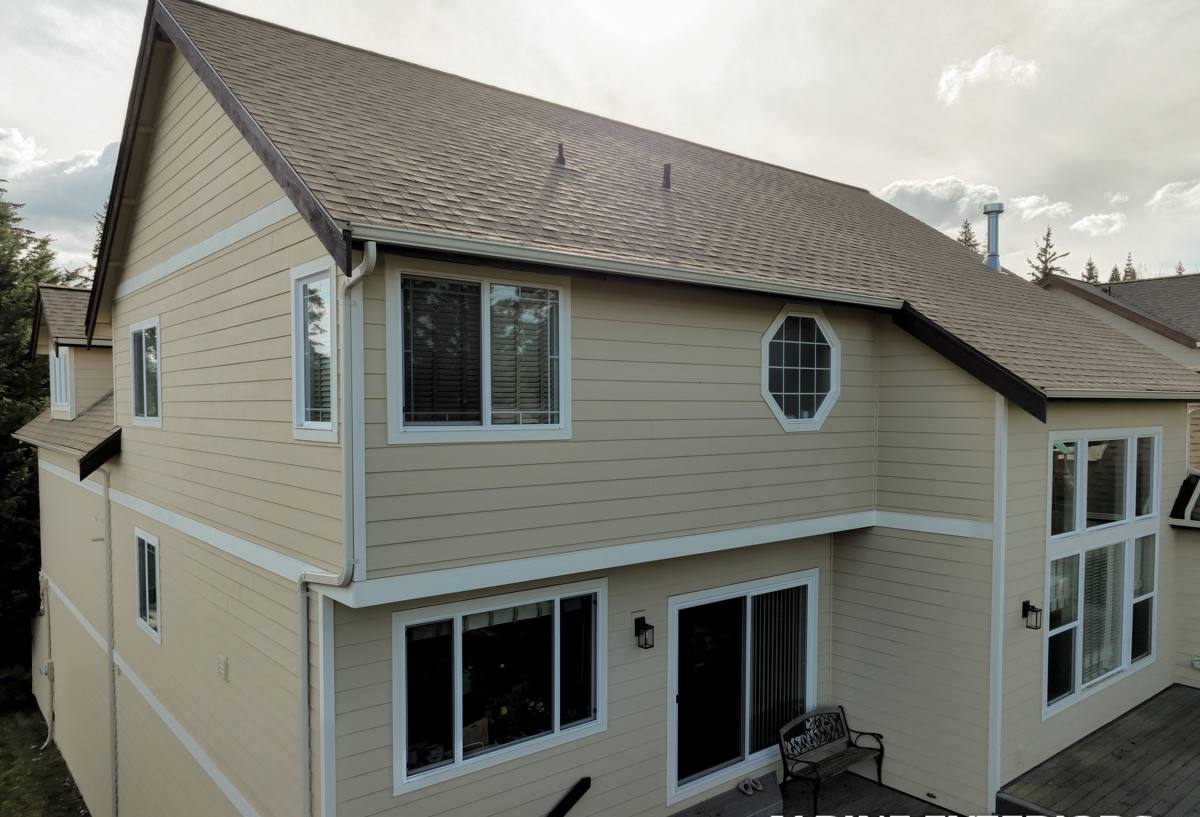
What Creekside Conditions Do to Siding
Shade and Slow-Drying Walls
Tree cover along the creek corridor blocks the sun and wind that would otherwise dry a wall out within a day or two of a storm. On a lot backing up to the creek, or tucked under a stand of trees, one elevation of the house can stay visibly damp long after the rest of the property has dried. That uneven drying is the detail a lot of siding work overlooks — treating every wall the same when one of them genuinely needs more protection.
Ground-Level Moisture and Grade Clearance
Lower-lying, creek-adjacent lots often have less fall away from the house than a lot up on a slope. That means less runoff, more splashback off the ground during heavy rain, and occasionally softer, wetter ground near the foundation for longer stretches of the year. Siding installed too close to grade sits directly in that zone. James Hardie's own installation spec sets minimum clearance from grade and from roof lines for exactly this reason — on a creekside lot, that clearance isn't a technicality, it's doing real work every wet season.
Salt-Tinged Marine Air Reaching Inland
Even set back from open water, California Creek still sits within the belt of salt-tinged air that moves off Birch Bay and Drayton Harbor across this part of Whatcom County. That air contributes to fastener corrosion and finish breakdown over time, and it compounds the moisture problem rather than replacing it — a wall here can be dealing with slow drying and salt exposure at the same time.
A Long Moss and Mildew Season
Shade plus sustained dampness is exactly the combination moss and mildew need. On California Creek properties, that usually shows up first on the creek-facing or north-facing wall, and on any siding run shaded by overhanging trees. Materials that hold moisture at the surface instead of shedding it give moss more time to establish before the next dry stretch arrives.
Why James Hardie Fiber Cement Is the Right Match Here
We used to install a wider range of siding products. We narrowed that down after seeing, repeatedly, which materials held up on shaded, moisture-heavy properties like the ones along California Creek — and which ones developed problems within a handful of years regardless of how well they were maintained.
- Non-combustible core: Fiber cement doesn't feed a fire the way wood-based siding can, which matters for safety and often for insurance.
- Factory-applied ColorPlus finish: The color is baked on under controlled factory conditions rather than field-applied, so it holds up against the fading, chalking, and mildew staining that slow-drying, shaded walls are prone to.
- Climate-engineered HZ product lines: Hardie's HZ5 formulation is built for regions with heavy moisture exposure and freeze-thaw cycling, which matches a shaded, creek-adjacent setting in Whatcom County well.
- Dimensional stability: Fiber cement doesn't swell, cup, or warp the way engineered wood products can after repeated, prolonged wetting.
- Strong transferable warranty: Hardie backs correctly installed product with one of the more substantial warranty structures in the siding industry.
We don't install LP SmartSide, vinyl siding, Cemplank, Allura, primed spruce, or cedar. Each has a place in the broader market, and plenty of homeowners elsewhere are satisfied with them. But on a shaded, creek-adjacent lot where one wall of the house can stay damp far longer than the rest, we've made a professional call to install one system we can fully stand behind rather than a lower-cost option that quietly shifts moisture risk back onto the homeowner.
What Correct Installation Requires on a Shaded, Creek-Adjacent Lot
Fiber cement only performs the way it's engineered to when it's installed to Hardie's published specifications — correct fastener type and spacing, proper clearance from grade and roofline, a drainage plane or rain-screen detail behind the panels where the wall assembly calls for it, and properly caulked and lapped joints. On the specific wall of a California Creek home that gets the least sun and the most shade, those details matter more than they would on the road-facing side of the same house. A quality material installed loosely will still develop moisture problems on a wall that never fully dries out between storms.
What a Correct Fiber Cement Siding Job Involves
A siding job on a California Creek property starts with understanding how moisture actually moves around that specific lot, not just measuring wall area. That means walking the property to see which elevations get shade, where the ground holds water longest, and whether the existing siding shows signs of the wall behind it having stayed wet for extended periods. From there, correct work follows a consistent sequence: removing the old siding without damaging the sheathing underneath, inspecting and repairing the weather-resistive barrier and any soft or rotted sheathing found in the process, correcting grade clearance if the old installation ran too close to the ground, installing a drainage plane where the wall assembly calls for it, and then installing the Hardie product to spec — correct fasteners, correct spacing, correct clearances, properly sealed joints.
- Grade clearance measured and corrected, not just re-covered over the old line
- Sheathing and weather-resistive barrier inspected before new siding goes up, not assumed to be sound
- Drainage plane or rain-screen detailing added where the wall's moisture exposure calls for it
- Fastener type, spacing, and depth matched to Hardie's published specification
- Joints and butt seams properly caulked and sequenced to shed water, not just sealed and hoped for
- ColorPlus finish and factory color match checked at every cut edge
Signs Existing Siding Is Already Struggling in California Creek
Because moisture problems on a shaded, creek-adjacent wall build slowly, homeowners often don't notice until the damage is well underway. A few signs are worth checking for, especially on the shaded or creek-facing side of the house:
- Soft or spongy spots low on the wall, near grade, where splashback and ground moisture concentrate
- Paint or finish that's failing, chalking, or peeling faster on one wall than the rest of the house
- Moss or algae staining that returns within weeks of being cleaned off
- Swelling, delamination, or visible warping in wood-based or engineered wood siding
- Gaps opening up at butt joints or corners where caulking has failed
- Rust streaking or corrosion visible at fasteners, trim, or flashing
Comparing Materials for a Shaded, Creek-Adjacent Lot
| Material | Moisture Behavior | Maintenance in Shade and Dampness | Typical Longevity Here |
|---|---|---|---|
| James Hardie fiber cement | Dimensionally stable; resists swelling and warping | Low; factory finish resists mildew staining and fading | 30+ years with correct installation |
| Vinyl siding | Can trap moisture behind panels on slow-drying walls | Low upfront cost, but seams stay damp longer in shade | Variable; shorter on shaded, low-drainage elevations |
| LP SmartSide / engineered wood | Wood-based core is moisture-sensitive at cut edges and joints | Moderate to high; edge sealing is critical where drying is slow | Depends heavily on installation quality and upkeep |
| Cedar / primed wood | Absorbs and releases moisture readily | High; needs frequent refinishing on shaded walls | Shorter without consistent, disciplined maintenance |
Why a Crew That Already Works California Creek Matters
Lots along California Creek vary more than they might look like from the road. One property sits close to the creek's low point and holds moisture at grade almost year-round; the next one up has a slight rise and drains cleanly. On a single house, the wall shaded by trees can need a different drainage and clearance approach than the wall facing the street. A crew that regularly works this area already knows to check for that variation wall by wall, rather than applying one generic installation spec to the whole house and hoping the shaded side keeps up.
That local judgment shows up in decisions that don't come up in a sales pitch — how much extra clearance to build in where the old siding was clearly too close to wet ground, whether a particular elevation needs a rain-screen detail that the rest of the house doesn't, which fastener grade makes sense given both the salt exposure and the sustained dampness. Those are the choices that decide whether siding here is still performing cleanly in twenty-five years or showing soft spots and moss in five.
A Simple Checklist Before Hiring for Siding Work in California Creek
- Ask what siding material they install and why, and whether it carries a written, transferable warranty
- Confirm current Washington contractor licensing and active liability insurance
- Ask specifically how they handle grade clearance and drainage on shaded or low-lying walls
- Ask about their experience with creek-adjacent or heavily wooded properties, not just general siding replacement
- Get a clear, written scope of work and timeline before signing anything
Our Process
We start with an on-site walk of the exterior, paying specific attention to how shade, grade, and moisture vary from one wall to the next — since the creek-facing side of a California Creek home can be dealing with a very different exposure than the side facing the road. From there we put together a clear, written scope and timeline before any work begins. Correct grade clearance, drainage detailing, and fastener choices are standard practice on every siding job we take on here, not optional upgrades added at extra cost.
If you're weighing siding options for a home in California Creek, we're happy to walk the property with you and give an honest read on what it actually needs. Reach out below for a free, no-pressure estimate.