 Birch Bay Roofing
 Storm Damage in Marietta: What Birch Bay's Weather Actually Does to a Roof
Marietta sits close enough to the water that its roofs live a different life than a roof twenty miles inland. Homes here take on salt-laden air off the Strait of Georgia, wind-driven rain that doesn't fall so much as get pushed sideways under flashing and shingle tabs, and a moss season that runs long through the wet Whatcom County winter. None of that shows up as a single dramatic event most of the time. It shows up as a slow accumulation of small failures that a storm then finds and exploits.
Salt Air and Corrosion
Metal components take the brunt of it — nail heads, flashing, vent boots with metal collars, gutter fasteners. Salt air speeds up corrosion on anything that isn't fully protected, and once a fastener or flashing seam starts to corrode, it stops sealing the way it should. A storm with real wind behind it will find that weak point fast.
Wind-Driven Rain
Birch Bay gets weather off the water, and wind-driven rain behaves differently than a straight-down downpour. It gets pushed up under shingle edges, sideways through vent screens, and into any flashing lap that's a little short or a little loose. A roof can look intact after a storm and still have taken on water in three or four places you can't see from the ground.
A Long Moss Season
Western Washington's moss season is long, and Marietta's tree cover and damp air keep roofs wet longer after each rain than they would be somewhere drier. Moss holds moisture against the roof surface, works its way under shingle edges, and lifts tabs just enough for wind and rain to get a grip during the next storm. A roof with moss going into storm season is a roof that's already compromised before the wind even shows up.
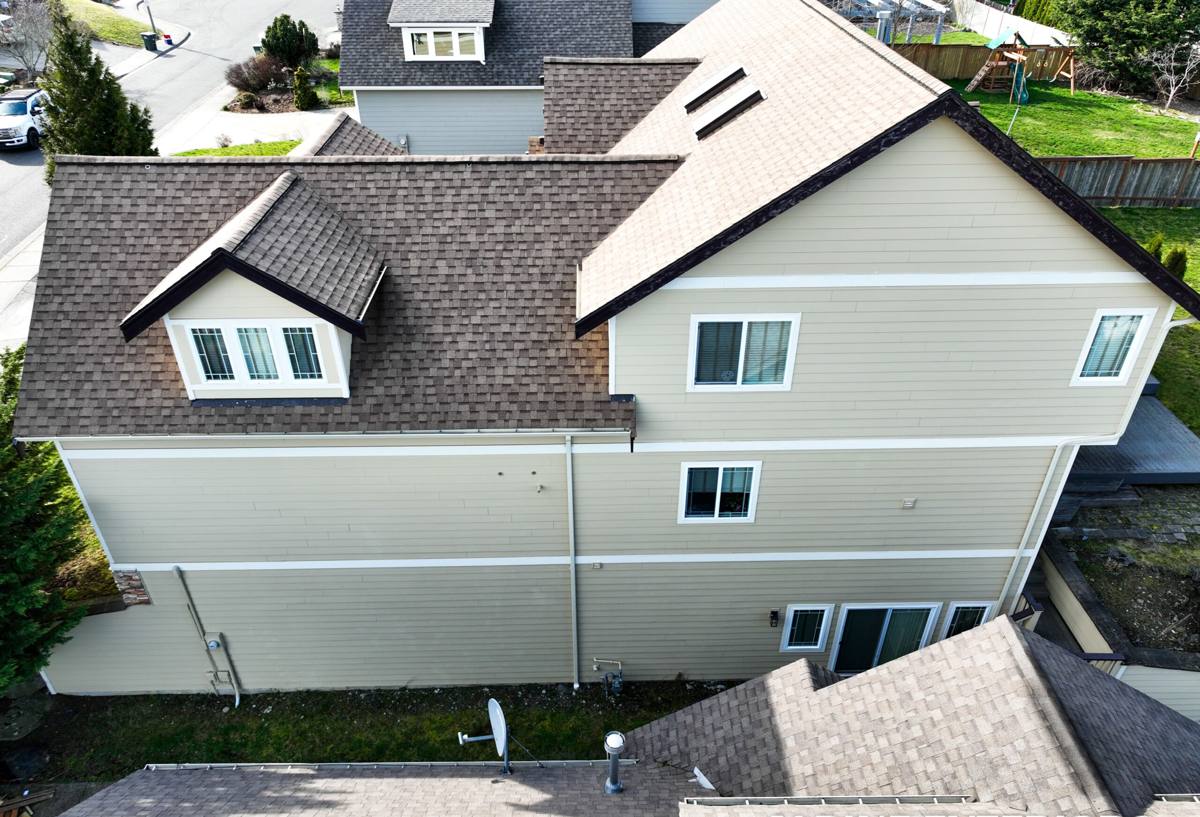
Signs Your Marietta Roof May Have Storm Damage
Storm damage is often quiet at first. Here's what we tell homeowners to watch for after any significant wind or rain event:
- Shingles that look lifted, curled, or creased, even if none are missing
- Granules collecting in gutters or at downspout outlets
- New or worsening ceiling stains, especially near chimneys, skylights, or where two roof planes meet
- Flashing that looks bent, pulled away from the surface it seals against, or visibly rusted
- Soft spots or slight sagging when walked on (we check this, not you — don't get on the roof)
- Debris damage: branch strikes, dented vents, or dislodged ridge caps
- Moss that's thicker or more widespread than it was last season
Any one of these on its own might be minor. Two or three together, especially after a wind event, usually means water has found a way in somewhere.
What a Correct Storm Damage Repair Actually Involves
Inspection Before Anything Gets Touched
A rushed repair patches the visible problem and leaves the cause in place. Our inspection covers the whole roof plane, not just the spot that's obviously damaged, because wind damage rarely stays in one location — if the wind was strong enough to lift shingles in one area, it likely stressed the surrounding field too. We also check attic-side sheathing where accessible, since water intrusion often travels before it stains a ceiling.
Matching Materials and Technique to What's Already There
A patch that doesn't match the existing roof's material, exposure, or fastening pattern is a future leak with a delay timer on it. We match shingle type, color run where possible, and — just as important — the underlying technique: correct nail placement, proper flashing laps, and shingle courses that tie into the existing field rather than sitting on top of it. On a home with salt air exposure, we also pay close attention to fastener and flashing material, since standard-grade hardware corrodes faster this close to the water.
Sealing the Cause, Not Just the Symptom
If moss lifted the shingle that let wind in, we address the moss and the drainage that's keeping the roof wet, not just the lifted shingle. If a flashing lap failed, we re-lap it correctly rather than caulking over the gap. Caulk and sealant have their place, but they're a short-term patch, not a substitute for correct flashing work — and on a Birch Bay roof, a sealant-only fix rarely survives a full winter.
Repair or Replace? How We Make That Call
Not every storm-damaged roof needs a full replacement, and not every roof that "just needs a patch" should get one. We walk homeowners through the actual factors rather than defaulting to whichever answer is easier to sell:
| Factor | Points Toward Repair | Points Toward Replacement |
|---|---|---|
| Roof age | Under 10-12 years, otherwise sound | Nearing or past expected shingle lifespan |
| Extent of damage | Isolated to one section or slope | Spread across multiple planes |
| Underlying deck condition | Sheathing solid, no rot found | Soft or water-damaged decking present |
| Moss and moisture history | Managed, minimal past intrusion | Chronic moss buildup, repeated leak history |
| Material availability | Matching shingles still obtainable | Discontinued line, poor color/profile match |
| Insurance scope | Adjuster approves targeted repair | Adjuster or inspection supports full slope/roof |
We'll tell you plainly which side of that table your roof falls on, and why — including when a repair is genuinely the right call and a full replacement would be overkill.
Our Process for Marietta Storm Calls
- Contact and initial assessment. We ask what happened, when, and what you've noticed since — that helps us prioritize if there's active water intrusion.
- On-site inspection. We examine the roof surface, flashing points, attic access where available, and document what we find with photos for your records and any insurance claim.
- Written scope and estimate. You get a clear explanation of what's damaged, what needs to happen, and what it costs — no vague line items.
- Repair or replacement work. Scheduled around weather windows, since storm-damage repair on a wet or windy day is how you end up doing it twice.
- Final walkthrough. We show you what was done and what to watch for going forward, particularly around drainage and moss if that contributed to the damage.
Storm Damage and Insurance Claims
Most homeowner policies cover sudden storm damage — wind, falling debris, impact damage — differently than they cover gradual wear like moss deterioration or age-related shingle failure. That distinction matters, because an adjuster will want to see clear evidence the damage was storm-caused and recent, not a pre-existing condition. Our inspection documentation is written to support that distinction honestly: we tell you what looks storm-related and what looks like ongoing wear, because misrepresenting one as the other can jeopardize a claim. We're happy to meet an adjuster on-site or provide a written scope they can review, but we don't inflate damage findings to help a claim along — it isn't good for you long-term and it isn't how we do business.
Why a Crew That Already Works Marietta Roofs Matters
A roofing crew that works Birch Bay and the surrounding Whatcom County shoreline regularly already knows what salt exposure does to fasteners over five years, what a typical moss cycle looks like on this side of the water, and which flashing details tend to fail first on homes built for this specific coastal exposure. That's not something you get from a crew that mostly works inland and treats a Marietta storm call like any other repair. It shows up in small decisions — fastener grade, flashing lap direction relative to prevailing wind, whether a patch needs to extend further than the visible damage — that a generic repair approach tends to miss.
It also matters for response time. Storm damage that sits exposed for a week between the storm and the repair is storm damage that keeps getting worse, especially with more rain in the forecast. Being local means we can usually get eyes on a Marietta roof quickly after a storm, not after a multi-day drive-time backlog.
Preventing the Next Storm From Doing the Same Damage
Every storm repair is also a chance to reduce what the next storm can do. That usually means clearing and treating moss before it re-establishes, confirming gutters and downspouts are actually moving water off the roof rather than backing it up at the eaves, and checking that flashing repaired this time is upgraded to hold up against the same wind-driven rain that caused the original problem. We'll flag any of that during the inspection — not as an upsell, but because it's the difference between fixing this storm's damage and just waiting for the next one.
If your Marietta home has taken storm damage, or you're not sure whether what you're seeing is storm-related or just wear, we're glad to take a look. The estimate is free, there's no pressure attached to it, and you'll get a straight answer about what's actually going on with your roof — just fill out the form below to get started.