 Birch Bay Roofing
 Decking Built for the Nooksack Area's Marine Climate
Homes in and around Nooksack sit close enough to the water and the low-lying farmland of Whatcom County that decks take a beating most inland properties never see. Salt-laden air off the Sound works its way into fasteners and finishes, driving rain comes in sideways more often than straight down, and a long, damp moss season means anything horizontal stays wet for months at a time. Composite decking exists largely because wood struggles with exactly these conditions. Done right, it's one of the few deck systems that can shrug off a Whatcom County winter and still look presentable come July.
This page is specifically about composite decking for homes in the Nooksack area — not a generic rundown of every decking material on the market. If you're comparing options, want to know what a correct installation actually looks like, or you're trying to figure out why your last deck failed early, this is written for you.
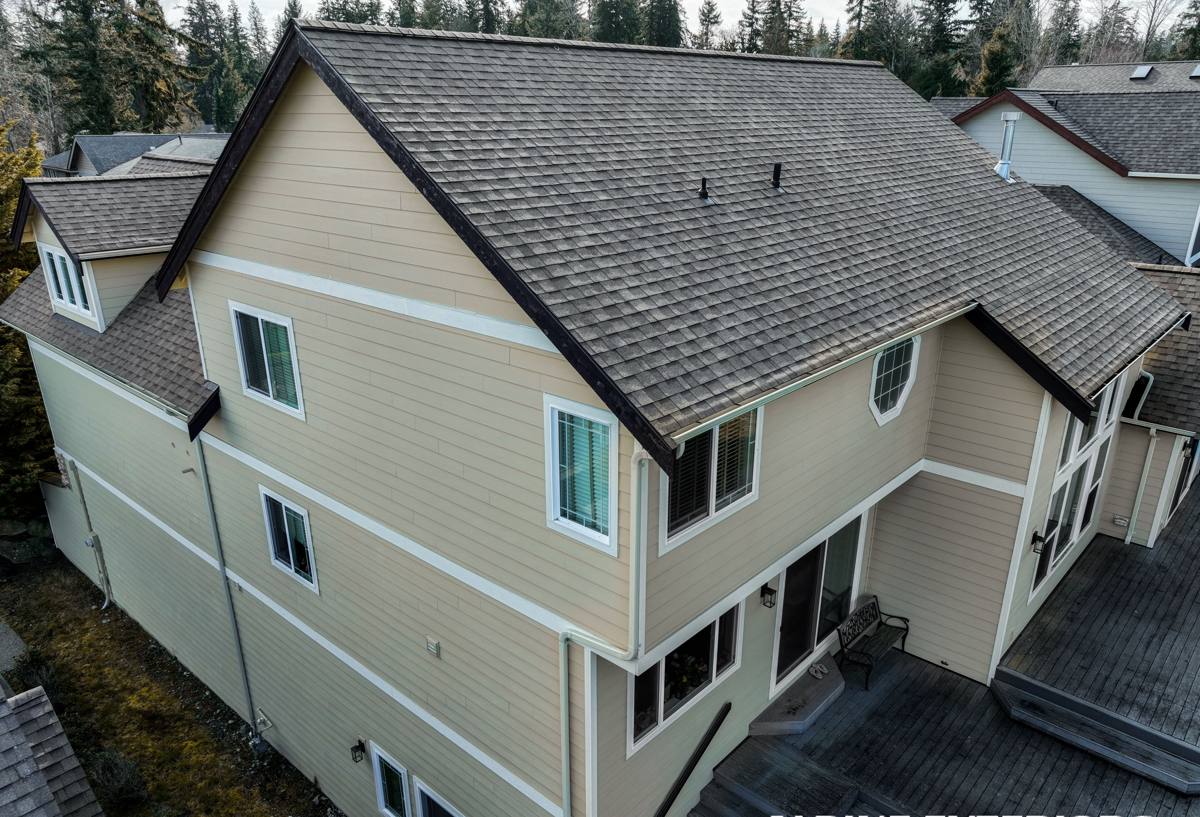
What Salt Air, Driving Rain, and Moss Actually Do to a Deck
Salt Air
Airborne salt doesn't just sit on the surface — it works into any exposed fastener, hinge, or metal bracket and accelerates corrosion. On a wood deck, corroding fasteners loosen boards and stain the surrounding wood with rust streaks. On a poorly installed composite deck, the same corrosion happens out of sight in the hidden clips and screws holding the boards down, which is why fastener choice matters as much as the decking material itself.
Driving Rain
Wind-driven rain finds its way under rail caps, into end-cuts, and behind ledger boards in a way that vertical rain never does. Any gap or seam that isn't properly flashed or capped becomes a wicking point. Over a few seasons, that's where rot starts in wood and where moisture staining and mold show up on lower-quality composite boards.
Moss Season
Whatcom County's damp stretch from fall through spring means decks rarely get a real chance to dry out. Moss and algae need moisture and shade to establish, and a deck that stays wet for weeks at a time is exactly that environment. Once moss takes hold in the grain of a wood deck, it holds moisture against the board permanently. Composite decking doesn't feed moss the way wood fibers do, but moss and algae can still grow on the surface of any decking material if drainage and airflow underneath are poor — which is a build-quality issue, not just a material issue.
Why Composite Makes Sense Here — and Where It Still Requires Judgment
Composite decking is a blend of wood fiber and plastic, usually with a protective cap layer on the better products. It doesn't absorb water the way solid wood does, it doesn't need annual staining or sealing, and it resists the freeze-thaw and wet-dry cycling that splits and cups wood boards over time. That's a real advantage for a Nooksack-area home dealing with the marine climate described above.
It isn't maintenance-free, and it isn't identical from one product line to the next. Composite still needs to be cleaned periodically to keep surface mildew from taking hold, it still expands and contracts with temperature, and cheaper uncapped boards can absorb moisture at cut ends if they aren't sealed correctly during installation. The material solves the big problems wood has in this climate; it doesn't eliminate the need for correct installation.
Composite vs. Wood vs. PVC: The Honest Cost-Factor Comparison
There's no single "best" decking material — there's the right material for a given budget, maintenance appetite, and how exposed the deck is to weather. Here's how the three common options actually compare for a coastal Whatcom County property:
| Factor | Pressure-Treated Wood | Composite | PVC / Cellular |
|---|---|---|---|
| Upfront cost | Lowest | Mid-range | Highest |
| Maintenance | Annual staining/sealing | Periodic cleaning | Minimal cleaning |
| Moisture & moss resistance | Poor without upkeep | Good with capped boards | Very good |
| Salt air tolerance | Fair; fasteners corrode | Good with correct hardware | Very good |
| Typical lifespan (this climate) | 10-15 years | 20-30 years | 25-30+ years |
| Appearance over time | Grays, splinters, cups | Fades slowly, stays uniform | Very stable, some find it plasticky |
For most Nooksack-area homeowners, composite lands in the sweet spot: it costs less than PVC, requires far less upkeep than wood, and holds up to salt air and moss season a lot better than an untreated or lightly maintained wood deck ever will.
What a Correct Composite Deck Installation Actually Involves
The decking board is the part homeowners see, but it's the substructure and details underneath that determine whether a composite deck lasts twenty years or needs rework in five. In this climate, we treat the following as non-negotiable:
Substructure and Ventilation
Joists need proper spacing for the specific composite product being used — manufacturers vary, and undersized joist spacing is one of the most common causes of boards sagging or bouncing later. Airflow underneath the deck matters just as much as the framing itself; a deck built low to the ground or boxed in without vents traps moisture and creates the exact damp, shaded conditions moss and mildew need.
Fasteners and Hardware
Given how much airborne salt this area sees, we use corrosion-resistant, stainless or coated hardware rated for coastal exposure — not the standard fasteners that come bundled with some decking kits. This is one of those details that's invisible on installation day and expensive to ignore later.
Flashing and Ledger Boards
Where a deck attaches to the house, proper ledger flashing keeps driving rain from working its way behind the board and into the wall assembly. This is one of the most common failure points we find on older decks in this area, and it's a building-envelope issue as much as a decking issue.
Board Spacing and Drainage
Correct gapping between boards allows water to drain through rather than pool on the surface, and it accounts for the expansion and contraction composite boards go through across a Whatcom County winter-to-summer temperature swing. Cut ends, especially on uncapped composite, should be sealed or capped to keep moisture from wicking into the exposed core.
Quick Installation Checklist
- Joist spacing matched to the specific composite product's span rating
- Clear airflow path underneath the deck — no boxing in without ventilation
- Corrosion-resistant fasteners and hidden clips rated for coastal/salt-air exposure
- Ledger board properly flashed where the deck meets the house
- Consistent board gapping for drainage and thermal movement
- Cut ends sealed or capped, especially on uncapped composite boards
- Railing posts anchored into framing, not just decking boards
Our Process, Start to Finish
We keep this straightforward because a deck project shouldn't feel complicated to the homeowner paying for it.
- On-site assessment — we look at the existing structure (if there is one), grade and drainage around the deck footprint, and how exposed the site is to prevailing wind and rain.
- Material walkthrough — we talk through composite options at different price points and explain the real tradeoffs, not just a brochure pitch.
- Written estimate — a clear scope covering framing, hardware, decking, railing, and any flashing or drainage work the site needs.
- Build — framing and ventilation first, then decking, railing, and finish details, with the hardware and flashing standards described above applied as a matter of course, not an upgrade.
- Walkthrough — we go over the finished deck with you, including what maintenance (if any) the specific product you chose actually needs.
Maintenance: What Composite Actually Needs in This Climate
One of the honest selling points of composite is how little it asks for compared to wood, but "low maintenance" isn't "no maintenance," especially with a moss season this long.
- Rinse or sweep the deck periodically through fall and winter to keep organic debris (leaves, needles, pollen) from sitting on the surface and holding moisture
- Clean visible mildew or algae with a soft-bristle brush and a cleaner made for composite — pressure washing on the wrong setting can damage the cap layer
- Keep planters, mats, and furniture legs from sitting in one spot for months at a time, which can trap moisture underneath
- Check railing connections and fastener points annually, since this is where corrosion shows up first
- Clear gutters and downspouts feeding onto or near the deck so runoff isn't concentrating in one area
None of this is heavy work — it's the difference between a deck that looks the same in year fifteen as it did in year two, and one that develops surface staining it never needed to.
Signs Your Current Deck Needs Attention or Replacement
If you're not building new and instead wondering whether your existing deck is worth repairing versus replacing with composite, look for:
- Soft or spongy spots underfoot, which usually means the framing or decking has taken on water
- Persistent moss or dark staining that comes back within weeks of cleaning
- Visible rust streaks around fasteners or hardware
- Gaps opening up around the ledger board where the deck meets the house
- Boards that have cupped, split, or splintered despite regular staining
- Railings that feel loose or flex when leaned on
Any one of these is worth a look. Several at once usually means the deck is past the point where patching makes financial sense.
Why It Matters That We Already Work in the Nooksack Area
A lot of decking problems in this part of Whatcom County trace back to a crew that built a deck the way they'd build one anywhere else — standard fastener kit, standard spacing, no particular thought given to salt air or a wet season that runs longer than most regions ever deal with. That approach can hold up fine in a drier climate and fail early here.
Working regularly in and around Birch Bay and the Nooksack area means we're not guessing at how this climate treats a deck over time — we're the ones who get called back when a shortcut catches up with a homeowner a few years later, and we'd rather build it right the first time. That shapes real decisions on your project: which hardware grade we default to, how much ventilation we build in underneath, and how seriously we treat flashing details that are easy to skip and expensive to fix after the fact.
Get a Straightforward Estimate
If you're planning a new composite deck in the Nooksack area, or trying to figure out whether your current deck is worth repairing, we're happy to take a look and give you an honest read — no pressure, no upsell. Use the form below to request a free estimate.