 Birch Bay Roofing
 Why Sandy Point Siding Has to Work Harder
Sandy Point sits close enough to the water that the siding on your home isn't just dealing with normal Pacific Northwest weather — it's dealing with salt air, near-constant humidity, and wind-driven rain coming off the water with almost nothing to slow it down. Add in the shade and moisture that a lot of Whatcom County lots hold onto through the fall and winter, and you've got a recipe for siding that fails faster here than it would fifteen or twenty miles inland.
We install fiber cement siding throughout the Birch Bay area, and Sandy Point is one of the neighborhoods where the difference between a correct installation and a corner-cut one shows up fastest. Salt-laden air accelerates corrosion on fasteners and trim metal. Driving rain finds every gap in flashing and caulking that a calmer inland job might get away with for years. And a long, damp moss season means anything that traps moisture against the wall — bad overlaps, missing rainscreen gaps, caulked joints that should have been left open — turns into a problem within a season or two, not a decade.
This page is about what fiber cement siding needs to actually do here, not just what it looks like on a spec sheet.
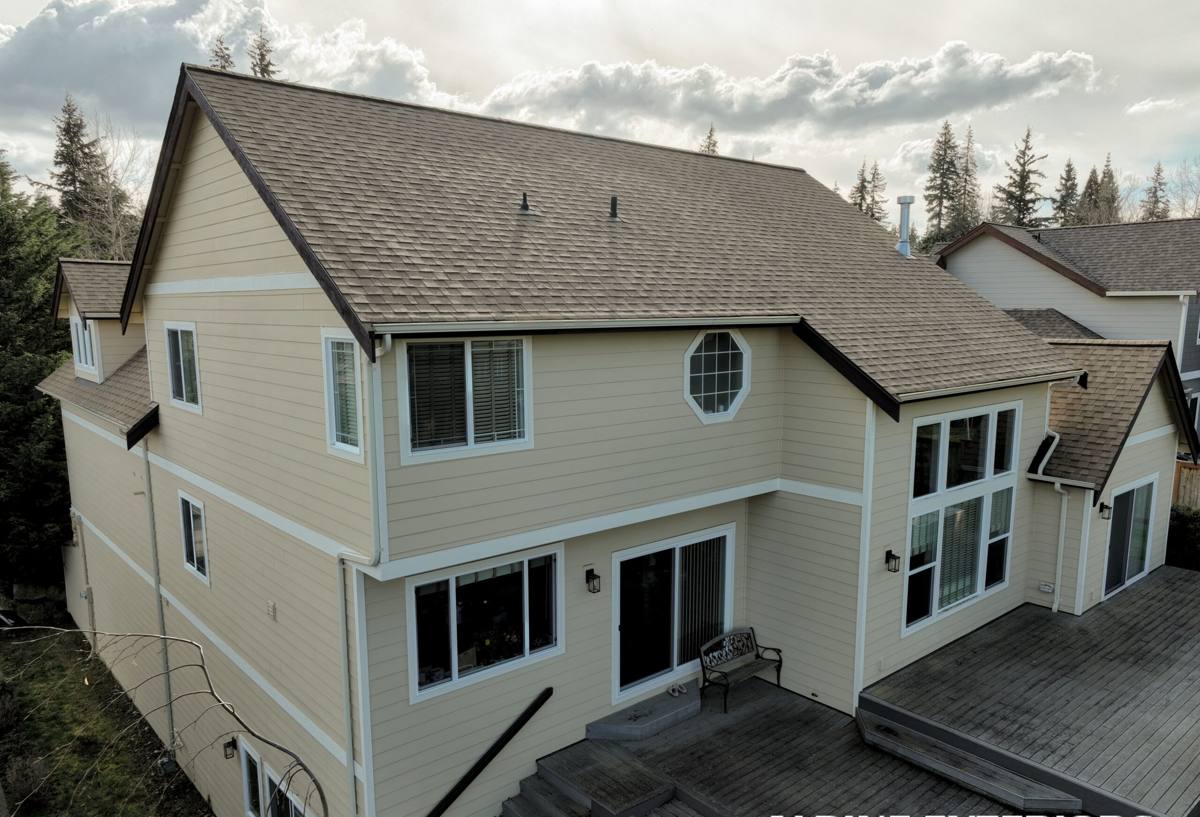
What "Correct" Fiber Cement Siding Looks Like in a Salt-Air Environment
Fiber cement itself is a good match for coastal conditions — it doesn't rot, it doesn't feed insects, and it holds paint far better than wood over the long run. But the material is only half the equation. In a location like Sandy Point, the installation details matter more than they would in a drier, more sheltered spot.
The details we don't skip
- Stainless steel or hot-dip galvanized fasteners rated for coastal exposure — not standard fasteners that will streak or corrode within a few years of salt exposure
- A drainage plane and rainscreen gap behind the siding so any moisture that does get past the surface has somewhere to go
- Correct flashing at every window, door, and roof-to-wall intersection, lapped so water is always shed outward and down
- Manufacturer-specified nailing patterns and clearances — fiber cement is unforgiving of shortcuts around butt joints and courses
- Caulking only where the manufacturer calls for it — over-caulking traps moisture instead of releasing it
Skip any one of these and you can still end up with siding that looks fine for a year or two before problems start showing at seams, corners, and anywhere water collects.
Why We Install James Hardie and Nothing Else
We standardized on James Hardie fiber cement products years ago and we haven't gone back to offering alternatives. Part of that is the material itself — non-combustible, engineered specifically for wet coastal and marine-influenced climates in Hardie's HZ5 product line, and finished with the ColorPlus factory coating system so the color is baked on rather than field-painted. Part of it is the warranty structure, which is transferable and backed by a manufacturer with a long track record in exactly this kind of climate.
We don't install vinyl, LP SmartSide, or other fiber cement brands on the homes we work on. That's a standard we hold ourselves to, not a claim that every other product is unusable — it's that we've seen what holds up on the Whatcom County coastline over the long haul, and we'd rather put our name on one system we trust completely than offer a menu of options with different risk profiles.
Why the finish matters here specifically
Factory-applied color matters more in a salt-air environment than most homeowners expect. Field-painted siding depends on a paint film bonding to a cut edge or a job-site-primed surface, and that bond is exactly what salt air and repeated wet-dry cycles attack first. A factory finish, backed by a separate finish warranty, removes that weak point.
Our Installation Process for Sandy Point Homes
Every job starts with an in-person look at the house, not a phone estimate. Waterfront and near-shore lots in this area often have their own quirks — wind exposure on one elevation, more shade and moss growth on another, older trim or sheathing that needs attention before new siding goes on.
- Assessment: we walk the exterior, check the condition of the sheathing and existing moisture barrier, and note any elevations that take the brunt of wind and rain
- Prep: remove old siding, repair or replace any damaged sheathing, and install a code-compliant weather-resistive barrier
- Drainage plane: install a rainscreen or furring system so the siding isn't sitting flush against a wet wall assembly
- Flashing: detail every penetration, window, and roof-wall intersection before a single piece of siding goes up
- Installation: install James Hardie panels, lap siding, or shingle-style products to manufacturer spec, using coastal-rated fasteners
- Trim and finish: install trim, corner boards, and any accent details, then do a final walk-through
We don't shortcut the prep and flashing stages to get to the visible part of the job faster. On a coastal lot, those hidden steps are what determine whether the siding is still performing in fifteen years.
Moss, Algae, and Sandy Point's Long Wet Season
Whatcom County's wet season runs long, and shaded, low-airflow spots on a home — north-facing walls, areas tucked under eaves or trees — can stay damp for weeks at a stretch. That's exactly the environment moss and algae need to take hold. Fiber cement resists this kind of surface growth far better than wood, but it's not immune, especially if the installation trapped moisture behind the panels in the first place.
A properly vented rainscreen assembly lets walls dry out between storms instead of staying saturated. That single detail does more to keep moss and mildew from getting a foothold than any surface treatment applied after the fact.
Cost Factors for Fiber Cement Siding in Sandy Point
Every home is different, but the factors that move the price up or down are consistent. We give firm, written quotes only after an in-person assessment — the table below is meant to help you understand what drives the number, not to serve as a quote itself.
| Factor | Why It Matters Here |
|---|---|
| Home size and elevation count | More wall area and more corners/intersections means more material and more detail work |
| Condition of existing sheathing | Coastal moisture exposure sometimes means hidden rot that has to be repaired before new siding goes on |
| Wind and rain exposure by elevation | Sides facing open water or prevailing weather may need extra flashing and fastener attention |
| Siding profile chosen | Lap siding, panel systems, and shingle-style products differ in material and labor cost |
| Trim and accent detailing | Corner boards, window trim, and accent bands add labor time and material |
| Access and site conditions | Waterfront and canal-adjacent lots sometimes have tighter access that affects staging and equipment |
Maintenance That Actually Matters in This Environment
Fiber cement is low-maintenance compared to wood, but "low-maintenance" doesn't mean "no maintenance" — especially this close to salt water. A short annual routine keeps small issues from becoming expensive ones.
- Rinse salt residue and grime off the siding once or twice a year, especially on elevations facing open water
- Check caulking at windows, doors, and trim joints for cracking or separation
- Look for streaking or discoloration around fasteners, which can signal corrosion starting
- Keep gutters clear so overflow doesn't run down the face of the siding repeatedly
- Trim back vegetation that's shading a wall and keeping it damp longer than it should be
- Address any moss or algae growth promptly rather than letting it establish
Why It Matters That We Already Work in This Area
A crew that's worked on homes throughout Birch Bay and the surrounding Whatcom County coastline already knows which elevations tend to take the worst weather, which fastener and flashing choices actually hold up near salt water, and what a wet-season inspection should be catching before it turns into a bigger repair. That local pattern recognition is hard to replicate on a first visit, and it's part of why the installation details on this page matter more than they would somewhere drier and further from the shoreline.
If your current siding is showing streaking, soft spots, moss buildup, or failing caulk lines, or if you're planning ahead for a replacement, we're happy to take a look. Reach out for a free, no-pressure estimate — we'll walk the house with you, talk through what your specific elevations are dealing with, and give you a straight answer about what the job actually involves.