 Birch Bay Roofing
 Siding Built for Point Whitehorn's Exposure
Point Whitehorn sits right up against the water on Whatcom County's northern shoreline, and that location comes with a specific set of demands most siding products were never engineered to handle well over the long term. Homes here take on salt-laden air moving off the Strait of Georgia, wind-driven rain that hits siding at an angle instead of falling straight down, and a wet season that stretches long enough to give moss and algae months to establish themselves on anything that stays damp. None of that is unique to one house — it's the baseline condition for the whole stretch of shoreline from Birch Bay up toward the Point Whitehorn Natural Area.
What that means practically is that siding choice and installation quality matter more here than they would in a drier, more sheltered inland neighborhood. A product or installation detail that's merely adequate in a protected subdivision can fail years early on an exposed coastal lot. We install James Hardie fiber cement siding exclusively, and we install it to a standard built around what this specific stretch of coastline actually does to a house.
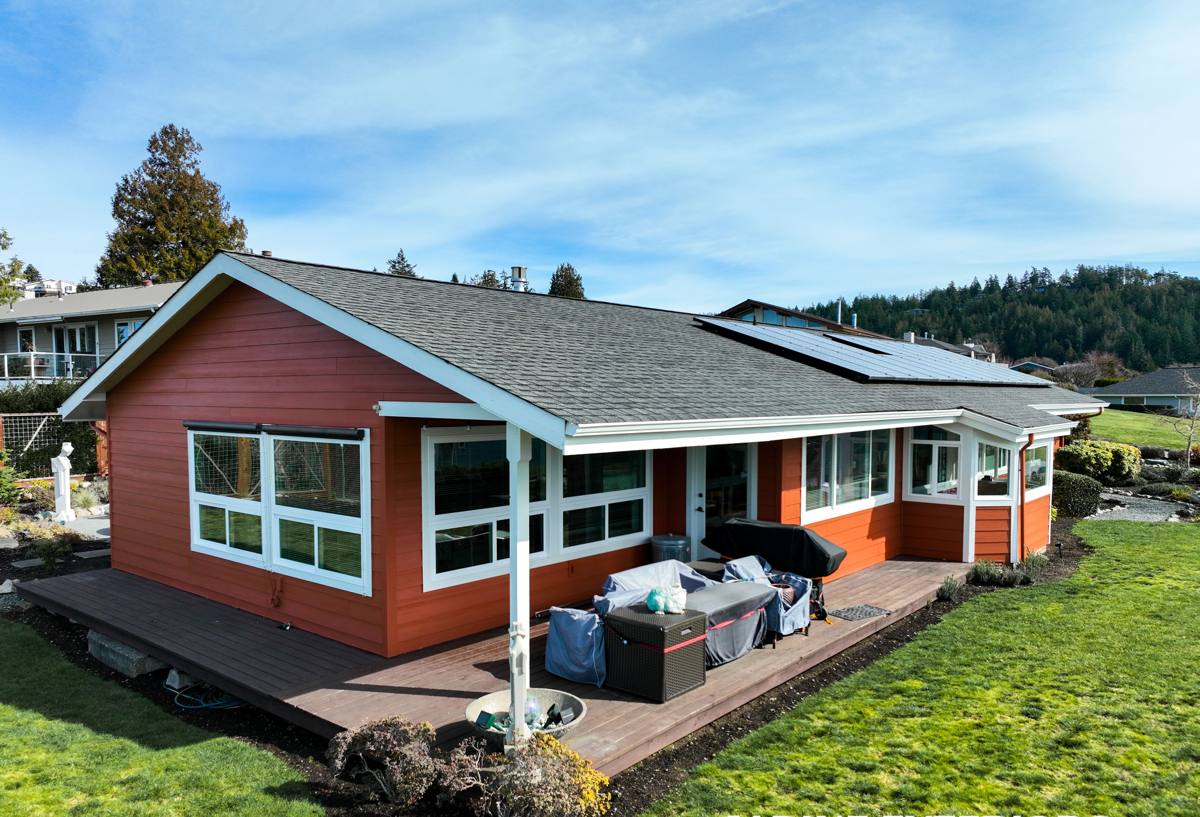
What This Climate Does to Siding Over Time
It helps to be specific about the mechanisms at work, because "coastal weather is tough on siding" is true but not very useful on its own.
Salt Air
Airborne salt is corrosive to exposed metal fasteners, flashing, and trim, and it accelerates the breakdown of coatings that aren't formulated to resist it. Siding installed close to the water needs corrosion-resistant fastening and flashing details, and a surface finish that isn't going to chalk, fade, or degrade faster than it should under salt exposure.
Driving Rain
Wind off the water pushes rain sideways into wall assemblies instead of letting gravity do the work. That means water finds its way behind siding at laps, seams, and penetrations far more aggressively than it would in a calm, inland setting. The siding material matters less here than the water management behind it — house wrap, flashing, and proper lap technique are what actually keep a wall dry.
Moss and Algae
Whatcom County's wet season runs long, and shaded, north-facing walls near the water can stay damp for extended stretches. Moss and algae need moisture and time to take hold, and Point Whitehorn's tree cover combined with marine humidity gives them plenty of both. Siding that holds surface moisture or has a finish that traps grime gives moss a foothold; siding that sheds water and holds a factory finish resists it.
Why We Only Install James Hardie
We made a decision to install one siding system, not because it's the cheapest option on every job, but because it's the one we're willing to stand behind on homes exposed to this kind of weather. James Hardie fiber cement is non-combustible, dimensionally stable, and doesn't rot, swell, or delaminate the way wood-based or engineered wood siding products can when they take on repeated moisture exposure. The ColorPlus factory finish is baked on under controlled conditions rather than field-applied, which gives it better fade and chip resistance than a job-site paint job — a real advantage on a wall that's going to see years of salt air and sideways rain.
James Hardie also engineers specific product lines (their HZ5 and HZ10 systems) for different climate zones, which lets us match the product to the exposure level of a given wall rather than installing one generic product everywhere. We won't install vinyl, LP SmartSide, primed wood, or other fiber cement brands — not because every one of those products is without merit, but because we've standardized our crews, our details, and our warranty backing around one system we trust in this environment.
What a Correct Installation Actually Involves
Siding installation is mostly invisible once it's done — the parts that determine whether it lasts are underneath the finished surface. On an exposed site like Point Whitehorn, we pay particular attention to:
- A continuous, properly lapped weather-resistant barrier behind the siding, with no gaps at seams or penetrations
- Correct flashing at every window, door, and roof-to-wall intersection, directing water out and away from the wall assembly
- Proper starter strip and first-course installation so the bottom edge of the siding sheds water correctly
- Fastener placement and spacing per James Hardie's published specifications — over-driven or under-driven nails are a common cause of premature failure
- Corrosion-resistant fasteners and trim hardware appropriate for a marine-influenced environment
- Correct lap and gap dimensions at butt joints, with sealant only where Hardie's install guide calls for it
- Clearance between the bottom of the siding and grade, decks, or roof lines to prevent constant wicking
Every one of those details is spelled out in James Hardie's installation manual, and every one of them affects the manufacturer's warranty. Skipping or rushing any of them is how a good product ends up with a bad reputation.
Signs Your Current Siding Is Losing the Fight
If your home is already sided in something other than fiber cement, or in fiber cement that wasn't installed to spec, there are usually warning signs before things get serious:
- Persistent moss or dark streaking on shaded or north-facing walls that keeps coming back after cleaning
- Soft spots, bubbling, or visible swelling, especially near the bottom courses or around windows
- Paint that's chalking, peeling, or failing faster than it should for its age
- Visible gaps, warping, or cupping at board edges and seams
- Rust staining running down from nail heads or metal trim
- Interior signs — musty smell, discoloration, or soft drywall near exterior walls — that point to moisture getting behind the siding
Any of these on a Point Whitehorn home is worth a closer look sooner rather than later, since exposed sites give problems less time to stay small.
Our Process on Point Whitehorn Homes
1. On-Site Assessment
We walk the exterior, check for existing moisture damage, evaluate the current water management (or lack of it), and look at how exposed each elevation is to prevailing wind and rain direction — a west-facing wall on an open lot near the water needs different attention than a sheltered, tree-covered elevation.
2. Tear-Off and Sheathing Check
Old siding comes off and the sheathing underneath gets inspected. This is often where hidden moisture damage from a previous installation shows up, and it needs to be addressed before anything new goes on the wall.
3. Weather Barrier and Flashing
We install a continuous weather-resistant barrier and flash every penetration and transition correctly before a single piece of siding goes up. This step is the one that actually keeps water out — the siding itself is the second line of defense, not the first.
4. Hardie Installation to Spec
Siding goes on following James Hardie's installation guidelines exactly — fastener spacing, lap dimensions, clearances, and trim details all matter, and cutting corners on any of them is how a warranty gets voided down the road.
5. Final Walkthrough
We walk the finished exterior with the homeowner, check every elevation, and go over care and maintenance specific to a coastal property before calling the job done.
Cost Factors for a Point Whitehorn Siding Job
| Factor | Why It Matters Here |
|---|---|
| Wall exposure and elevation count | West and north-facing walls near the water often need more flashing detail and take more time |
| Existing sheathing condition | Hidden moisture damage from prior siding sometimes requires sheathing repair before install |
| Home size and complexity | Number of windows, roof lines, and trim details drives labor hours more than square footage alone |
| Hardie product line (HZ5 vs. HZ10) | Higher-exposure walls may call for the more climate-engineered HZ10 line |
| Access and site conditions | Tree cover, driveway access, and lot grading affect setup and staging time |
We give a firm, itemized quote after the on-site assessment — not a phone estimate — because the factors above vary enough from house to house that a generic number isn't useful to you.
Why Hiring a Crew That Already Works This Area Matters
A contractor who mostly works inland or in more sheltered neighborhoods doesn't always think about corrosion-resistant hardware, wind-driven rain details, or the moss cycle the way a crew that works the Birch Bay and Point Whitehorn shoreline regularly does. That local familiarity shows up in small decisions — how tight the flashing overlaps are, which fastener grade gets used, how much clearance gets left at grade — that don't show up on a proposal but do show up in how the siding performs five and ten years out.
Before hiring anyone for a siding project in this area, it's worth checking a few things:
- Are they a factory-certified James Hardie installer, and can they explain what that certification actually covers?
- Do they carry current Washington contractor licensing and insurance, and can they provide proof without hesitation?
- Can they speak specifically to how they handle flashing and water management on exposed, coastal-facing walls?
- Will they put the manufacturer's warranty terms and their own workmanship warranty in writing?
- Do they have experience with homes in Birch Bay, Point Whitehorn, or comparable Whatcom County shoreline locations?
Living With Hardie Siding on the Point Whitehorn Coast
Correctly installed James Hardie siding is low-maintenance, but "low" isn't "zero," especially in a marine environment. A periodic rinse to keep salt residue and organic buildup from accumulating, prompt attention to any caulking that starts to fail, and keeping gutters clear so water isn't overflowing onto the wall below all go a long way toward getting the full lifespan out of the installation. None of that is heavy work — it's the kind of upkeep any coastal homeowner already expects — but it matters more here than it would a few miles inland.
If you're weighing a siding project on a Point Whitehorn or Birch Bay home, we're glad to walk the property with you, look at what your specific elevations are dealing with, and put together a straightforward, no-pressure estimate. There's no obligation — just a clear look at what correct siding for this coastline actually involves.