 Birch Bay Roofing
 Siding Repair Built for What Custer Actually Deals With
Most of the siding repair calls we get in Custer aren't dramatic. Nobody's siding blew off in a storm. It's a soft spot near a downspout, a section that's cracked at a corner, a stretch of wall where paint keeps failing no matter how many times it's been touched up, or a homeowner who noticed a musty smell in a room that backs up to a shaded exterior wall. Individually, none of that looks urgent. Left alone in this part of Whatcom County, it usually doesn't stay minor.
Custer sits inland from the water in the flat agricultural country north of Ferndale, close enough to the Salish Sea and Birch Bay that salt-laden air, storm-driven rain, and a moss season that runs most of the year all still reach it. That combination is hard on any siding material, and it's especially hard on a wall where the siding has already been compromised — a crack, a gap, a failed seal — because that's the exact spot where moisture stops running off and starts getting in. Repair work here isn't just cosmetic patching. Done right, it's about restoring the wall's ability to shed water before a small problem becomes a sheathing or framing problem.
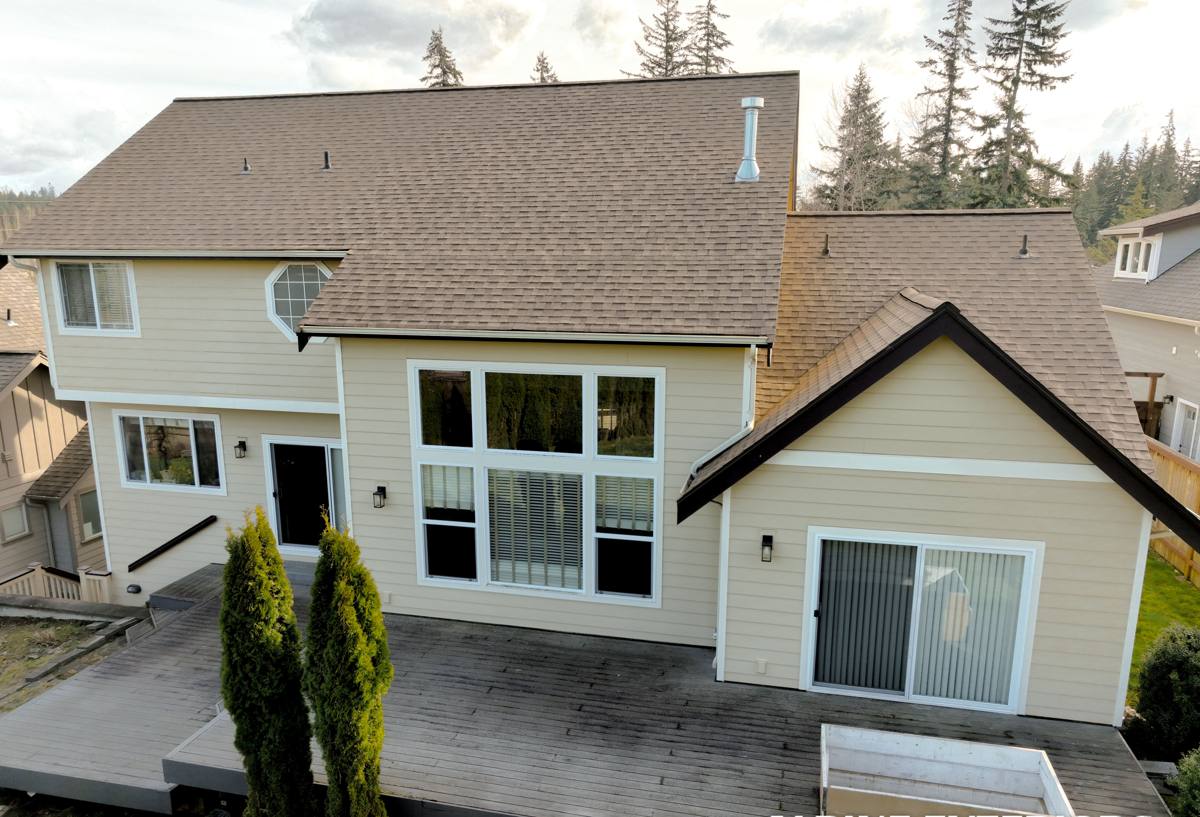
What Custer's Climate Puts Siding Through
Salt-Laden Air
Custer isn't waterfront, but it's close enough to the Salish Sea and Birch Bay that salt carried on winter storms reaches most properties in town, not just the ones closest to the shoreline. Salt exposure speeds up the breakdown of factory finishes and accelerates corrosion on fasteners, trim hardware, and any exposed metal flashing. On a wall that's already damaged, that acceleration matters more, because compromised material has less protective finish left to lose.
Wind-Driven Rain
Open, flat terrain around Custer doesn't give storms much to slow them down. Rain coming off the water gets pushed sideways into wall assemblies instead of falling straight down, which means it finds cracks, gaps, and failed caulk lines that would stay dry in a calmer climate. A small opening in a lap joint or a corner trim piece becomes a real entry point when the rain hitting it is horizontal rather than vertical.
A Moss Season That Barely Ends
Mild temperatures and near-constant moisture keep moss and mildew active across most of the calendar here, especially on shaded, tree-lined lots, which describes a lot of Custer properties. Moss holds moisture directly against the siding surface long after a dry spell would have let a cleaner wall dry out. On a section that's already cracked or gapped, that trapped moisture has a much shorter path to the sheathing behind it.
Signs a Custer Home Needs Siding Repair
Most of these are easy to miss from the ground, especially on a wall you walk past every day. Worth a closer look if you notice any of the following:
- Cracked, chipped, or missing sections of siding, especially near corners, window trim, or ground level
- Soft, spongy, or discolored spots when you press on the siding or the trim around it
- Paint or finish that's peeling, bubbling, or failing faster on one section than the rest of the house
- Visible gaps or separation at seams, corners, or where siding meets window and door trim
- Persistent moss or mildew growth on the same section even after cleaning
- A musty smell in a room that backs onto an exterior wall, particularly on a shaded or north-facing side
- Warping, buckling, or a section that no longer sits flat against the wall
What We Typically Find Once Damaged Siding Comes Off
What's underneath a damaged section tells us a lot about how the repair needs to be handled, and it varies by material. This is a rough sense of what we commonly run into on repair calls, not a claim about every house:
| Existing Siding Type | Common Repair Issue in This Climate | What It Usually Means |
|---|---|---|
| Vinyl | Cracking at fastener points, warping near heat sources, brittle panels that snap on removal | Panels often need full replacement rather than a clean patch, since matching discontinued colors or profiles is hit-or-miss |
| Engineered wood (e.g. LP SmartSide) | Swelling, soft or crumbling edges where the factory coating failed or wasn't resealed after a cut | Damage often extends past what's visible, since the wood-fiber core keeps absorbing moisture once the coating is breached |
| Cedar or primed spruce | Rot at butt joints and lower courses, cupping, paint failure exposing bare wood | Sound sections can sometimes be saved with a repaint, but rotted boards need to come out, not just be resealed |
| James Hardie fiber cement | Cracked or chipped boards from impact, caulk failure at seams, occasional install-error gaps | The board itself typically isn't degrading; the fix is usually a section swap and correcting the detail that let water in |
That last row is a big part of why we standardized on James Hardie for every repair and replacement we do. When we open up a wall and the fiber cement board itself is still sound, the fix is straightforward. When it's an engineered wood or vinyl product with core damage, the repair often turns into a larger job than the homeowner expected, because the material itself is what failed, not just the finish on top of it.
Repair vs. Replacement: How We Make the Call
We don't default to recommending a full re-side just because a homeowner called about a repair. Plenty of Custer properties genuinely just need a section fixed. But we also won't patch over damage that's going to reopen the same problem in a year or two.
- Isolated, recent damage — a cracked board from an impact, a small gap that hasn't let moisture in yet — is usually a straightforward repair.
- Localized water damage caught early — one soft section near a downspout or a single failed seam — is often repairable if the sheathing behind it hasn't been compromised.
- Widespread moisture damage, rot in multiple areas, or a material that's failing across the whole house — like an engineered wood product losing its coating broadly, or vinyl that's cracked and brittle throughout — usually isn't worth chasing section by section. At that point a full re-side is the more honest recommendation, even though it's the bigger job.
We check the sheathing behind any damaged section before quoting a repair, because a clean-looking patch over compromised sheathing doesn't actually solve anything — it just hides the problem for a while.
What a Correct Siding Repair Actually Involves
A siding repair that holds up in this climate is more than swapping in a matching board. The details around the repair matter as much as the patch itself:
- Removing damaged material back to sound substrate, not just cutting out the visibly cracked piece
- Inspecting and, where needed, repairing the water-resistive barrier and sheathing behind the old siding before anything new goes back on
- Re-flashing around any window, door, or penetration near the repair so water is directed out, not trapped behind the new section
- Using correct fastener type, placement, and depth for the replacement material, matched to manufacturer spec rather than whatever's on hand
- Sealing field-cut edges properly rather than relying on caulk alone to do the sealing that a factory edge would otherwise provide
- Matching color and profile as closely as the existing siding allows, so the repair doesn't stand out as an obvious patch
Skipping any of these steps is how a repair looks fine for a season and then fails again, usually in the same spot, because the underlying cause — bad flashing, compromised sheathing, an unsealed edge — never actually got fixed.
Why Every Repair We Do Uses James Hardie Fiber Cement
When we're repairing a section of existing James Hardie siding, we replace it with matching Hardie board, which keeps the wall performing the way it was engineered to. When the existing siding is vinyl, engineered wood, or cedar and the damage is extensive enough that patching isn't a real long-term fix, we recommend Hardie fiber cement for the repaired section rather than trying to match the original material. That's a judgment call worth being upfront about: it means a repair on an older vinyl or engineered wood home might involve a small material transition rather than an exact match.
We made that call because fiber cement is inorganic — it doesn't have a wood-based core that can absorb water and rot, and it holds up differently to the salt air and driving rain that define this part of Whatcom County than the materials it's replacing. James Hardie's ColorPlus factory finish and climate-engineered HZ5 line, built for regions with sustained moisture and freeze-thaw cycles, are a better long-term match for Custer's conditions than most alternatives on the market. We'll always explain the trade-off on a case-by-case basis rather than assuming every homeowner wants a material change mid-repair.
Our Siding Repair Process in Custer
We start with an on-site look at the damaged area and a check of the sheathing behind it, since that's what actually determines whether a section repair is realistic or whether we're looking at a bigger scope. From there we give a straightforward read on repair versus replacement, along with a written scope before any work starts. On the repair itself, we remove damaged material back to sound substrate, correct any flashing or drainage issue that contributed to the damage, and install the replacement section to the same fastening and sealing standards we use on a full re-side — not a shortcut version of it. We don't treat repair work as lesser work just because it's a smaller job.
Why a Local Crew Matters for This Kind of Repair
A crew that already works Custer regularly has seen the pattern of failures this specific climate produces — where moss tends to take hold first, which elevations catch the worst of the wind-driven rain, which older installations around town used caulk in place of proper flashing and are now paying for it. That's the kind of judgment that comes from repeated exposure to this exact combination of salt air, storm patterns, and moisture, not from a general siding background applied to an unfamiliar area. It shows up in small decisions during a repair — how far back to cut out damaged material, whether a section needs new flashing or just a patch, how much lap a seal needs — and those decisions are what determine whether a repair lasts one wet winter or many.
If you've got a section of siding on your Custer property that's cracked, soft, or just not looking right, we're glad to take a look and give you a straight answer about what it needs. Reach out using the form below to schedule a free, no-pressure estimate.