 Birch Bay Roofing
 Siding Repair Built for the Bellingham and Birch Bay Climate
Homes in and around Bellingham and Birch Bay sit in one of the more demanding stretches of Whatcom County for exterior siding. You've got salt-laden air coming off the water, long stretches of driving rain pushed sideways by wind, and a moss season that can run most of the year in shaded, north-facing spots. None of that is unusual for this part of Washington — but it means siding repair here has to account for conditions that a crew working inland doesn't deal with nearly as often.
A repair that looks fine on a dry, calm day can fail within a season if it wasn't done with this climate in mind. That's the core of what we do differently: we treat every repair as a chance to fix the underlying moisture or material problem, not just patch the visible symptom.
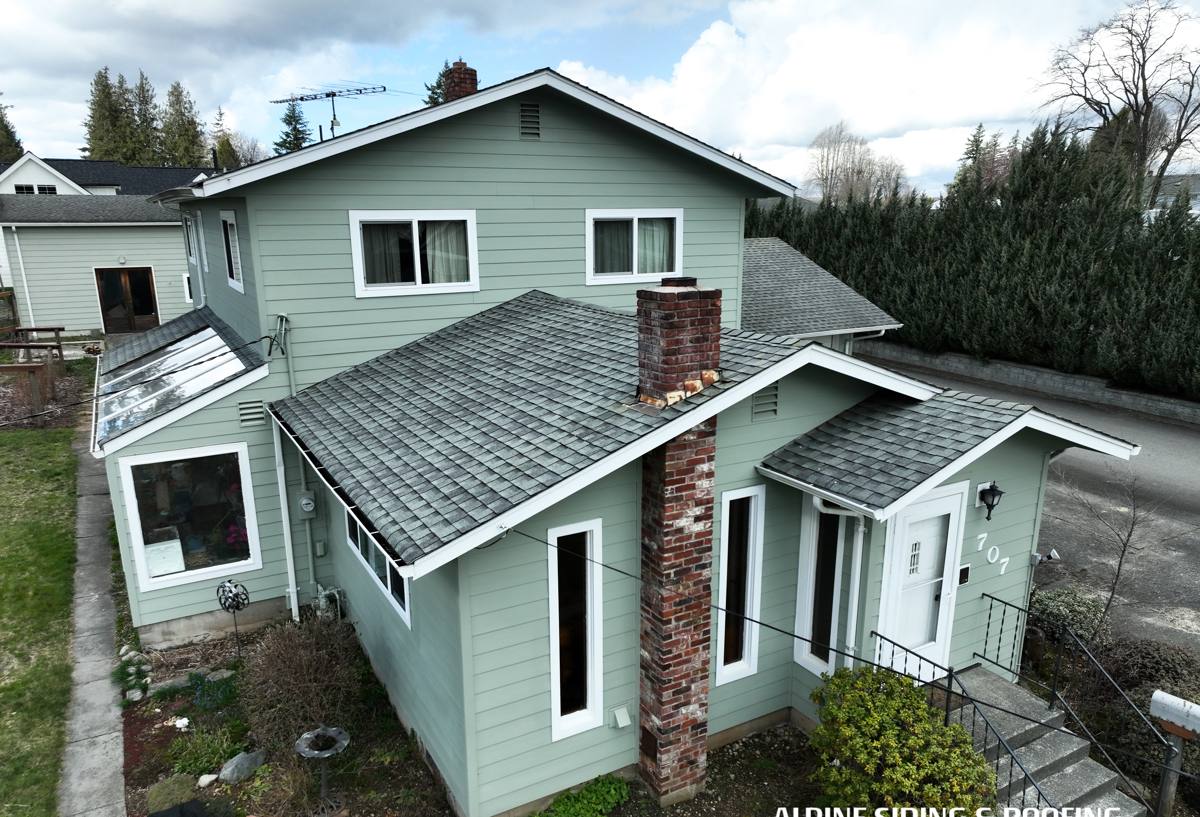
What Salt Air, Driving Rain, and Moss Actually Do to Siding
Salt Air
Proximity to the water means airborne salt settles on exterior surfaces constantly. On siding, this accelerates the breakdown of paint films, corrodes exposed fasteners and metal trim, and can leave a chalky residue that traps moisture against the surface rather than letting it shed. Fasteners and flashing that aren't rated for a marine-influenced environment tend to show rust and staining well before they would further inland.
Driving Rain
Wind-driven rain doesn't behave like a straight-down shower. It gets forced sideways and upward into laps, seams, and trim joints that were only ever designed to shed water moving downward. Over time, this is what turns a small gap at a butt joint or a poorly sealed penetration into a real water intrusion problem behind the siding, not just on top of it.
Moss Season
Shaded walls, north-facing elevations, and anywhere airflow is limited stay damp longer here than most homeowners expect. Moss and algae take hold in those conditions, and once established they hold moisture directly against the siding surface around the clock. That constant dampness is harder on siding than any single storm — it's a slow, ongoing problem rather than an event.
Signs a Bellingham or Birch Bay Home Needs Siding Repair
Some damage is obvious. A lot of it isn't — it shows up as a soft spot, a color change, or a smell before it shows up as a visible hole. Walk your exterior periodically and look for:
- Soft, spongy, or bulging sections when pressed gently
- Peeling, bubbling, or chalking paint, especially on shaded or salt-exposed walls
- Dark streaking, green or black growth, or persistent moss buildup in the same spots
- Gaps opening up at butt joints, corners, or trim intersections
- Rust staining below fasteners or metal flashing
- Warping, cupping, or visible separation between siding courses
- A musty smell near an exterior wall from inside the house
- Nail pops or fasteners backing out of the siding face
Any one of these on its own might be minor. Several in the same area, or any sign near a window, door, or roofline, usually means water has already gotten past the surface and the repair needs to address what's happening behind the siding, not just what's visible on it.
What a Correct Repair Actually Involves
Diagnose Before You Patch
The most common mistake in siding repair isn't bad workmanship on the patch itself — it's patching the wrong thing. If water is getting in through a failed flashing detail or a gap at a window head, replacing the siding panel alone just buys time before the same spot fails again. We start by tracing the damage back to its source, which sometimes means pulling more siding than the visible damage alone would suggest.
Check What's Behind the Siding
Once siding is off, the water-resistive barrier and any sheathing underneath need to be inspected. In a climate with this much driving rain and long wet seasons, we've found that damage often extends into the sheathing before it's visible from outside. A repair that reinstalls new siding over compromised sheathing or a torn weather barrier isn't a real repair — it's a cosmetic fix with a short clock on it.
Match Material and Reinforce Water Management
Repairs need to match the existing siding's profile, exposure, and thickness closely enough that water continues to shed the way the original installation intended. Flashing, kick-out flashing at rooflines, and proper lap sequencing matter as much as the siding itself — a technically correct patch with sloppy water management around it will fail in this climate faster than it would somewhere drier.
Address the Cause of Moss and Staining
Where moss or algae is a recurring problem, a repair isn't complete until we've looked at why that section stays wet — inadequate drainage gap, blocked airflow, or a shading and drainage issue that isn't going away on its own. Cleaning it off without addressing the moisture source just means it comes back.
Repair or Replace? What Actually Decides It
Not every problem area needs a full re-side, and not every homeowner needs to be sold one. The honest answer depends on scope, cause, and what's underneath.
| Factor | Points Toward Repair | Points Toward Replacement |
|---|---|---|
| Extent of damage | Isolated to one or two areas | Recurring across multiple walls |
| Sheathing condition | Sound, dry | Soft, stained, or rotted |
| Material behind repair area | Still available or closely matchable | Discontinued or badly mismatched |
| Age of existing siding | Newer, otherwise in good shape | Original material near end of service life |
| Underlying material type | Fiber cement in good condition | Deteriorated wood, hardboard, or failing vinyl |
| Root cause | Single fixable defect (flashing, sealant) | Systemic moisture or design issue |
We'll tell you plainly which category your situation falls into. If a targeted repair genuinely solves the problem, that's what we recommend — a full re-side isn't the answer to every damaged panel.
Our Process for a Siding Repair
1. On-Site Assessment
We look at the full exterior, not just the spot you called about, since damage from driving rain and moss exposure often shows up in more than one place.
2. Explain What We Find
You get a straight explanation of what's causing the problem, what repair options make sense, and what a repair versus a partial or full re-side would involve — no pressure toward the bigger job if it isn't warranted.
3. Remove and Inspect
Damaged siding comes off carefully so we can inspect the water-resistive barrier and sheathing before anything new goes back on.
4. Repair the Water Management, Not Just the Surface
Any compromised barrier, flashing, or sheathing gets addressed first. This is the step that determines whether the repair actually lasts through the next wet season.
5. Install and Match
New material is installed to match the existing siding's reveal and profile as closely as possible, with attention to proper lapping and sealed penetrations.
6. Final Walkthrough
We review the completed work with you and point out anything else on the exterior worth keeping an eye on.
Why Material Choice Matters When You're Repairing
We install James Hardie fiber cement siding exclusively, and that shapes how we approach repairs too. When a repair area needs new material — whether it's a few boards or a full section — we use Hardie's engineered fiber cement rather than mixing in a different product. Fiber cement holds up to the salt air, moisture cycling, and moss exposure common here far better than materials that absorb water or rely entirely on paint film integrity to stay protected. If your existing siding is a different material and the damaged section is beyond a clean repair, we'll walk you through what replacing that section — or eventually the whole elevation — with Hardie would look like, without pushing you toward a bigger project than the problem calls for.
Why Hire a Crew That Already Works Bellingham and Birch Bay
Siding repair mistakes in this climate are usually mistakes of assumption — using a general repair approach that would be fine in a drier region but doesn't account for how much water this area actually sees, or how long moss stays established on a shaded wall here. A crew that regularly works Bellingham and Birch Bay homes has already seen which details fail first in this environment and builds the repair to account for it from the start, rather than learning that on your house.
If you're seeing soft spots, staining, gaps, or recurring moss on your siding, we're happy to take a look and give you a straight read on what's actually going on — and a free, no-pressure estimate for fixing it right. There's a form below to get started.