 Birch Bay Roofing
 Building Decks for Cherry Point's Coastal Climate
Cherry Point sits right up against the water in Whatcom County, which means homes here take on weather that inland Birch Bay properties simply don't see. Salt-laden air moves off the Strait of Georgia and settles into every exposed fastener, hinge, and joint. Add Northwest Washington's long, wet winters and the moss season that follows, and you have a set of conditions that will find every weak point in a deck within a few years if the build doesn't account for them from day one.
A deck built to a generic spec sheet might look fine for the first year or two. Out here, the difference between a deck that lasts and one that needs early repairs almost always comes down to decisions made before the first board was ever installed: fastener grade, ledger flashing, joist protection, and gap spacing for drainage. We build with those Cherry Point conditions in mind, not as an afterthought but as the starting point.
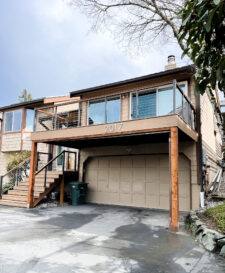
What Cherry Point Homes Actually Need From a Deck
Most of the decks we're asked to build or replace in this area fail — or start looking rough — for a handful of predictable reasons:
- Standard steel fasteners corroding from salt exposure, leaving rust streaks and weakened connections
- Moss and algae building up on shaded or low-airflow surfaces, making boards slick and accelerating rot
- Poor ledger board flashing letting water track back into the house framing
- Undersized or poorly spaced joists that flex under wet, swollen decking
- Decking installed too tight, trapping moisture between boards instead of shedding it
None of these are exotic problems. They're the ordinary result of building a deck the same way you'd build one somewhere dry and inland, then setting it a few hundred yards from saltwater. The fix isn't complicated — it's about choosing the right materials and details up front.
Salt Air and Metal Components
Every fastener, bracket, and hanger on a coastal deck is fighting corrosion from the day it's installed. We spec stainless steel or heavy hot-dip galvanized hardware rated for coastal and treated-lumber use, not the standard-duty fasteners that are fine for drier inland builds. It costs a little more up front and saves you from rust stains, loosening connections, and structural concerns down the road.
Moss, Algae, and Shade
Whatcom County's moss season isn't a minor cosmetic issue — moss holds moisture against the decking surface, and that constant dampness is what actually breaks materials down over time, along with making the surface dangerously slick underfoot. Deck orientation, board spacing, and surface texture all affect how much moss takes hold, and we factor that into the layout rather than treating it as a maintenance problem to solve later.
Choosing the Right Decking Material
There's no single "best" decking material for Cherry Point — there's a best material for your budget, your maintenance appetite, and how exposed your specific site is to wind-driven rain and salt spray. Here's how the common options compare in this climate:
| Material | Coastal Performance | Maintenance | Typical Lifespan Here |
|---|---|---|---|
| Pressure-treated lumber | Good if properly sealed and re-coated; needs vigilance near saltwater | Annual cleaning and re-sealing recommended | 15-20 years with upkeep |
| Cedar | Naturally rot- and insect-resistant, but softens faster under constant moisture | Regular sealing to hold color and resist moss | 15-20 years with upkeep |
| Composite decking | Handles moisture and salt exposure well; won't warp or splinter | Occasional washing; low overall upkeep | 25-30+ years, manufacturer-dependent |
| PVC decking | Fully moisture-resistant, strong choice for high salt-spray exposure | Lowest maintenance of the group | 25-30+ years, manufacturer-dependent |
We'll walk through these trade-offs honestly based on where your deck sits relative to the water, how much shade it gets, and what you're comfortable maintaining. A lower-maintenance material usually costs more upfront but less over the life of the deck — that's a decision that should be yours to make with real numbers in front of you, not a sales pitch.
What's Underneath Matters More Than What's on Top
Homeowners naturally focus on decking boards, but the substructure is what determines whether a deck stays solid for decades or starts needing repairs within five years. In a coastal, high-moisture climate like Cherry Point's, we pay particular attention to:
Ledger Attachment and Flashing
Where the deck attaches to the house is the single most common point of hidden water damage on any deck, coastal or not. Proper flashing — installed correctly, not just present — keeps water from tracking behind the ledger board and into your home's framing. This is also one of the most commonly rushed or skipped steps on older or budget builds, and it's usually invisible until there's already rot underneath.
Joist Protection
Joist tape or a comparable flashing membrane over the top of each joist keeps water from pooling in fastener holes and wicking into the wood grain. In a climate with this much year-round rainfall, that's not an optional upgrade — it's one of the cheapest ways to add years to the structure's life.
Post Bases and Footings
Ground contact near the water table in low-lying coastal areas means post bases need to keep wood clear of standing moisture. We use elevated post base hardware rather than burying posts directly, and we size footings to local frost and soil conditions.
Our Deck Building Process
Every deck we build in the Cherry Point area follows the same basic sequence, adjusted for your site and design:
- Site assessment — we look at sun exposure, prevailing wind and rain direction, drainage, and proximity to salt spray before recommending materials
- Design and material selection — honest trade-offs on cost, maintenance, and lifespan for your specific site
- Permitting — we handle the Whatcom County permit application and inspection scheduling
- Framing and structural work — ledger flashing, joist protection, coastal-rated hardware throughout
- Decking installation — proper board spacing for drainage and airflow, fastening method matched to material
- Railing, stairs, and finish work — built to current code for guard height and baluster spacing
- Final walkthrough — we go over care and maintenance specific to the material you chose
We don't skip steps to hit a lower number on a bid. If a shortcut would cost you a repair bill in five years, we'll tell you before we build, not after.
Permits and Code Requirements
Most new decks and significant deck replacements in Whatcom County require a building permit, with inspections at the framing stage and again at final completion. Requirements cover things like footing depth, guard rail height, stair geometry, and ledger attachment method. We manage this process as part of the build so you're not the one tracking down inspection windows or code citations — and so the finished deck is documented and compliant if you ever sell the home.
Keeping a Coastal Deck in Good Shape
Even a well-built deck needs some seasonal attention in this climate. A short annual routine goes a long way:
- Sweep debris and standing organic matter off the surface before fall rains set in
- Rinse salt residue off the decking and railings a few times a year, especially after storms
- Treat moss and algae early with an appropriate cleaner rather than letting it establish
- Check fastener heads and railing connections annually for looseness or corrosion
- Re-seal wood decking on the manufacturer's recommended schedule, typically every one to two years
- Keep gutters and downspouts near the deck clear so runoff isn't draining directly onto it
Composite and PVC decking cut most of this list down to occasional washing, which is a big part of why they've become popular for waterfront and near-waterfront properties in this area.
Why a Crew That Already Works Cherry Point Matters
Deck building isn't a one-size-fits-all trade, and coastal Whatcom County isn't a generic building environment. A contractor who mostly works inland, drier regions may not think twice about standard-grade fasteners or skip the extra flashing detail that saltwater exposure calls for — not out of carelessness, but because it's never been part of their normal routine. Working Birch Bay and Cherry Point regularly means we've seen how decks actually age here, not just how they're supposed to perform on paper. That shows up in the hardware we spec, the flashing details we don't skip, and the honest conversations we have with homeowners about which materials are worth the extra cost for their specific site.
If you're planning a new deck or need to replace one that's showing its age, we're happy to take a look and put together a straightforward, no-pressure estimate. There's a form below — reach out and we'll go from there.