 Birch Bay Roofing
 Siding Built for Custer's Particular Kind of Weather
Custer sits close enough to Birch Bay and the Strait of Georgia that homes here deal with a mix of coastal exposure and open farmland wind that a lot of siding products simply weren't designed for. It's not one dramatic storm that wears out a house — it's the everyday combination of salt-laden air drifting off the water, driving rain that hits siding sideways instead of straight down, and a moss season that runs longer here than in most of the country. Any one of those is manageable. All three, year after year, is what separates siding that looks good at year three from siding that still looks good at year twenty.
This page is about one thing specifically: installing siding correctly on a Custer home, using the one product system we trust for this climate. We don't try to cover every siding option available, because we don't install every option available. We install James Hardie fiber cement siding, and we want to explain why, and what a correct installation actually looks like out here.
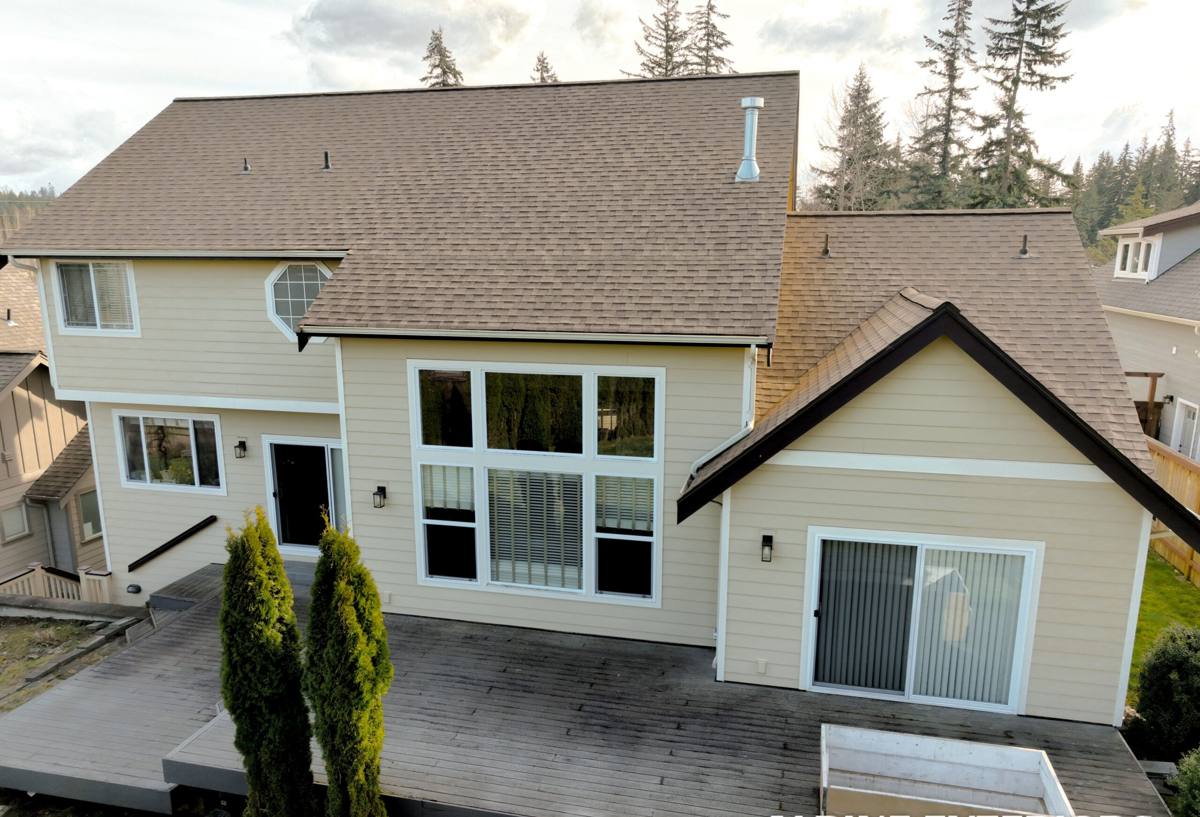
What Salt Air, Rain, and Moss Actually Do to a House
Salt Air
Proximity to the water means airborne salt settles on exterior surfaces even miles inland. Salt is corrosive to metal fasteners and trim, and it's abrasive to finishes that aren't rated to handle it. Over years, a siding product with a weak factory finish will chalk, fade unevenly, or start showing wear at corners and edges first — the spots where salt-laden moisture collects and doesn't fully dry.
Driving Rain
Whatcom County rain rarely falls straight down. Wind off the water pushes it sideways, which means it hits siding at an angle and works its way into any gap, seam, or poorly lapped joint. Products that depend on paint film or surface sealing to stay water-resistant are the first to fail this test, because wind-driven rain finds the one spot the installer didn't quite get tight.
Moss Season
The long wet stretch from fall through spring gives moss and algae months to establish themselves on north-facing walls, under eaves, and anywhere siding stays shaded and damp. Moss holds moisture against the surface far longer than open air would, which accelerates whatever damage the material is already prone to — rot in wood-based products, delamination in some composites, and cracked caulk joints everywhere.
None of this is unique to Custer specifically, but it's more constant here than in drier parts of the state, and it's exactly why generic siding advice written for a different climate doesn't always apply to a house a few miles from Birch Bay.
Why We Install Only James Hardie Fiber Cement
We used to get asked to install other products — vinyl, LP SmartSide, primed wood, other fiber cement brands — and for years we did. What changed is that we started tracking which siding jobs held up in this climate without callbacks, and which ones didn't, and the pattern was consistent enough that we made a standardizing decision: James Hardie only.
That's not a knock on every alternative in every climate. Vinyl is inexpensive and low-maintenance in dry regions. Wood has real appeal if you're willing to maintain it. LP SmartSide performs reasonably well when installation and maintenance are both done exactly right. But in a coastal, wet, moss-prone environment like Custer's, the margin for error on those products is thin, and the failure modes — moisture intrusion behind panels, edge swelling, finish breakdown from salt exposure — are expensive and disruptive to fix once they start. James Hardie's fiber cement formulation doesn't absorb water the way wood-based products do, it's non-combustible, and its factory-applied ColorPlus finish is engineered to hold color and resist the kind of weathering salt air causes. We'd rather install one product exceptionally well than several products adequately.
What a Correct Installation Actually Involves
Fiber cement siding is only as good as the installation behind it. A rushed or generic install can undercut even the best material, and in a climate like this one the mistakes show up faster than they would somewhere drier. A correct James Hardie installation on a Custer home includes:
- A properly lapped weather-resistant barrier behind the siding, with all seams taped and integrated with window and door flashing
- Correct fastener spacing and type — stainless or coated fasteners rated for coastal exposure, driven to Hardie's specified depth, not over- or under-driven
- Proper clearance at the bottom edge of the siding from grade, decks, and roof lines so water has somewhere to go instead of wicking into the material
- Factory-cut and factory-primed edges kept intact wherever possible, with any field cuts sealed per Hardie's requirements
- Correctly sized gaps at butt joints and trim, caulked with a product rated for the movement and moisture this climate produces
- Flashing details at every penetration — vents, hose bibs, light fixtures, meter bases — that direct water outward and downward, never behind the siding plane
Every one of those steps exists because skipping it creates a specific failure mode. Skip the flashing tape at a seam and you get a slow leak that doesn't show up for two or three winters. Get fastener depth wrong and you either crack the board or leave it able to rattle loose over time. None of this is exotic knowledge — it's Hardie's own installation specification — but following it precisely, on every board, on every wall, is what separates a siding job that lasts from one that doesn't.
James Hardie Product Lines for This Climate
Hardie makes several siding profiles and formulates its boards for different climate zones. For a Custer home, the relevant distinction is the HZ5 formulation, engineered for wetter, freeze-prone regions of the country, which is what we specify here rather than the HZ10 formulation built for hot, dry climates.
| Consideration | James Hardie Fiber Cement | Typical Alternatives |
|---|---|---|
| Moisture absorption | Very low; cement-based, doesn't swell or rot | Wood-based products can absorb and swell; vinyl doesn't absorb but can warp |
| Finish durability in salt air | Factory ColorPlus finish, engineered coastal-rated color adhesion | Site-applied paint or vinyl color can fade or chalk unevenly near salt exposure |
| Fire resistance | Non-combustible | Wood-based products are combustible; vinyl can deform under heat |
| Installation sensitivity | Moderate — requires correct fastening, gapping, flashing | Varies; some products are more forgiving, others equally sensitive |
| Warranty structure | Long-term, transferable manufacturer warranty on substrate and finish | Varies widely by product and manufacturer |
Signs a Custer Home's Siding Needs Attention
Because moss and moisture damage build slowly, a lot of homeowners don't realize how much wear their siding has taken until it's well along. Worth checking for:
- Soft or spongy spots when you press on siding near the bottom edges or below windows
- Persistent moss or dark streaking on north- or shaded-facing walls that pressure washing doesn't fully remove
- Visible gaps, cracked caulk, or separated joints at corners and trim
- Paint or finish that's peeling, bubbling, or chalking heavily in one area but not others
- Warping, buckling, or panels that no longer sit flat against the wall
- Any history of water stains on interior walls near exterior corners, which often points to a siding or flashing failure rather than a roof issue
Any one of these on its own might be minor. Several together, especially on a home that's had the same siding for fifteen-plus years, usually means it's worth a full evaluation rather than a spot repair.
How Our Process Works
We start with an on-site walkthrough of the home, checking the current siding condition, the existing weather barrier if we're doing a full tear-off, and any trouble spots like window returns, deck ledgers, or roof-to-wall intersections where past leaks are most likely. From there we put together a scope and estimate specific to that house — not a generic per-square-foot number, because the amount of trim work, flashing detail, and prep varies a lot from one Custer property to the next.
Once a project is scheduled, the work itself follows the same sequence every time: remove old siding and inspect the sheathing underneath for hidden damage, repair anything compromised before covering it back up, install a new weather-resistant barrier, then install the Hardie siding and trim to spec with correct flashing at every penetration. We don't cover up sheathing problems to save time — finding rot behind old siding is common enough in this climate that we treat it as a normal part of the process, not a surprise change order sprung on the homeowner.
Why a Crew That Already Works Custer Matters
Siding installation isn't just about following a spec sheet — it's about knowing how a specific house in a specific location tends to fail. A crew that's worked houses throughout Custer and greater Birch Bay already has a feel for which walls take the worst of the wind-driven rain, which lots hold moisture longest into the spring, and where moss tends to establish first based on tree cover and sun exposure. That local pattern recognition doesn't replace following manufacturer specs — it adds to it, catching details a crew unfamiliar with this specific stretch of Whatcom County coastline might not think to double-check.
It also means straightforward accountability. A local crew is easy to reach if a question comes up after the job is done, and has a reputation in the immediate area worth protecting.
What This Costs
Siding project costs vary based on the size of the home, how much trim and detail work is involved, whether there's sheathing repair needed once old siding comes off, and the specific Hardie profile chosen. Rather than quote a number that doesn't reflect your house, we walk every property and provide a written estimate based on what we actually find — no pressure, no obligation.
If you're noticing wear on your Custer home's siding, or you're planning ahead before it becomes an urgent problem, we're happy to come take a look and give you a straightforward, no-pressure estimate using the form below.