 Birch Bay Roofing
 Metal Roofing Built for the Way Lynden Weather Actually Behaves
Homes in and around Lynden deal with a specific combination of weather that most roofing materials were never designed for: months of low-intensity rain that never really stops, wind-driven storms that push moisture sideways instead of straight down, and a damp, shaded microclimate that keeps roofs wet long after the rain has passed. Add in the marine air that moves inland off the Salish Sea and settles into Whatcom County's valleys, and you have conditions that are hard on asphalt shingles and unforgiving of sloppy installation work.
Metal roofing holds up well against all of that when it's installed correctly. The problem is that "installed correctly" is doing a lot of work in that sentence — metal roofing is far less forgiving of shortcuts than asphalt shingles, and a roof that looks fine on installation day can develop serious problems within a year or two if the fastening, flashing, or ventilation was rushed. This page covers what Lynden homeowners actually need to know before committing to a metal roof: what the local climate does to roofing materials over time, what a correct installation involves, how our process works, and what to look for in a contractor.
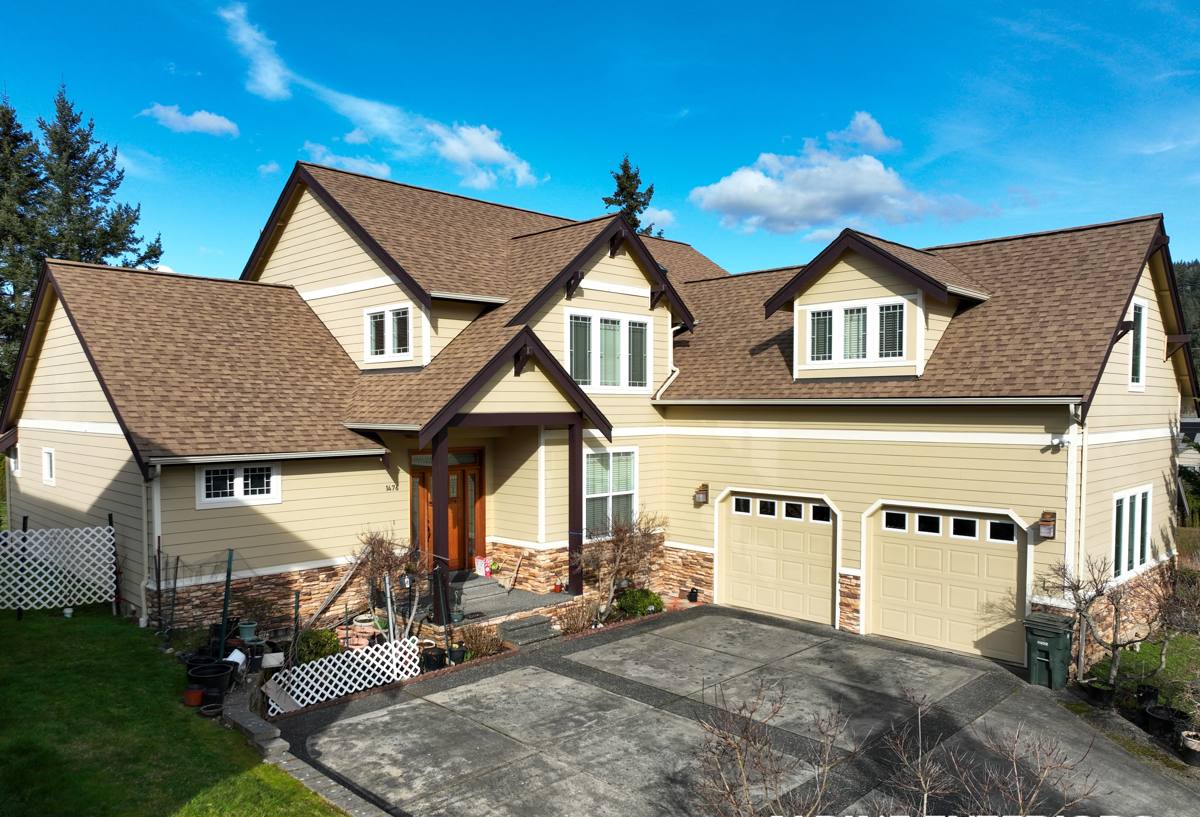
What Whatcom County's Climate Does to a Roof Over Time
It's worth being specific about why climate matters here, because it changes what "good roofing" means compared to a drier region.
Driving rain
Wind-driven rain doesn't just fall on a roof — it gets pushed under shingle tabs, into fastener holes, and along flashing edges that would stay dry in a calmer climate. This is why lap direction, fastener placement, and flashing detail matter more here than in places with mostly vertical rainfall. A roof that's watertight in a light rain can still leak in a sideways storm if those details were skipped.
Long moss season
Whatcom County's combination of shade, moisture, and mild temperatures gives moss and algae a long growing window — often close to year-round on north-facing slopes and shaded sections. Moss holds water against the roof surface, works into seams and laps, and on some materials it can lift edges as it grows. It also adds weight and traps organic debris that keeps a roof wetter than it would otherwise be.
Salt-tinged marine air
Even away from the immediate shoreline, air moving in off the water carries a low level of salt and moisture that accelerates corrosion on unprotected or poorly coated metal, and slowly breaks down organic roofing materials like asphalt. Fasteners, flashing, and any exposed metal components need coatings and finishes rated for that environment, not just standard interior-grade hardware.
None of these factors are dealbreakers for metal roofing — in fact, metal handles all three better than most other materials when it's specified and installed correctly. But each one points to a specific decision that has to be made correctly during installation, which we'll cover below.
Why Metal Roofing Is a Strong Fit for This Climate
Metal sheds wind-driven rain more reliably than shingles because it has far fewer seams and no exposed tabs for water to work under. A properly installed metal roof relies on continuous panel runs and engineered seams rather than overlapping pieces, which cuts down on the entry points that cause leaks during sideways storms.
Metal is also inhospitable to moss compared to asphalt or wood. Moss needs a rough, porous surface to anchor and hold moisture — smooth painted steel or aluminum gives it far less to grip, and the steep pitch common on many Lynden-area roofs helps water and debris move off the surface before moss can establish. That doesn't mean metal roofs never see moss or algae staining, especially in heavily shaded yards, but the growth is typically slower and easier to keep in check than on a shingle roof.
Longevity is the other piece. A correctly installed and properly coated metal roof commonly outlasts two or three asphalt shingle replacements, which matters in a climate that's hard on roofing materials year-round rather than just during a short storm season.
What a Correct Metal Roof Installation Actually Involves
This is where most of the difference between a metal roof that performs for decades and one that fails early gets decided. A few areas deserve specific attention in this climate:
Fastening and panel movement
Metal panels expand and contract with temperature swings more than shingles do. Fasteners and clips have to allow for that movement without loosening or tearing the panel over time. Over-driven or under-driven screws are one of the most common causes of early metal roof leaks, and it's a detail that's easy to rush on a large roof.
Underlayment
A high-quality synthetic or self-adhered underlayment underneath the metal gives the roof a second line of defense if wind-driven rain ever does work past a seam or fastener. In a climate with as much sustained moisture as this one, skipping a proper underlayment to save cost is a decision that tends to catch up with a roof within a few winters.
Flashing at every transition
Valleys, chimneys, skylights, and wall transitions are where the large majority of roof leaks originate — on metal roofs as much as any other type. Flashing has to be custom-fit and properly integrated with the panel system, not just caulked into place. Caulk is a maintenance item, not a waterproofing strategy.
Ventilation
A roof deck that can't breathe traps moisture underneath the metal, which leads to condensation, wood rot, and premature failure of the underlayment — even though the metal itself is uncorroded. Proper ridge and soffit ventilation is part of a correct metal roof installation, not an optional upgrade.
Fastener and flashing material
Given the marine air in this region, fasteners and flashing should be rated for coastal or high-moisture exposure. Mismatched metals (for example, the wrong fastener against a dissimilar metal panel) can set up galvanic corrosion that eats through hardware years before the roof panels themselves would wear out.
Comparing Metal Roofing Options for This Climate
Not all metal roofing is the same, and the right choice depends on the home, the roof pitch, and the budget. Here's how the common options stack up for a climate like Lynden's:
| Type | How It Sheds Water | Moss/Algae Resistance | Typical Lifespan | Best Fit |
|---|---|---|---|---|
| Standing seam | Raised, mechanically seamed panel joints — no exposed fasteners | Excellent — smooth surface, no seam gaps to trap debris | 40-70 years | Homes wanting the longest service life and lowest maintenance |
| Exposed-fastener panel | Overlapping ribbed panels with visible screws | Good, but fastener washers need periodic inspection | 25-40 years | Budget-conscious projects, outbuildings, simpler rooflines |
| Stone-coated steel | Interlocking panels resembling shingle or tile profiles | Good — textured coating sheds water well, though texture can hold more debris than smooth panel | 40-50 years | Homeowners wanting a traditional look with metal's durability |
We'll walk through which of these fits a given roof during the estimate — pitch, existing structure, and the look the homeowner wants all factor into that recommendation.
How Our Process Works
- On-site assessment. We inspect the existing roof deck, ventilation, flashing points, and any moss or moisture damage before recommending a system.
- System selection. Based on pitch, budget, and the home's exposure to wind and shade, we recommend a panel type and gauge suited to this specific roof — not a one-size-fits-all package.
- Deck prep. Any soft, rotted, or moisture-damaged decking gets replaced before anything goes down. Installing new roofing over a compromised deck just hides a problem that will resurface.
- Underlayment and flashing. Full synthetic or self-adhered underlayment goes down first, followed by custom-fabricated flashing at every valley, penetration, and wall transition.
- Panel installation. Panels are fastened per manufacturer spec for this climate's wind and moisture exposure, with attention to proper clip spacing and thermal movement allowance.
- Ventilation check. We confirm ridge and soffit ventilation is adequate for the new system before calling the job complete.
- Final walkthrough. We walk the finished roof with the homeowner and explain what maintenance, if any, the system needs going forward.
What Drives the Cost of a Metal Roof
Metal roofing costs more upfront than asphalt shingles, and the total depends on several factors beyond just square footage:
| Factor | Why It Matters |
|---|---|
| Panel type and gauge | Standing seam with a heavier gauge costs more than lighter exposed-fastener panel, but lasts longer and needs less upkeep |
| Roof complexity | Valleys, dormers, and multiple roof planes require more custom flashing labor than a simple gable roof |
| Deck condition | Rot or moisture damage found during tear-off adds repair cost that can't always be predicted before the old roofing comes off |
| Tear-off vs. overlay | Removing old roofing first is usually the right call for a long-term metal installation, but it adds labor compared to roofing over an existing layer |
| Ventilation upgrades | Older homes often need added ridge or soffit venting brought up to a standard that suits a metal system |
We give a firm, itemized number after the on-site assessment rather than a rough phone estimate — roof condition varies enough house to house that a real number requires a real look.
Moss, Debris, and Long-Term Maintenance
A correctly installed metal roof needs less maintenance than shingles, but "less" doesn't mean "none." In a climate with this much sustained moisture, a few habits go a long way:
- Keep gutters and valleys clear of needles and leaf debris so water doesn't pool against seams
- Trim back overhanging branches to reduce shade and speed up drying after rain
- Have the roof looked at after any major windstorm, since a lifted flashing edge is far easier to fix before the next rain than after months of water intrusion
- Address any moss or algae staining early with a gentle, roof-safe treatment rather than pressure washing, which can damage panel finishes and force water under seams
- Check exposed fasteners on exposed-fastener panel systems periodically, since washers are the first component to age
None of this requires a specialist visit every year — most of it is the kind of thing a homeowner can keep an eye on between the occasional professional inspection.
Why a Crew That Already Works in Lynden Matters
Roofing crews that work regularly in Whatcom County develop a feel for details that don't show up in a manufacturer's install manual — how much ventilation an older home in this area typically needs, which flashing details tend to fail first under sustained wind-driven rain, and how aggressive the moss season really gets on a shaded, north-facing slope. That local pattern recognition is the difference between a roof that's technically installed to spec and one that's actually built for the conditions it will face.
It also matters for accountability. A crew based in and around this area isn't hard to reach if a question comes up after the job, and they have a reputation in the community worth protecting — which tends to show up in the quality of the work itself.
What to Ask Before Hiring a Metal Roofing Contractor
- Are you licensed and insured to work in Washington State, and can you provide proof?
- What underlayment and flashing materials do you use, and are they rated for coastal or high-moisture exposure?
- Will you inspect and address ventilation as part of the installation, not just the roof surface?
- What does your warranty cover — materials, workmanship, or both — and for how long?
- Can you walk me through how you handle valleys and penetrations specifically, since that's where most leaks start?
- Do you have experience with metal roofing specifically, not just asphalt shingle work?
A contractor who can answer these clearly and specifically, without vague reassurances, is usually one who understands what this climate actually demands from a roof.
Get a Straight Answer for Your Roof
Every roof is different, and the right metal roofing approach for a home depends on its pitch, shade, existing deck condition, and how exposed it is to wind and rain. If you're weighing metal roofing for a Lynden-area home, we're happy to take a look and give you a straightforward, no-pressure estimate — use the form below to get started.