 Birch Bay Roofing
 What Nooksack Homes Need From Their Siding
Nooksack sits back from the water compared to the Birch Bay shoreline, but the weather here doesn't respect that distance. Whatcom County's marine air moves inland on windy days, carrying moisture and a faint edge of salt with it, and it settles into tree-shaded lots and low-lying areas around Nooksack just as easily as it does closer to the beach. Add in a long, wet winter and the shade cover common on many Nooksack properties, and you get a moss and mildew season that can run eight months or more.
Siding in this environment has to do more than look good on installation day. It has to shed driving rain without letting water track behind the cladding, resist the slow buildup of moss and algae on north-facing walls, and hold its finish through repeated freeze-thaw and wet-dry cycles without cracking, cupping, or letting go of paint. A lot of siding failures we see in this area aren't dramatic — they're slow moisture problems that started small and went unnoticed for a few seasons.
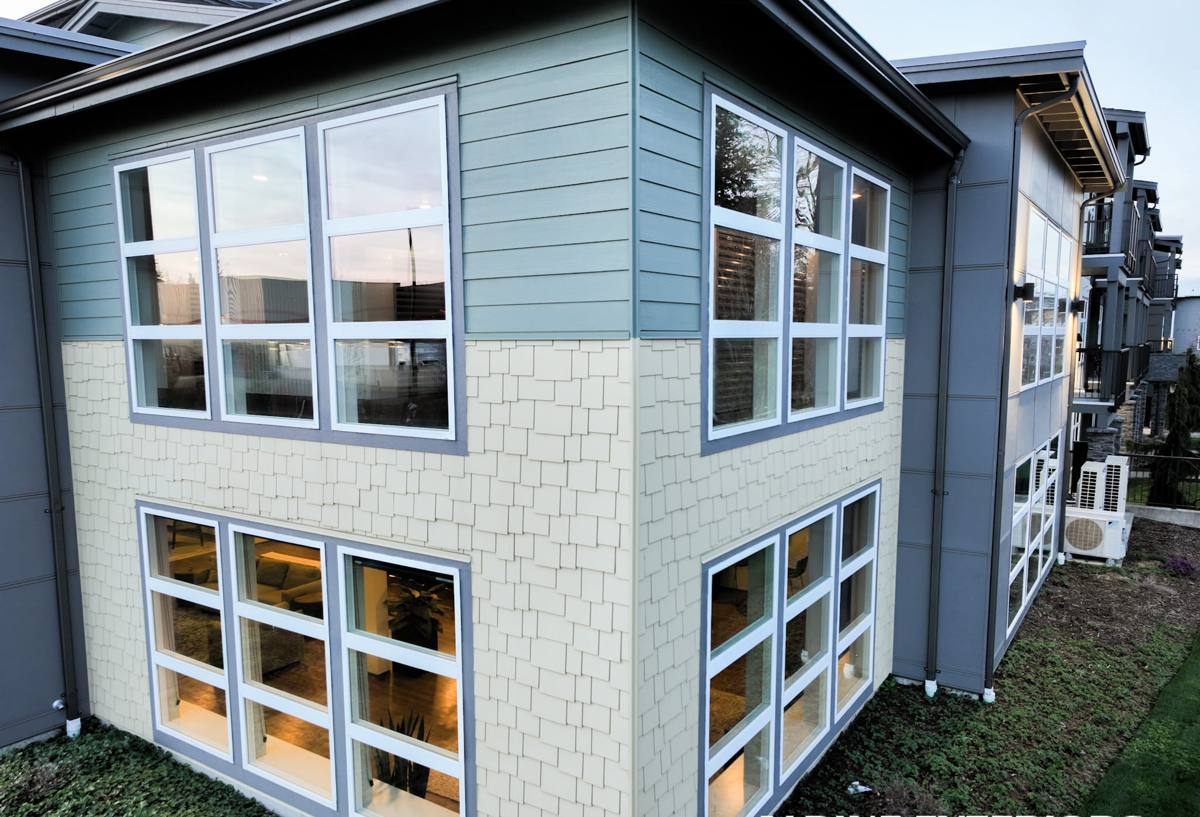
Why We Installed Only James Hardie Fiber Cement
We used to get asked why we don't offer vinyl, LP SmartSide, or cedar alongside Hardie. The honest answer is that after years of tearing old siding off Whatcom County homes, we stopped seeing a reason to install anything else. Wood-based products — including engineered wood like LP SmartSide and traditional primed spruce or cedar — depend on an intact factory or field-applied coating to keep moisture out of the wood fiber. Once that coating is compromised at a cut edge, a fastener hole, or a joint that opens up, moisture gets into the substrate, and in a climate this wet, that problem doesn't stay small. Vinyl holds up fine against water but is thin, flexes with wind, fades with UV exposure over time, and can crack in a hard freeze.
Fiber cement is cement, sand, and cellulose fiber pressed and cured into a rigid board. It doesn't absorb water the way wood fiber does, it doesn't support combustion, and it doesn't expand and contract the way vinyl does in temperature swings. James Hardie's ColorPlus factory finish is baked on and warranted separately from the substrate, which matters in a region where field-painted siding often needs repainting well before the siding itself would otherwise need replacing.
Built for This Climate Specifically
James Hardie engineers its siding by climate zone rather than selling one product everywhere. The HZ5 formulation used in the Pacific Northwest is engineered around moisture exposure and freeze-thaw cycling rather than the fire-and-drought concerns that drive their HZ10 line in the Southwest. That distinction sounds like marketing until you've seen what generic siding does after a decade of Whatcom County winters — it's a real difference in how the board is formulated.
What a Correct Fiber Cement Installation Actually Involves
Fiber cement is only as good as its installation. The material itself resists moisture well, but almost every siding failure we get called out to inspect traces back to water getting in at a seam, a penetration, or a bottom edge that was never properly flashed — not a failure of the board itself.
Flashing and Clearances
Every window, door, and roof-to-wall transition needs proper flashing integrated with a weather-resistant barrier behind the siding, installed shingle-style so water sheds down and out rather than getting trapped. Hardie's own installation instructions call for specific clearances above roofs, decks, and grade — skip those clearances and you create a wicking point that will eventually show up as staining, swelling at the bottom edge, or paint failure, even though the board itself is fine.
Fastening and Joints
Fiber cement needs the correct fastener type, spacing, and penetration depth — too few or misplaced fasteners and panels can work loose in wind; overdriven fasteners crack the board's edge and create an entry point for water. Butt joints need to be caulked with a high-quality, paintable sealant or backed with a joint flashing system, not just butted tight and left to gap as the house settles.
Cutting and Sealing Cut Edges
Factory edges come primed and finished, but every field cut exposes raw fiber cement. Those cut edges — around windows, corners, and utility penetrations — need to be primed or sealed before the piece goes up. This step gets skipped more often than homeowners realize, because it doesn't show on the finished wall, but it's exactly the kind of detail that determines whether a board still looks new in fifteen years or starts showing edge deterioration in five.
Our Process for a Nooksack Siding Project
- Walk-through and assessment — we look at the existing siding, the condition of the sheathing and weather barrier underneath where accessible, and any problem areas like north-facing walls or spots with heavy tree cover.
- Written estimate — a clear scope of work, product selection (profile, color, trim), and a price that doesn't change once work starts unless the homeowner asks for a change.
- Tear-off and substrate check — old siding comes off and we inspect the sheathing underneath for any rot or moisture damage that needs to be addressed before new siding goes on. Covering up a hidden problem is how small issues become expensive ones.
- Weather barrier and flashing — house wrap or building paper installed correctly, with flashing detailed at every window, door, and penetration before a single piece of siding goes up.
- Installation to Hardie spec — correct fasteners, clearances, joint treatment, and cut-edge sealing throughout, not just on the parts that show.
- Final walk-through — we go over the finished work with the homeowner before calling the job done.
Comparing Siding Materials for This Area
Every siding material is a trade-off. Here's how the main options stack up against the conditions Nooksack and Birch Bay homes actually deal with.
| Material | Moisture Behavior | Fire Resistance | Typical Maintenance |
|---|---|---|---|
| James Hardie Fiber Cement | Doesn't absorb water into the substrate; factory finish sheds moisture | Non-combustible | Occasional wash; repaint only if desired, not required for protection |
| Vinyl | Sheds water well but seams and J-channels can trap moisture behind panels | Melts/deforms under heat | Low, but cracks in hard freezes and fades with UV over time |
| LP SmartSide / Engineered Wood | Wood fiber substrate; vulnerable once coating is breached | Combustible, treated for ignition resistance | Coating needs monitoring at joints, cuts, and fastener holes |
| Cedar / Primed Spruce | Natural wood; absorbs moisture without diligent upkeep | Combustible | Regular repainting or staining, moss and mildew control |
We only install and warranty the first row of that table. It's not that the other products can't be made to work — it's that we've decided the long-term moisture and maintenance trade-offs aren't ones we want to put our name behind in this climate.
Signs Your Current Siding Is Due for Replacement
Homeowners often wait too long to address siding problems because the damage develops slowly and out of sight. Watch for:
- Persistent moss or dark streaking on north- or shade-facing walls that comes back within weeks of cleaning
- Paint that's peeling, bubbling, or chalking heavily, especially at seams and bottom edges
- Soft or spongy spots when you press on wood or engineered wood siding
- Visible gaps or separation at butt joints, corners, or trim
- Warping, cupping, or boards that no longer sit flat against the wall
- Interior signs like musty smells or discoloration on inside walls near exterior corners
Any one of these is worth a professional look before it's addressed with paint alone. Paint can hide a moisture problem for a season, but it doesn't fix what's happening underneath.
Maintenance You Can Actually Expect
Correctly installed Hardie siding is low-maintenance, not no-maintenance. Plan on rinsing the exterior periodically to keep moss and organic growth from taking hold, especially on shaded or north-facing walls where Whatcom County's damp winters give algae the most time to establish. Check caulked joints every couple of years and have any that have separated re-sealed. Because the ColorPlus finish is factory-applied and warranted on its own terms, you're not on the same repainting schedule you'd be on with field-painted wood siding — that's one of the practical reasons this product costs less to own over time even when the upfront number is similar to the alternatives.
Why Hire a Crew That Already Works This Area
Installation quality is what determines whether fiber cement performs the way it's designed to, and installation quality depends on knowing the conditions you're building for. A crew that mostly works drier inland climates can still make mistakes with clearances and flashing that a wetter coastal-influenced area like Nooksack and Birch Bay won't forgive. We size flashing details, fastener schedules, and joint treatment around what actually happens to a wall here over a wet winter and a mossy shoulder season, not around a generic install sheet. That local pattern recognition — knowing which walls take the worst weather, which details get skipped most often, and what a five-year-old installation should still look like — is the difference between siding that performs for decades and siding that needs attention again in five years.
If your Nooksack home needs new siding, or you're weighing whether to repair or replace what's there now, we're happy to take a look and give you a straight answer. Use the form below to request a free, no-pressure estimate.