 Birch Bay Roofing
 Why Decks in Sandy Point Wear Out Faster Than Inland Homes
Sandy Point sits right on the water, and that location is exactly why decks here don't age like decks a few miles inland in Birch Bay or Blaine. Salt-laden air rolling off the water attacks metal fasteners, hinges, and structural hardware year-round, not just during storms. Add in wind-driven rain that comes at the house sideways instead of straight down, and you get moisture forced into joints, end grain, and fastener holes that a typical deck design never accounts for.
Then there's the moss. Whatcom County's long, wet, mild winters mean shaded and north-facing decks can stay damp for weeks at a stretch. Moss and algae don't just look bad — they hold moisture against the wood or composite surface, which accelerates rot in real wood and can make composite boards dangerously slick underfoot.
None of this means a deck in Sandy Point is doomed. It means the replacement has to be built with this specific environment in mind, from the framing up, not just re-decked with whatever boards are on sale.
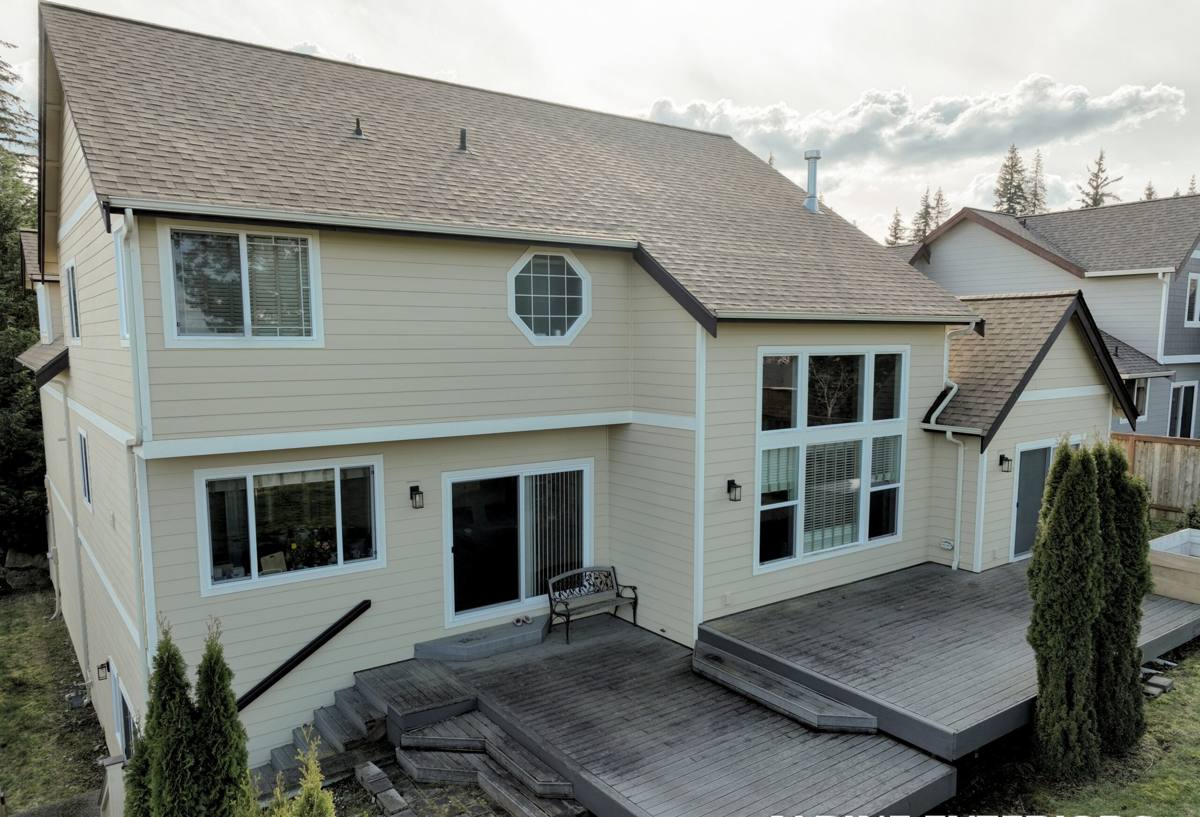
Signs a Sandy Point Deck Needs Replacing, Not Just Repairing
Not every tired-looking deck needs a full tear-off. But in a salt-air, high-moisture environment, some warning signs point to problems in the structure itself, not just the surface.
- Soft, spongy, or bouncy spots when you walk across the deck
- Fasteners that are rusted, bleeding stains, or backing out of the boards
- Visible gaps or rust at the ledger board where the deck attaches to the house
- Persistent black or green staining that returns within weeks of cleaning
- Wobbly railings or posts that move independently of the frame
- Corroded or failing joist hangers and connector hardware
If you're seeing more than one or two of these, it's usually a sign the frame or ledger connection has been absorbing moisture for a while — surface repairs won't fix that.
Why Ledger and Framing Problems Matter Most
The ledger board — the piece that bolts the deck to your house — is the single most important connection on the whole structure, and it's also the piece most exposed to whatever runs down your siding in a driving rain. A deck can look fine on top and still have a compromised ledger or rim joist underneath. That's one reason we always inspect the connection points, not just the decking surface, before recommending a repair versus a full replacement.
What a Correct Deck Replacement Involves in This Climate
A deck rebuilt for a waterfront, salt-air property needs a few things a standard inland deck can skip.
- Flashing at the ledger — proper metal flashing and a moisture barrier between the ledger and the house siding, so wind-driven rain can't track behind the board
- Corrosion-resistant fasteners and hardware — stainless steel or heavy hot-dip galvanized fasteners and joist hangers rated for coastal exposure, not standard coated screws that will rust and stain within a couple of seasons
- Proper drainage and airflow underneath — grading, gaps, and joist spacing that let air move and water shed instead of pooling under the deck
- Post bases that keep wood off the ground — elevated post bases instead of posts buried in or resting directly on damp soil
- Ventilated or drainage-oriented decking — board profiles and gapping that don't trap standing water on shaded sections
Skip any one of these and you're rebuilding the same problem that took the last deck down, just with new lumber.
Choosing Decking Material for a Salt-Air, Moss-Prone Property
There's no single "best" decking material for every Sandy Point home — it depends on how much shade the deck gets, how close it sits to the water, and how much upkeep you want to do. Here's how the common options actually compare in this environment.
| Material | How it handles salt air | Moss & moisture behavior | Upkeep |
|---|---|---|---|
| Pressure-treated lumber | Holds up if fasteners and flashing are corrosion-resistant; the wood itself is treated for rot | Needs regular cleaning and sealing or moss takes hold on shaded boards | Highest — annual cleaning, periodic re-sealing |
| Cedar | Naturally rot-resistant, but surface grays and needs finish upkeep near salt spray | Prone to moss in shade without regular cleaning and treatment | High — finish maintenance to keep it performing, not just looking good |
| Composite decking | Doesn't rot or corrode, but check hardware and hidden fasteners for the same coastal-rated hardware | Some early composite products stained or grew algae in shade; current capped composites resist this much better | Low — periodic washing, no sealing or staining |
| PVC decking | Fully inert to moisture and salt | Sheds moss and mildew easily with occasional washing | Lowest — cleaning only |
We'll walk through these trade-offs with you honestly, including upfront cost versus what you'll actually spend on upkeep over ten or fifteen years in this climate. There's no reason to pay for a premium material your deck's design and location don't call for, and no reason to save money upfront on a deck that will need re-sealing every year in a spot exposed to constant salt spray.
Our Deck Replacement Process for Sandy Point Homes
1. On-Site Inspection
We look at the whole structure — decking, framing, ledger connection, posts, and footings — not just the visible surface. This tells us whether you need a full replacement or whether parts of the substructure can be reused.
2. Honest Scope and Estimate
You get a clear breakdown of what's being replaced, what materials we're recommending and why, and a real number — not a lowball that grows once the tear-off starts.
3. Tear-Off and Structural Assessment
Once the old decking and railings come off, we can see the framing clearly. If we find hidden rot or corrosion beyond what was visible during inspection, we'll show you before any work continues — no surprises billed after the fact.
4. Rebuild to Coastal Standards
New framing, ledger flashing, corrosion-resistant hardware, and proper drainage go in before a single decking board is installed. This is the part of the job that determines whether the deck lasts five years or twenty-five.
5. Decking, Railing, and Final Details
Decking, railings, stairs, and any fascia or skirting go on last, finished to spec and cleaned up before we walk it with you.
Permits and Local Considerations
Deck replacements in Whatcom County generally require a permit once you're doing more than a like-for-like surface swap, and requirements can differ depending on deck height, size, and proximity to property lines or the water. If your property in Sandy Point is part of an HOA, private road association, or has its own architectural guidelines, those requirements sit on top of the county's — and we'll factor both into the plan before work starts, not after. We handle the permit process as part of the job so you're not tracking down paperwork on your own.
Maintaining Your New Deck in a Salt Air, High-Moss Climate
A well-built deck still needs some seasonal attention here. A little consistent upkeep goes a long way toward avoiding an early second replacement.
- Sweep or hose off salt residue and debris regularly, especially after storms
- Clean moss and algae off shaded sections before it spreads, rather than waiting for annual cleaning
- Check fasteners, railings, and stair connections once a year for looseness or corrosion
- Keep gutters and downspouts clear so runoff isn't dumping extra water onto the deck
- Trim back vegetation that's shading the deck and keeping it damp longer than necessary
- Re-seal wood decking on the schedule your material actually requires — don't stretch it to save time
Why It Matters to Hire a Crew That Already Works in Sandy Point
A deck built to a generic spec sheet, without accounting for wind-driven rain off the water or a long moss season, tends to show problems within a few years — loose railings, rusted hardware, soft spots near the ledger. A crew that already works this stretch of Whatcom County knows to spec corrosion-resistant hardware and proper flashing from the start, because we've seen what happens when a deck skips that step. That's less time and money spent redoing work that should have been done right the first time, and a deck that actually holds up to the conditions it's built in.
If your deck in Sandy Point is showing its age — or you're just ready to stop patching it — we're happy to take a look and give you a straight answer about what it needs. Reach out for a free, no-pressure estimate using the form below.